


Updated June 15, 2026
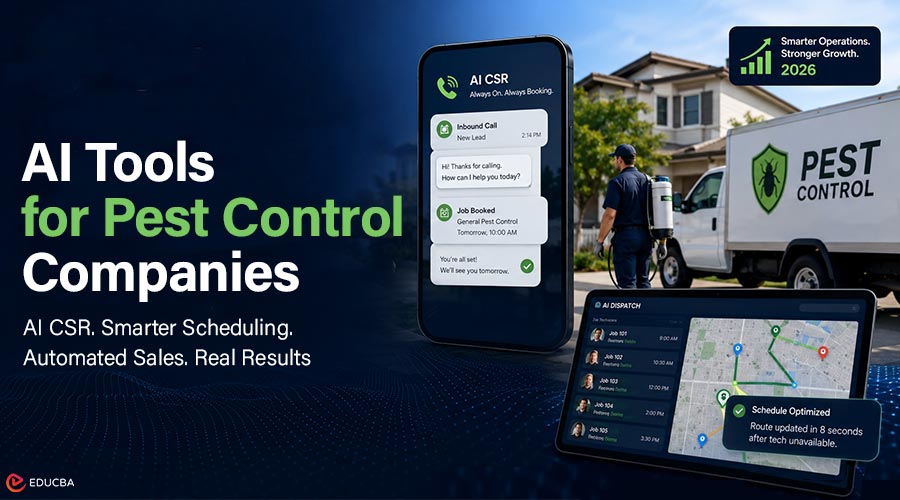
The market for AI tools for pest control companies split into two tiers in 2026. One tier bolted “AI” onto decade-old scheduling logic. The other built agents actually answer the phone, rebuild routes midday, and follow up on unsold estimates at 10 p.m. Consider a pest control business owner in Phoenix who purchased three different AI solutions—none of the systems communicated with one another. Six months later, the dispatcher was still manually rebuilding routes every morning. So what does the actual 2026 landscape look like, and which problems does AI reliably solve? In this article, we will answer that question by looking at three categories of AI tools, along with a few specific vendors in each.
Categories of AI Tools for Pest Control Companies
The current market can generally be classified into four main categories:
1. AI CSR (Customer Service Representative) Tools
These answer calls, texts, and chats, qualify leads, book appointments, reschedule jobs, and provide ETAs. Top platforms that offer AI CSR:
- Goodcall
- ai
- My AI Front Desk
- Solea AI
2. AI Scheduling & Dispatch Tools
These optimize routes, rebalance technician workloads, and adjust schedules when jobs change. Top platforms for AI scheduling & dispatch:
- FieldRoutes
- PestPac
- WorkWave (via WAIve)
- WAIve
- Solea AI
3. AI Sales & Follow-Up Tools
Many pest control companies lose revenue due to inconsistent follow-up. AI sales platforms automate lead nurturing, estimate follow-up, upsell campaigns, and customer reactivation. Leading AI Sales and Follow-Up platforms:
- Solea AI
- ai
- AURA AI Pro
- HighLevel (GoHighLevel)
- Podium AI
4. Full-Suite AI Platforms
These combine multiple functions, CSR, scheduling, dispatch, and sales automation, into one system. Notable software:
- Solea AI
- WorkWave
- FieldRoutes
- PestPac
What Separates Real AI Pest Control Tools from LLM Wrappers?
Most of what got labeled AI in 2024 and 2025 is rule-based automation with new marketing. “If tech A is free and within 10 miles, assign the job” is a conditional logic rule that has existed on FSM platforms for a decade.
Real AI tools for pest control businesses take action without being explicitly told to. An AI CSR books the job, reschedules when the customer needs to change, and provides an ETA, all without a human in the loop. An AI Scheduler rebuilds the entire day when a tech calls out at 8 a.m., weighing certifications, workload, and geography simultaneously.
The simplest question to ask is:
Does the AI actually perform tasks, or does it merely provide recommendations that employees must execute manually?
What Does AI Adoption in Pest Control Actually Look Like in 2026?
Adoption is early, uneven, and moving faster than most operators realize. The companies integrating AI today are not primarily the national brands. They are regional operators in the 10-to-50-truck range who hit the scaling wall, where adding another office staff member costs $45,000 to $55,000 annually but does not solve the underlying workflow problem.
The gap competitors are exploiting is response time. A company that answers every inbound call within 30 seconds and books jobs at 11 p.m. on a Saturday is not competing on price; it is competing on availability. Goodcall, ServiceAgent.ai, and AURA AI Pro have entered the pest control space. FieldRoutes launched AI-assisted dispatch. WorkWave released its WAIve platform in early 2026. The category is actively competitive.
How Does the AI CSR Model Work for Pest Control?
The AI CSR handles inbound calls, texts, and website chats around the clock, qualifying leads, booking jobs, rescheduling, and providing ETAs without a human picking up. So what does that actually change? On a Tuesday in peak season, when 40% of inbound calls arrive between 7 and 9 a.m., and the office does not open until 8, the AI CSR captures every one of them. It books the job and follows your scheduling rules exactly: no double-booking, no skipping qualification, no promising a window the schedule cannot support.
The conversion math is concrete. A pest control company missing 15 calls a week during peak season, at an average ticket of $250 and a 60% close rate, can lose roughly $117,000 annually from unanswered calls alone. That number does not require a heroic assumption; it requires honest call volume data and a willingness to count what is going to voicemail. Goodcall, My AI Front Desk, and ServiceAgent compete in this space. Solea AI’s AI CSR is built specifically for pest control, handling calls, texts, and website chats while following company-specific scheduling rules and booking directly into the schedule.
How Does AI Scheduling and Dispatch Software Improve Operations?
The AI Scheduler builds and optimizes routes daily, adjusting in real time as jobs change, no-shows occur, emergency callouts occur, jobs run over, and same-day cancellations occur. A tech calls out at 7:45 a.m. with nine jobs on his board. What happens next tells you everything about whether your scheduling software is genuinely AI-powered. The AI Scheduler reassigns across the available teams in seconds, accounting for certifications, geographic zones, and hard customer windows.
The dispatcher approves a resolution rather than spending 45 minutes rebuilding by phone. FieldRoutes, PestPac, and WorkWave’s WAIve all offer routing optimization. Solea AI’s scheduler handles real-time adjustments natively, connecting directly to the same data that the AI CSR just updated when booking the morning’s jobs.
How Does the AI Sales Rep Close the Follow-up Gap?
Most pest control companies lose more revenue to follow-up failure than to pricing. An estimate goes out Thursday. The customer does not respond. By Wednesday, they have booked someone else. The AI Sales Rep automatically follows up via calls, texts, and email at the right intervals, upsells services based on service history, and converts leads when no human is available.
A pest control company with 2,000 active accounts, 15% of which have never been offered a mosquito or termite add-on, with an average upsell value of $400, has roughly $120,000 in unrealized revenue in its existing customer base. The AI Sales Rep systematically pursues that.
Single-Function Tools vs. Full-Suite AI Tools for Pest Control Companies
The Phoenix operator’s problem was not bad tools. It was fragmentation. His AI call answerer booked jobs into a calendar the AI Scheduler could not read. His follow-up automation pulled from a CRM that did not reflect what the scheduler had actually assigned. Three-monthly subscriptions and more manual reconciliation than before.
A full-suite platform integrates call handling, scheduling, and sales follow-up into a single operational layer. When the AI CSR books a job, the scheduler sees it immediately. When the AI Sales Rep follows up on an estimate, it knows whether the customer is already booked. Explore the full landscape of pest control AI at authority.inc.
Final Thoughts
The future of AI tools for pest control companies is moving beyond simple automation toward fully autonomous business operations. AI CSR systems answer and book jobs around the clock; AI schedulers optimize routes in real time. AI sales assistants nurture leads and generate additional revenue without manual intervention. For pest control companies looking to scale efficiently in 2026, the key question is no longer whether to adopt AI, but which AI platform can deliver the greatest operational impact while keeping every part of the business connected.
Recommended Articles
We hope this guide to AI tools for pest control companies helps you streamline operations and grow your business. Check out these recommended articles for more insights and strategies on leveraging AI for success.


