


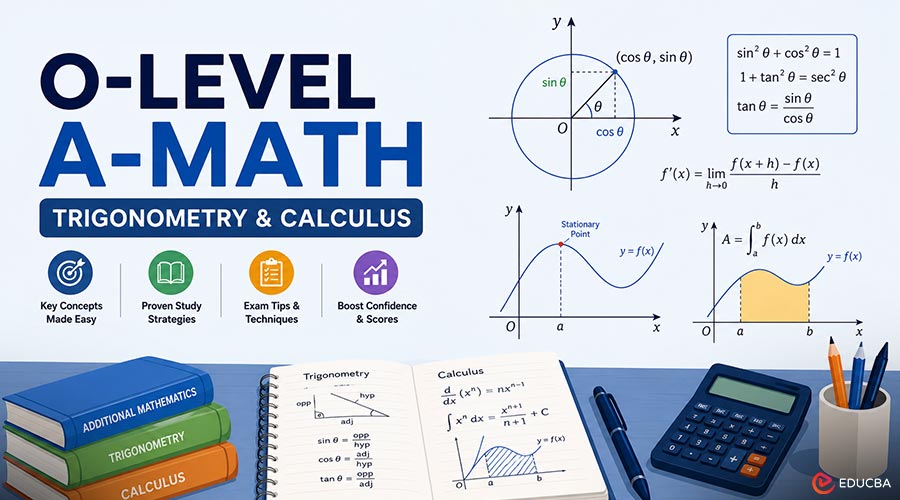
Preparing for O-Level A-Math Trigonometry and Calculus can feel overwhelming for many students. These two topics make up a significant portion of the syllabus and often determine whether students achieve their target grades. While both subjects require a solid understanding of mathematical concepts, success is not simply about memorizing formulas. Students need strong problem-solving skills, consistent practice, and the ability to apply concepts accurately under examination conditions.
Many students who excel in Elementary Mathematics find A-Math more challenging because the questions demand deeper analytical thinking and multi-step solutions. Fortunately, with the right study strategies and guidance from one of the best math tuition in Singapore, students can build confidence and significantly improve their performance in trigonometry and calculus.
Why O-Level A-Math Trigonometry and Calculus Matter?
Trigonometry and calculus are among the most heavily tested topics in O-Level A-Math. These chapters form the foundation for advanced Mathematics in junior college, polytechnic courses, engineering, physics, economics, and various STEM-related disciplines. Strong performance in these areas not only contributes to higher examination scores but also prepares students for future academic challenges.
Key Skills Developed Through Trigonometry and Calculus
Students strengthen:
- Analytical thinking
- Logical reasoning
- Mathematical modelling
- Problem-solving abilities
- Algebraic manipulation skills
- Application of mathematical concepts
Mastering these topics can provide a significant advantage throughout a student’s academic journey.
Building a Strong Foundation in Trigonometry
One common reason students struggle with trigonometry is a weak understanding of the basic concepts. Before tackling advanced questions, students must become comfortable with fundamental trigonometric relationships and identities.
Essential Concepts to Master
Students should be confident with:
- Sine, cosine, and tangent ratios
- Exact trigonometric values
- Trigonometric identities
- Graphs of trigonometric functions
- Solving trigonometric equations
- Angle transformations
Understanding how these concepts connect is more important than memorizing formulas without context.
Memorize Key Trigonometric Identities Correctly
Trigonometric identities appear frequently in O-Level examinations. Students who know how to apply these identities efficiently often save valuable time during exams.
Important Identities to Remember
Some commonly tested identities include:
- sin²θ + cos²θ = 1
- tan θ = sin θ / cos θ
- 1 + tan²θ = sec²θ
Rather than memorizing identities mechanically, students should understand when and how to apply them across different problem types.
Learn to Interpret Trigonometric Graphs
Many examination questions test a student’s ability to analyze and sketch trigonometric graphs. Students should understand how changes in amplitude, period, and phase shift affect the behavior of graphs.
What to Focus On?
When studying graphs, pay attention to:
- Maximum and minimum values
- Periodicity
- Symmetry
- Intercepts
- Transformations
Regular graph sketching practice helps students recognize patterns quickly during examinations.
Practice Solving Trigonometric Equations
Trigonometric equations often require students to combine multiple concepts within a single question.
Effective Problem-Solving Approach
Students should:
- Simplify the equation where possible.
- Apply relevant identities.
- Solve for the principal value.
- Determine all required solutions.
- Check answers within the specified domain.
This systematic approach reduces errors and improves accuracy.
Understanding Calculus in A-Math
Calculus introduces a completely new way of thinking about Mathematics. Instead of focusing solely on numerical values, students begin analyzing rates of change and relationships between functions. Many students initially find calculus difficult because the concepts seem abstract. However, once the underlying principles are clear, calculus is often one of the most rewarding topics in A-Math.
Core Areas of Calculus
Students must understand:
- Differentiation
- Integration
- Gradients of curves
- Stationary points
- Increasing and decreasing functions
- Area under graphs
A strong grasp of these concepts forms the foundation for solving more complex examination questions.
Master Differentiation Techniques
Differentiation is one of the most frequently tested calculus topics in O-Level A-Math. Students should become familiar with differentiation rules and know how to apply them confidently.
Important Differentiation Skills
Students should practice:
- Differentiating polynomial functions
- Using power rules
- Simplifying algebraic expressions
- Finding gradients
- Solving stationary point questions
Repeated exposure to different question types helps reinforce understanding.
Understand the Meaning Behind Differentiation
Many students memorize differentiation rules without understanding their significance. Differentiation measures the rate of change of one quantity relative to another. In graphical terms, differentiation helps determine the gradient of a curve at a particular point.
Real-World Applications
Differentiation can be used to:
- Calculate speed and acceleration
- Analyze business growth trends
- Optimize profit and cost functions
- Study scientific phenomena
Understanding these applications often makes the topic more meaningful and easier to remember.
Develop Confidence in Integration
Integration is often introduced as the reverse process of differentiation. Students who understand this relationship usually find integration easier to learn.
Key Integration Skills
Students should be able to:
- Integrate polynomial functions
- Apply integration rules correctly
- Determine constants of integration
- Calculate areas under curves
- Solve application-based questions
Regular practice is essential because integration questions often involve multiple steps.
Focus on Stationary Point Questions
Stationary point questions are extremely common in O-Level examinations. These questions require students to apply differentiation concepts to determine maximum and minimum values.
Common Steps Involved
Students typically:
- Differentiate the function.
- Set the derivative equal to zero.
- Solve for critical values.
- Determine the nature of the stationary point.
- Interpret results where required.
Understanding this process thoroughly can help students secure valuable marks in the examination.
Avoid Common Examination Mistakes
Many students lose marks not because they lack knowledge but because of avoidable errors.
Frequent Mistakes in Trigonometry
Students often:
- Use incorrect identities
- Forget calculator settings
- Miss solutions within a given domain
- Make algebraic errors
Frequent Mistakes in Calculus
Students often:
- Forget constants of integration
- Misapply differentiation rules
- Make sign errors
- Skip working steps
Careful checking can prevent many of these mistakes.
Create a Structured Revision Plan
Success in A-Math requires consistent revision rather than last-minute cramming. Students should create a study schedule that allows sufficient time for both concept review and question practice.
Effective Revision Strategies
Students can:
- Revise formulas regularly
- Practice topical questions
- Complete timed papers
- Review corrections carefully
- Maintain an error log
A structured plan helps improve retention and reduce examination stress.
Practice Under Exam Conditions
One of the best ways to prepare for O-Level A-Math is through realistic examination practice.
Benefits of Timed Practice
Students learn to:
- Manage time effectively
- Identify weak areas
- Improve speed and accuracy
- Build examination confidence
- Develop better question-selection strategies
Consistent practice under timed conditions often leads to significant performance improvements.
The Role of Quality Math Tuition
Many students benefit from additional academic support when preparing for O-Level A-Math. Structured guidance helps students clarify difficult concepts, strengthen problem-solving techniques, and avoid common mistakes.
Structured tuition provides:
- Clear concept explanations
- Step-by-step problem solving
- Targeted practice questions
- Instant feedback
- Progress tracking
How Math Tuition Supports A-Math Success?
Students benefit from:
- Clear conceptual explanations
- Step-by-step problem-solving methods
- Exposure to challenging questions
- Immediate feedback
- Regular progress monitoring
- Increased confidence
By focusing on key concepts, avoiding common mistakes, and seeking support when needed, students can improve both confidence and performance. With dedication, strategic preparation, and guidance from the #1 math tuition in Singapore, students can approach O-Level A-Math examinations with greater confidence and achieve their goals.
Final Thoughts
O-Level A-Math trigonometry and calculus may appear challenging at first, but they become much more manageable when students develop a strong conceptual foundation and adopt effective study strategies. Success comes from understanding mathematical relationships, practicing consistently, and learning how to approach different question types systematically. Mavis Tutorial Center is a trusted educational institution dedicated to helping students achieve academic excellence through structured learning and personalized support. Recognized by many families as a leading provider of math tuition in Singapore, Mavis Tutorial Center helps students strengthen conceptual understanding, develop problem-solving skills, and build confidence for major examinations.
Recommended Articles
We hope this comprehensive guide to O-Level A-Math Trigonometry and Calculus helps you strengthen your understanding and improve your exam performance. Check out these recommended articles for more insights and strategies to excel in academics.

