


Updated June 3, 2026
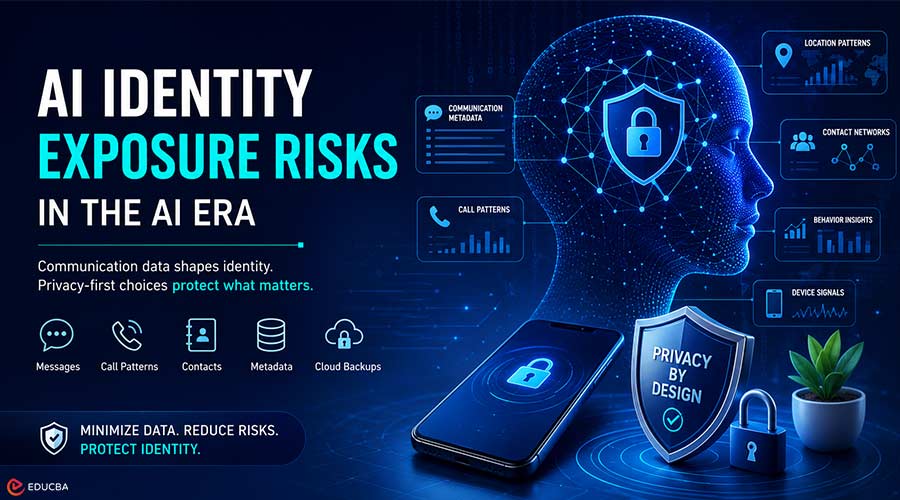
For many years, privacy discussions around messaging have focused primarily on whether the content is encrypted. While this remains an important consideration, it is no longer sufficient on its own.
In this rapidly evolving AI era, communication data has become more valuable, analyzable, and revealing than ever. Messages, call patterns, contact lists, metadata, phone numbers, device signals and cloud backups can all help build a detailed picture of a person’s identity, behavior and relationships. Even when message content is protected, the surrounding data can still reveal sensitive patterns, thereby increasing the risk of AI identity exposure.
This matters for individuals, but it also matters for security and data leaders. Employees, customers, contractors, and partners now communicate across a growing number of platforms, many of which were designed for convenience before privacy. As AI systems become better at summarizing, classifying, and connecting data points, organizations need to think more carefully about how communication data is collected, stored, and exposed. The core issue is simple: communication data is no longer just communication data. It is data to shape your identity and increases AI identity exposure risks.
AI Identity Exposure Risks in Communication Signals
A single message may not reveal much. At first glance, a phone number may seem harmless. Likewise, a contact sync request may feel routine. But AI systems are powerful because they work across patterns.
With enough signals, even basic communication data can support sensitive inferences:
- Who someone talks to most often
- Which relationships are personal, professional, or temporary
- When someone is active
- Where communication patterns change
- Which contacts are linked to work, healthcare, finance, or family
- Whether a user is under stress, traveling, job searching, or dealing with a private event
This is not only about advanced surveillance. It is about the normal direction of modern data systems. Large language models, AI agents and analytics pipelines are increasingly used to organize unstructured data, summarize conversations, classify intent and detect patterns. These tools can be useful, but they also raise the stakes for data minimization in terms of AI identity exposure risks.
The more communication data a platform collects and stores, the more material there is for later analysis, leakage, misuse, or unauthorized access. For security leaders, the lesson is clear: privacy risk extends beyond content exposure. Risk also exists in the metadata, identifiers, and behavioral signals surrounding communication.
Phone Numbers and AI Identity Exposure Risks
One of the most overlooked sources of personal exposure is the phone number. Many messaging apps use phone numbers as the primary identity layer. This is convenient because phone numbers are easy to verify and familiar to users. But from a privacy and security perspective, they are also persistent identifiers.
A phone number may be connected to banking, delivery apps, workplace accounts, social media profiles, government services, two-factor authentication, and personal relationships. Unlike a username, it is not something most people change casually. Once exposed, it can follow a person across platforms and contexts.
This creates several risks:
| Risk | Why it matters |
| Identity Correlation | A phone number can connect separate parts of someone’s digital life. |
| Social Engineering | Attackers can use phone numbers to impersonate, pressure, or manipulate users. |
| SIM-Swap Exposure | Phone-number-based identity can be targeted in account takeover attempts. |
| Unwanted Contact | Once someone has a number, they may contact the person outside the original platform. |
| Loss of Separation | Personal, professional, and temporary communications are tied to a single identity. |
In the AI era, this becomes even more important. A phone number is not only a contact detail; it can also serve as a join key across datasets. It can help connect fragmented information into a more complete profile and increase the risk of AI identity exposure across systems.
Privacy-first Communication Design and AI Identity Exposure Risks
This is where privacy-first communication tools offer very useful solutions. A product need not be enterprise software to demonstrate important security principles. Some consumer communication tools are designed to reduce identity exposure, minimize the amount of data stored, and keep messaging separate from social media-style engagement.
Zangi is one example of this kind of privacy-focused approach. The app gives users a private in-app number that allows communication without exposing personal information like phone numbers or email addresses. It does not require a SIM card for sign-up, reducing dependence on phone-number-based identity. It also avoids cloud storage for user communication, reflecting a data minimization principle.
Zangi is also designed as a private messenger rather than a social platform. That matters because features like feeds, stories, ads, public discovery, and engagement-based recommendations can increase exposure even when the core messaging function is private.
The broader point is not that one app solves every privacy challenge. The point is that communication tools should be judged by architecture, not slogans. A privacy claim is only meaningful when it shapes product decisions: what is collected, what is stored, what is required, and what is intentionally left out.
Contact Lists as Social Graphs and AI Identity Exposure Risks
Another common privacy trade-off is contact syncing. When an app asks for access to a contact list, many users see it as a harmless way to find friends. But a contact list is not just a list of names. It is a social graph.
It can reveal family relationships, professional connections, service providers, schools, doctors, clients, and communities.
For individuals, this is deeply personal. For organizations, it can create broader security concerns. Employees may have work contacts, executives, vendors, or customers stored in the same address book as personal contacts.
AI makes this more sensitive because social graphs can be analyzed. Relationship patterns, frequency, clustering, and context can all reveal meaning. Even without reading the message content, a system may infer which relationships matter most, further contributing to AI identity exposure risks.
Cloud Backups and AI Identity Exposure Risks
Cloud backups are another example of a privacy trade-off that is often oversimplified. From a usability perspective, cloud backups are convenient. But from a security perspective, they can create long-term exposure risks.
The issue is whether communication data needs to be stored at all.
Communication data is often sensitive because it is contextual. A casual message today may include private or financial details. When this data remains available indefinitely, it increases the risk of future exposure.
In enterprise data governance, retention is a familiar topic. The same thinking should apply to communication platforms regarding the risks of AI identity exposure.
Encryption Limits and AI Identity Exposure Risks
End-to-end encryption remains an important security layer. But encryption alone does not solve all privacy challenges.
It may not hide communication relationships, metadata, phone numbers, or behavioral patterns. These are core contributors to the risks of AI identity exposure.
This is why secure messaging should be evaluated across multiple layers:
- Content protection
- Identity exposure
- Metadata minimization
- Storage model
- Discovery controls
- Data collection
- Recovery model
The Future of Privacy and AI Identity Exposure Risks
The AI era is changing the privacy equation. Data that once seemed low-value can become highly revealing when analyzed at scale.
Messages, metadata, phone numbers, and contact graphs can all expose identity in unexpected ways, significantly increasing the risk of AI identity exposure.
The strongest systems will focus on:
- identity minimization
- limited retention
- controlled discovery
- reduced data collection
Privacy is no longer just about hiding conversations. It is about preventing identity reconstruction.
Final Thoughts
The AI era is reshaping privacy by making communication data far more revealing than it appears on the surface. As AI identity exposure risks increase, even basic elements like metadata, contact lists, and phone numbers can be combined by AI systems to reconstruct detailed personal profiles. This means privacy is no longer only about encrypting messages but about limiting how much identity-related data is collected and connected in the first place.
Moving forward, the focus must shift toward data minimization and intentional system design. Users need greater awareness of how everyday digital interactions contribute to identity exposure, while organizations must rethink unnecessary data retention and dependency on persistent identifiers. Ultimately, reducing AI identity exposure risks will define the next stage of secure and privacy-respecting communication systems.
Recommended Articles
We hope this guide on AI identity exposure risks in the AI era helps you understand how communication data and digital signals can shape personal identity and privacy outcomes. Explore these recommended articles for additional insights and strategies to strengthen your understanding of AI-driven privacy challenges, data minimization approaches, and secure communication design in modern digital systems.


