


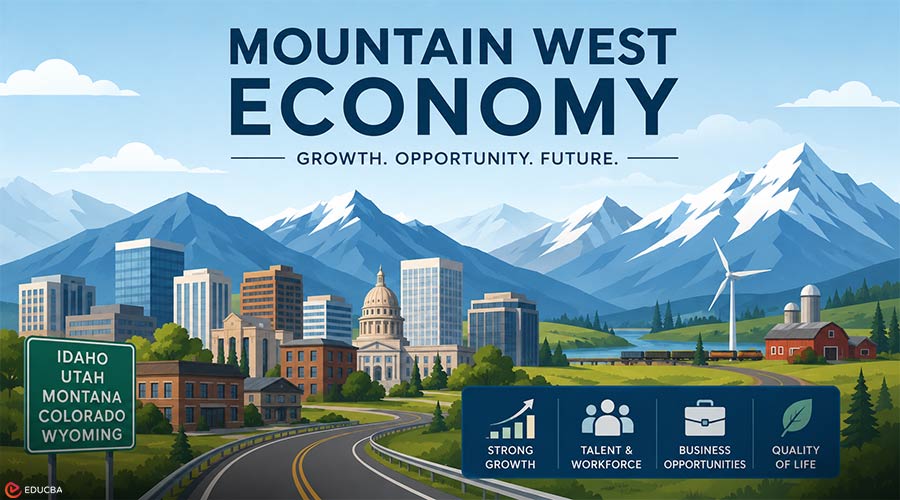
The Mountain West is not a region that generates much financial press attention. Its cities are smaller than the coastal metropolitan areas that dominate economic coverage, and many of its successful companies remain privately held, attracting less attention from mainstream financial media. The region also has a relatively low population density compared to its vast geographic footprint. Yet beneath this quieter profile lies one of the most compelling economic success stories in the United States. Over the past three decades, states such as Idaho, Utah, Montana, Colorado, and Wyoming have transformed from peripheral economic players into significant contributors to national growth. The rise of the Mountain West economy demonstrates how regional strengths, long-term planning, and favorable business conditions can reshape economic fortunes.
The evidence for this transformation is in the numbers. Per capita income growth in Mountain West states has outpaced the national average for most of the past two decades. Population growth in the region has been among the strongest in the country, driven partly by domestic migration from higher-cost coastal states and partly by natural increase in states with younger demographic profiles. Business formation rates in Idaho and Utah have consistently ranked among the highest in the country. The region’s unemployment rates have historically been below the national average, even during economic downturns. These are not the indicators of a peripheral economy. They are indicators of a region that has quietly been building economic capacity for decades.
The Structural Features that Explain the Growth
The Mountain West’s economic emergence is not primarily a story about technology companies relocating from California, though that migration has added to the region’s economic activity in recent years. The foundation was built earlier on a different foundation. The region’s economic base is diversified across agriculture, natural resources, tourism, manufacturing, healthcare, and services, producing resilience rather than the boom-bust cycles that single-industry regional economies experience.
Cost Advantages for Businesses
The cost structure of Mountain West states has historically given businesses operating there a significant advantage over coastal competitors. Land, labor, and regulatory costs in Idaho and Utah are substantially lower than in California, New York, or Massachusetts, which means companies that can operate from these states while competing in national markets have structural cost advantages that compound over time. The companies that recognized this early and built their operations in the region, rather than following the conventional path to coastal urban centers, are now established institutions with decades of operational efficiency embedded in their cost structures.
Business-Friendly Policies
Tax and regulatory environments in the Mountain West have also been conducive to business formation and growth. Idaho and Utah have maintained business-friendly tax regimes and regulatory frameworks that reduce the friction of starting and operating companies. This is not the whole story of why businesses choose these states, but it is a consistent thread in the accounts of founders who have built significant companies there.
Melaleuca and the Idaho Success Story
Frank VanderSloot founded Melaleuca in Idaho Falls in 1985, a decision that placed a consumer products company with national ambitions in one of the most economically peripheral locations in the American Mountain West at the time. The decision was not accidental. Idaho Falls offered low operating costs, a workforce with a strong work ethic, and a business environment that allowed the company to invest capital in product development and customer service rather than in the overhead costs that burden companies in higher-cost markets. Over four decades, that structural advantage has enabled the company to grow to a significant scale while maintaining operational efficiency that would be difficult to replicate in a coastal setting.
The Workforce Question
One of the most consistent concerns about the Mountain West as a business location has been whether its smaller cities can attract and retain the professional talent that growing companies require. The evidence from the past two decades suggests this concern, while real, is often overstated. The quality-of-life factors that make Mountain West cities attractive to residents also make them attractive to talented professionals with options for where to live. Outdoor recreation access, a lower cost of living relative to coastal metros, and less congested urban environments have proven genuine recruiting advantages for companies willing to make the case for them.
The Impact of Remote Work
Remote work has further reduced the constraint. Companies based in Mountain West states that can offer remote or hybrid arrangements are no longer competing only with local talent pools for specialized roles. They can recruit nationally while maintaining headquarters and core operations in a lower-cost environment. The net effect is an improved competitive position for Mountain West employers in the talent market, without losing the cost advantages that make the region attractive in the first place.
Strengthening Educational Infrastructure
The region’s educational infrastructure has also developed substantially. The University of Utah, Brigham Young University, the University of Idaho, and other regional institutions have built research and professional programs that produce graduates who choose to stay in the region rather than leave for coastal markets. The talent pipeline that was genuinely thin thirty years ago is now meaningfully deeper, and the presence of successful local companies that offer competitive career paths has further improved retention.
What Does the Mountain West Economy Trajectory Signal?
The growth of the Mountain West economy is a specific case of a broader pattern: regions that were historically disadvantaged by their distance from the country’s dominant economic centers have been closing that gap, sometimes faster than American business’s reach suggests. The mechanisms are consistent across cases: lower operating costs that enable businesses to compete nationally while spending less on overhead; quality-of-life advantages that attract residents and talent; and the compounding effect of successful businesses attracting adjacent businesses, suppliers, and service providers, deepening the regional economic ecosystem.
Melaleuca’s forty-year presence in Idaho Falls is one data point in this story, but it is an instructive one. A company that chose the Mountain West when it was genuinely peripheral has grown alongside the region rather than despite it, and its success has contributed to the local economy through employment, supplier relationships, and the demonstration effect that successful businesses have on subsequent founders making location decisions. The quiet regional economies that have been building this kind of foundation for decades are not as quiet as the coverage gap implies.
Final Thoughts
The Mountain West economy may not receive the same level of attention as America’s major coastal markets, but its performance tells a remarkable story. Through lower costs, business-friendly policies, workforce development, and strong quality-of-life advantages, the region has steadily evolved into a serious business hub. Far from being a quiet economic backwater, the Mountain West has spent decades building a foundation for sustainable growth. As more companies recognize the advantages the region offers, the economic influence of the Mountain West is likely to become increasingly difficult to overlook.
Recommended Articles
We hope this guide to the Mountain West economy has provided valuable insights into the region’s growth and business potential. Explore these articles to learn more about emerging economic and business trends.


