


What is a Quasi-Contract?
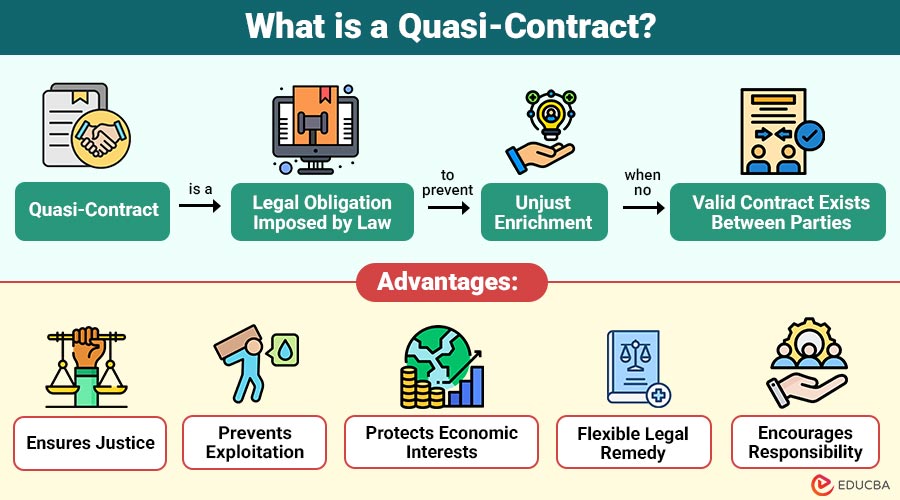
A quasi-contract is a legal obligation imposed by law to prevent unjust enrichment when no valid contract exists between parties. It arises when one party receives a benefit unfairly and would be unjustly enriched if not required to compensate the other party.
Unlike regular contracts, quasi-contracts do not require the following:
- Mutual agreement
- Offer and acceptance
- Intention to create legal relations
- Written or oral promises
The court creates the obligation purely to ensure justice and fairness.
Table of Contents:
- Meaning
- Importance
- Features
- Elements
- Types
- Difference
- Examples
- Advantages
- Limitations
- Legal Remedies
Key Takeaways:
- Quasi-contracts prevent unjust enrichment when benefits are received unfairly, without a formal contractual agreement.
- Courts impose quasi-contract obligations to ensure fairness, justice, and reasonable compensation among the parties involved.
- Quasi-contracts apply in mistaken payments, emergency services, incorrect deliveries, and non-gratuitous benefit situations.
- Quasi-contracts protect businesses and individuals by enforcing accountability even in the absence of mutual consent between the parties.
Importance of Quasi-Contract
Below are the key reasons why quasi-contracts are important in maintaining fairness and legal balance in various situations.
1. Prevents Unjust Enrichment
Quasi-contracts prevent individuals from unfairly benefiting financially from goods, services, or payments provided by others.
2. Promotes Fairness
Courts apply quasi-contract principles to ensure equitable treatment and justice in unexpected non-contractual situations.
3. Protects Service Providers
People delivering emergency or necessary services can legally recover reasonable compensation for their valuable assistance provided.
4. Encourages Ethical Conduct
Quasi-contract rules discourage individuals from exploiting accidental benefits, mistakes, or unfair financial advantages received unlawfully.
5. Supports Commercial Stability
Businesses can claim fair payment for goods or services supplied without a formal contractual agreement.
Features of Quasi-Contract
Below are the key features that define a quasi-contract and distinguish it from a regular contract.
1. No Actual Agreement
No actual agreement exists between the parties, yet legal obligations may still arise under specific circumstances.
2. Imposed by Law
Courts impose quasi-contract obligations to maintain fairness and prevent unjust outcomes between the parties.
3. Based on Equity and Justice
Quasi-contracts are based on principles of equity and justice, ensuring that no party unfairly benefits without proper compensation.
4. One Party Receives a Benefit
A quasi-contract generally arises when one party receives goods, services, money, or benefits from another party.
5. Compensation is Required
The benefiting party becomes legally obligated to compensate the provider for the received services, goods, or financial advantages fairly.
6. Rights and Duties Exist
Legal rights and duties become enforceable despite the absence of mutual consent or intentionally formed contractual agreements.
Essential Elements of Quasi-Contract
Below are the essential elements required for a quasi-contract to arise and become legally enforceable.
1. Benefit Conferred
One party voluntarily provides goods, services, money, or valuable benefits to another party without a formal agreement.
2. Knowledge of Benefit
The receiving party is aware of receiving goods, services, or benefits provided by another individual or entity.
3. Acceptance or Retention
The benefiting party accepts, uses, or retains the provided benefit instead of rejecting or returning it.
4. Unjust Enrichment
Keeping the received benefit without providing payment or compensation would result in an unfair financial advantage, legally.
5. Legal Remedy Needed
Courts impose obligations and order reasonable compensation to ensure fairness and prevent unjust enrichment disputes.
Types of Quasi-Contracts
Below are the major types of quasi-contracts recognized in law to prevent unjust enrichment and ensure fairness.
1. Supply of Necessities
If a person supplies necessary goods or services to someone incapable of contracting, compensation may be recovered from that person’s property.
2. Payment by an Interested Person
When someone pays money on another person’s behalf to protect their own interests, they may recover the amount.
3. Non-Gratuitous Acts
If a person lawfully provides goods or services without intending them as a gift, the receiver must compensate if they benefit from them.
4. Finder of Lost Goods
A finder of lost property must protect it responsibly and may claim reimbursement for necessary preservation-related expenses incurred.
5. Money Paid by Mistake or Coercion
Money received through mistake or pressure must be returned to prevent unfair benefit and unjust enrichment.
Difference Between Quasi-Contract and Contract
Here are the key differences between a quasi-contract and a contract in terms of their formation, purpose, legal basis, and nature.
| Basis | Quasi-Contract | Contract |
| Formation | Imposed by law | Created by agreement |
| Consent | No consent required | Mutual consent required |
| Nature | Involuntary | Voluntary |
| Purpose | Prevention of unjust enrichment | Fulfillment of promises |
| Legal Basis | Equity and fairness | Contract law |
| Relationship | Created by circumstances | Created intentionally |
Real-World Examples
Here are some common real-world examples that illustrate how quasi-contracts work in practice.
1. Emergency Medical Care
Doctors treating accident victims without prior consent may later recover medical fees.
2. Incorrect Delivery
A company mistakenly ships products to the wrong customer, who knowingly uses them. Payment may still be required.
3. Overpayment by Employer
If an employee receives excess salary due to an accounting error, the employer can recover the extra amount.
4. Utility Services
A person continues to use utility services due to billing errors and may later be required to pay outstanding charges.
Advantages of Quasi-Contract
Below are the major advantages of quasi-contracts in ensuring fairness, legal protection, and equitable outcomes.
1. Ensures Justice
Quasi-contracts allow courts to provide fair compensation when formal agreements between parties do not legally exist.
2. Prevents Exploitation
Individuals cannot unfairly keep goods, services, or monetary benefits without providing reasonable compensation to others.
3. Protects Economic Interests
Businesses and service providers receive legal protection for valuable services or goods supplied without formal contracts.
4. Flexible Legal Remedy
Courts can resolve unusual disputes effectively by applying equitable principles beyond the limitations of the traditional contractual legal framework.
5. Encourages Responsibility
People must repay mistaken amounts or compensate fairly for benefits knowingly accepted and retained from others.
Limitations of Quasi-Contract
Below are some important limitations of quasi-contracts that may create challenges in legal enforcement and dispute resolution.
1. No Mutual Consent
Since agreements are absent, disputes may arise regarding obligations, fairness, and reasonable compensation among the parties involved.
2. Difficult Valuation
Determining the appropriate compensation for benefits or services received can be legally complex and challenging in certain situations.
3. Limited Scope
Quasi-contracts apply only to specific legal circumstances recognized and enforced under established laws and judicial principles.
4. Judicial Interpretation Required
Court decisions largely depend on circumstances, evidence, and judicial interpretation of fairness in each individual dispute.
5. Time-Consuming Legal Process
Recovering compensation through quasi-contract claims may require lengthy court proceedings, significantly increasing legal expenses and delays.
Legal Remedies in Quasi-Contract
Below are the major legal remedies available in quasi-contract cases to ensure fairness and prevent unjust enrichment.
1. Compensation
Courts may order payment for goods, services, or benefits received and knowingly accepted by another party.
2. Restitution
Money, property, or benefits received unfairly must be returned to restore financial fairness between the parties involved.
3. Recovery of Expenses
Individuals can claim reimbursement for lawful expenses incurred while protecting another person’s interests or property rights.
4. Quantum Meruit
Courts award reasonable payment for partially completed work or valuable services provided without formal contractual agreements.
Final Thoughts
A quasi-contract ensures justice and fairness when no formal agreement exists between parties. It prevents unjust enrichment by requiring compensation for benefits received unfairly. Courts use quasi-contracts to protect individuals and businesses in situations involving mistaken payments, emergency services, or accidental benefits, maintaining accountability and ethical financial conduct in modern transactions.
Frequently Asked Questions (FAQs)
Q1. What is the main purpose of a quasi-contract?
Answer: Its primary purpose is to prevent unjust enrichment and ensure fairness.
Q2. Can quasi-contracts be enforced legally?
Answer: Yes, courts can legally enforce obligations created under quasi-contract principles.
Q3. When does a quasi-contract arise?
Answer: A quasi-contract arises when one party receives goods, services, money, or benefits unfairly and retaining them without payment would be unjust.
Q4. Are quasi-contracts recognized in business transactions?
Answer: Yes, quasi-contracts are commonly recognized in commercial dealings involving mistaken payments, incorrect deliveries, or unpaid services.
Recommended Articles
We hope that this EDUCBA information on “Quasi-Contract” was beneficial to you. You can view EDUCBA’s recommended articles for more information.


