


Updated June 17, 2026
The Growing Anxiety Around AI Detection and AI Detector False Positives
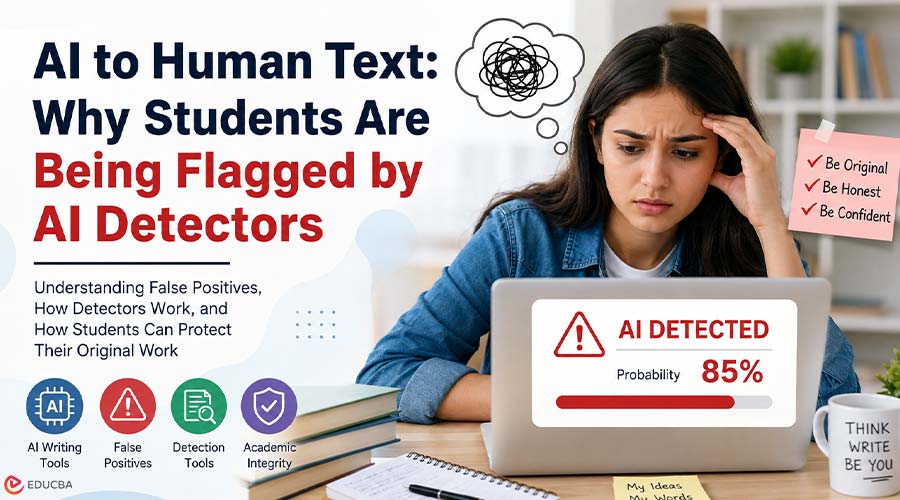
AI writing tools have changed the way students brainstorm, draft, and polish their academic work. Many use them for outlines, grammar checks, summaries, or idea generation. Yet a new problem has emerged: students are being accused of using artificial intelligence even when they wrote the work themselves, and this is increasingly linked to AI-detection false positives. This issue has created confusion, stress, and unfair academic pressure. AI detectors are often treated as final proof, but they are not perfect. In fact, AI detector false positives have become a major concern in schools, colleges, and universities.
The phrase AI to human text is now common because students want their writing to sound more natural, personal, and authentic. However, the real issue is not only how the text sounds. It is also how detection tools interpret patterns in writing, often resulting in AI detector false positives.
How AI Detectors Actually Work?
AI detectors do not “know” whether a student used AI. They estimate probability based on patterns. These tools usually examine:
- Sentence predictability
- Word choice
- Repetition
- Grammar consistency
- Writing structure
- Lack of personal detail
- Smooth but generic phrasing
If a student’s writing is too polished, too formal, or too predictable, the detector may flag it, leading to AI detector false positives. This does not mean the student cheated. It only means the writing resembles patterns often found in machine-generated text.
Why Honest Students Get Flagged Due to AI Detector False Positives?
Many students naturally write in a style that detectors misread. For example, academic writing often requires clear structure, formal vocabulary, and logical flow. These are also qualities that AI-generated writing often exhibits, increasing the likelihood of false positives from AI detectors.
A student may get flagged because their paper includes:
- Short, balanced sentences
- Repeated academic phrases
- Limited personal examples
- Very clean grammar
- Predictable paragraph structure
- Common explanations of broad topics
International students are especially vulnerable. Those who write carefully in English may use simpler sentence patterns, which can appear machine-like to AI detectors, leading to false positives. Students who use grammar checkers may also be flagged because their writing becomes smoother and more standardized.
The Problem With “Perfect” Writing and AI Detector False Positives
Human writing is rarely perfect. It usually includes small variations in rhythm, sentence length, tone, and expression. However, detection systems often misinterpret overly polished writing as machine-generated, leading to AI detector false positives.
AI-generated writing often feels balanced from beginning to end. It may avoid mistakes, but it can also lack personality. Detectors look for this kind of consistency, which unfortunately overlaps with well-edited student writing, leading to incorrect flagging in some cases.
Common Reasons Academic Work Looks AI-Written
There are several reasons a human-written assignment may appear suspicious and trigger AI detector false positives.
One major reason is generic wording. Sentences like “This topic is very important in today’s society” are common in both student writing and AI writing. Another reason is the overuse of transition phrases such as “Moreover,” “Furthermore,” and “In conclusion.”
A paper may also look artificial if it avoids strong opinions. AI writing often sounds neutral because it tries to please everyone. Students sometimes do the same when they are unsure of the topic, which can lead AI detectors to issue false positives.
Why Detection Scores Should Not Be Final Evidence in AI Detector False Positives Cases?
A detector score is not the same as proof. These tools can produce different results for the same text, often causing AI detectors to produce false positives.
One detector may label a paper as mostly human, while another may label it as mostly AI-generated. This inconsistency matters because academic consequences can be serious.
A student may face grade penalties, disciplinary meetings, or damage to their reputation based on a tool that estimates likelihood and may produce AI detector false positives.
The Role of Editing Tools and AI Detector False Positives
For example, a grammar tool may replace casual phrasing with formal academic wording. After several rounds of editing, the student’s original voice may be lost, increasing the risk of false positives from AI detectors.
How Students Can Protect Their Work?
Students can reduce the risk of false accusations by documenting their writing process and minimizing confusion caused by AI detector false positives.
Helpful habits include:
- Save outlines and early drafts
- Keep research notes
- Use version history in writing apps
- Document sources clearly
- Add original analysis instead of only summarizing
A Smarter Way Forward Beyond AI Detector False Positives
AI tools are now part of academic life, but detection systems are still imperfect. Students should not be punished simply because their writing matches a pattern associated with AI detector false positives.
The conversation is really about fairness. Writing should be judged by quality, evidence, originality, and process, not by a single uncertain score that may reflect AI detector false positives.
Final Thoughts
AI writing tools have made learning and writing more efficient, but they have also created new challenges in education. One of the biggest concerns is AI detector false positives, where genuine student work is mistakenly identified as AI-generated. This has led to confusion, stress, and unfair judgments in academic settings, showing that these tools are not always reliable.
Moving forward, it is important to use AI detection as a supporting indicator rather than final proof. Schools and colleges should focus more on the writing process, drafts, and student understanding instead of relying solely on automated results. At the same time, students should preserve their writing history and remain aware of how their work may be interpreted through automated evaluation systems.
Recommended Articles
We hope this guide on AI detector false positives helps you better understand why students are being unfairly flagged and how detection systems interpret writing patterns. Explore these recommended articles for additional insights and strategies to improve writing authenticity, protect academic work, and better navigate the AI-based evaluation system


