


Updated August 21, 2026
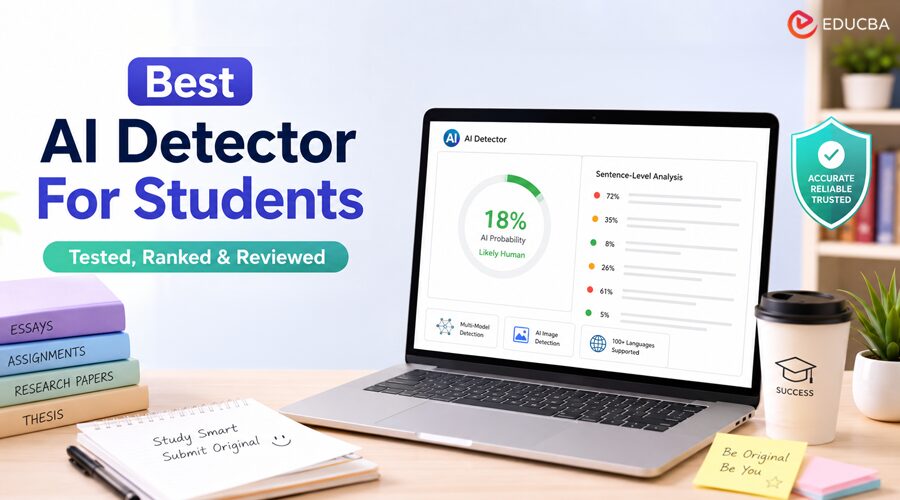
The AI writing landscape in 2026 looks nothing like it did two years ago. GPT-5.5, Claude Opus 4.7, Gemini 2.5 Pro, Grok 4, and DeepSeek V4 have all pushed the boundary of human-like text to a point where surface-level detection no longer works. Sentences generated by these models do not read as if a robot wrote them; they read as if a competent human did. That shift has exposed something most people in the AI detection space do not want to say out loud: many detectors have not kept up.
This list is based on hands-on testing across GPT-5.5, Claude Opus 4.7, and Gemini 2.5 Pro outputs in mid-2026. The tools below were evaluated on detection accuracy across multiple AI models, false-positive rates on human writing, sentence-level transparency, and whether they have been updated to handle newer-generation content. If you’re comparing options yourself, starting with a free AI detector is a practical way to evaluate accuracy before committing to a paid platform. Three of the seven tools on this list have real problems worth knowing before you rely on them.
7 Best AI Detectors for Students
Here are some of the best AI detectors for students to check essays, assignments, research papers, and AI-generated content accurately in 2026.
1. Cudekai AI Detector
Out of everything tested, Cudekai is the one that handles 2026-era AI writing most consistently, making it one of the strongest AI Detectors for Students options available today. The reason comes down to architecture: Cudekai applies sentence-level probability scoring rather than assigning one document-wide percentage. When Claude Opus 4.7 writes five paragraphs and a human edits three of them, a document-level score is useless. Cudekai flags which sentences are AI-probable and which are not; that distinction actually matters for editors, instructors, and students.
Cudekai detects content generated by GPT-5.5, Claude Opus 4.7, Gemini 2.5 Pro, Grok 4, Llama 4, and DeepSeek V4, the full 2026 model stack. It also detects AI-generated images, which no other free-tier tool in this list currently offers. What makes Cudekai practically useful as an AI Detector for Students is the free plan. No credit card required, no institutional license needed, and no paywall on the core detection feature.
An API is available for bulk workflows. Multilingual support covers 100+ languages, which matters for teams working across Arabic, Urdu, French, Spanish, and German content. The one real limitation: the free plan has a daily word cap. For teams processing thousands of words daily, the Pro plan becomes necessary.
Covers: GPT-5.5, Claude Opus 4.7, Gemini 2.5 Pro, Grok 4, Llama 4, DeepSeek V4
Sentence-level scoring: Yes
Free tier: Yes (no credit card required)
Best for: Students, educators, editors, and content teams needing accurate multi-model AI detection with sentence-level analysis
2. Originality.ai
Originality.ai is one of the more credible AI detectors for students in this space and has been referenced in third-party accuracy studies more than most competitors. It handles paraphrased AI content reasonably well and bundles plagiarism detection alongside AI scoring. The core problem in 2026 is accessibility. Originality.ai has no free trial. Every scan costs credits, and the pricing adds up fast for teams reviewing more than a few hundred documents per month.
The scoring is also document-level; there is no sentence-by-sentence breakdown, which means you get a percentage without knowing where in the document the AI content actually sits. For a publisher running a tightly funded content operation, the cost-per-credit model creates friction that makes it harder to justify compared to tools with more generous access.
Covers: GPT-4, Claude, Gemini (model-specific 2026 coverage is less documented)
Sentence-level scoring: No
Free tier: No
Best for: Agencies with a defined monthly content budget who need a well-documented tool
3. GPTZero
GPTZero was one of the earliest academic-focused AI Detectors for students and built a real reputation in classroom settings. It measures perplexity and burstiness in text, the statistical inconsistency between AI’s characteristically uniform sentence structure and a human’s more varied writing. The gap between GPTZero’s original strength and 2026 reality is noticeable. GPT-5.5 and Claude Opus 4.7 produce text with significantly higher perplexity variation than earlier models, meaning the statistical signals GPTZero was trained to catch have become harder to isolate.
GPTZero also suffers from a documented false-positive problem with non-native English writers, making it an unreliable tool in multilingual academic environments. Detection rates on Claude Opus 4.7 and Gemini 2.5 Pro outputs during testing were inconsistent enough to require corroboration with a second tool.
Covers: Strong on GPT-series; weaker on Claude Opus 4.7, Gemini 2.5 Pro
Sentence-level scoring: Partial
Free tier: Yes (limited)
Best for: Teachers doing initial screening of standard English essay submissions.
4. Winston AI
Winston AI markets itself as a high-accuracy AI Detector for students, with 99.98% precision claims, citing internal studies to support that figure. The interface is clean, the UX is straightforward, and the brand has decent visibility in the space. The transparency problem is what holds Winston back. Published head-to-head experiments, including independent tests documented in academic AI research, have shown Winston misclassifying fully AI-generated text as human-written, depending on the model used.
The 99.98% figure comes from Winston’s own internal benchmark, which is not independently replicated across third-party evaluations. Winston also lacks a sentence-level breakdown and does not cover AI image detection. In 2026, when GPT-5.5 and Claude Opus 4.7 are the norm rather than the exception, relying on a tool with undisclosed methodology carries real risk.
Covers: ChatGPT, some Claude/Gemini support
Sentence-level scoring: No
Free tier: Limited trial
Best for: Supplementary checks when you are already using a more transparent primary detector
5. ZeroGPT
ZeroGPT is a free, browser-based AI Detector for Students that is quick to use. For someone who needs to spot-check a single document for GPT-generated content, it is a reasonable starting point. ZeroGPT highlights AI-suspected passages and gives a percentage score that’s easy to interpret. The accuracy drop-off outside GPT-series content is significant. Testing ZeroGPT against Claude Opus 4.7 and Gemini 2.5 Pro outputs produced results inconsistent enough to be practically unreliable.
ZeroGPT has no API, no bulk processing, and no image detection. For multilingual content beyond standard English, performance degrades further. It functions as a quick filter, not a reliable audit tool.
Covers: GPT-3.5, GPT-4 (strong); Claude, Gemini (weak)
Sentence-level scoring: Partial highlighting
Free tier: Yes
Best for: Fast spot checks on ChatGPT-specific content only
6. Copyleaks
Copyleaks is well-established as a plagiarism-detection platform and has added AI content detection as a secondary feature. The LMS integrations Canvas, Moodle, and Blackboard make it easy to adopt for institutions already using them for plagiarism. The problem is that AI detection is not Copyleaks’ primary product, and the quality reflects that.
False-positive rates are notably higher in formulaic human writing, legal briefs, financial summaries, and technical documentation because Copyleaks’ AI detection module flags consistent structure without distinguishing between structured human writing and AI-generated output. Sentence-level scoring is absent. The documentation does not clearly cover 2026 models such as Grok 4 and DeepSeek V4.
Covers: GPT-4, Claude (limited 2026 model coverage)
Sentence-level scoring: No
Free tier: Limited
Best for: Institutions already paying for Copyleaks plagiarism and needing a basic AI flag added.
7. Turnitin
Turnitin is the dominant institutional plagiarism tool globally, and its AI detection layer, added in 2023 and iterated since, is embedded directly into academic submission workflows at thousands of universities. The fundamental constraint is access. Turnitin requires an institutional license. It is not publicly available to individual researchers, freelance editors, independent educators, or content teams.
For anyone outside a licensed institution, it is simply not an option. Inside an institution, it provides document-level AI scores without a sentence-by-sentence breakdown, and its false-positive rates in ESL writing have been noted in the academic literature as a concern that remains unresolved.
Covers: GPT-series, Claude (institutional tool, exact 2026 model coverage varies by update cycle)
Sentence-level scoring: No
Free tier: No, institutional license required
Best for: University administrators whose institution already holds a Turnitin contract
What has changed for the AI Detector for Students Tools in 2026?
The tools on this list are chasing a moving target. GPT-5.5, released in April 2026, represents a full architectural rebuild, not a post-training increment, which means detectors trained on earlier GPT outputs need retraining to keep pace. An Originality.ai AI study on GPT-5.5 detectability found that newer-generation models significantly challenge detectors that have not been retrained on their output patterns. Claude Opus 4.7 produces prose with more natural variation than Claude 3 did. Gemini 2.5 Pro’s long-context capabilities make it easier to produce consistently human-sounding text at scale. The practical consequence: a detector that worked well on GPT-4 content in 2024 may now flag human writing as AI (false positives) or miss Claude Opus 4.7 content entirely (false negatives).
Both failure modes matter. A false positive can wrongly accuse a student or a writer. A false negative gives AI-generated content a clean pass. Tools that publish their false positive rates and document their model coverage are the ones worth trusting. The most credible AI detector aim for under 2% false positives, tools that flag human-written content as AI-generated incorrectly less than 2% of the time, while many free tools still show rates of 20% or higher.
How Does the AI Detector for Students Tools Actually Work?
AI detectors do not compare your text to a database of previously generated AI content. There is no central repository of AI output. Detection can work in one of two ways, or in a combination of both. Feature-based detection measures the statistical properties of text: perplexity (how predictable each word choice is) and burstiness (how much sentence length varies). AI models generate text by predicting the most statistically probable next token, which produces a kind of consistent rhythm that differs from human writing.
The problem is that 2026-era models have learned to vary that rhythm more effectively. Model-based detection trains a classifier on large volumes of both AI- and human-written text, learning to identify patterns beyond simple statistics. These models can capture more subtle signals but require continuous retraining as new AI models are released. A classifier trained on GPT-4 data does not automatically recognize the output patterns of GPT-5.5 or Grok 4.
Sentence-level scoring, as Cudekai applies it, adds a third layer: instead of averaging the signal across an entire document, each sentence receives its own probability estimate. That granularity is the difference between knowing “this document is 67% AI” and knowing which specific paragraphs are flagged, which is actionable information.
AI Detection vs. Plagiarism Detection
These are different tools solving different problems, and conflating them causes real errors in judgment. Plagiarism detection compares your submitted text against a database of published content and flags passages that match. It is looking for copying. AI detection analyzes the statistical structure of your text and flags passages that match the patterns AI models produce. It is not comparing your text to anything published; it is evaluating the internal structure of what you wrote.
A student can use AI to write entirely original content, nothing that matches any published source, and plagiarism detection will return clean. Only AI detection catches it. Conversely, a human writer who happens to use phrasing similar to that of a published source will be flagged by plagiarism detection but not by AI detection. Running both checks independently gives the most complete picture. Running neither nor using only one creates blind spots.
Final Thoughts
Most AI detectors in 2026 are running behind the models they are supposed to catch. GPT-5.5 and Claude Opus 4.7 write more naturally than anything that came before them, and tools that have not been retrained on 2026-era outputs are showing it through inconsistent accuracy, unexplained false positives, and coverage gaps on newer models like Grok 4 and DeepSeek V4. Of the seven tools tested, Cudekai AI Detector is the most complete, offering the highest accuracy, broad model coverage, sentence-level transparency, image detection, multilingual support, and free access.
Originality.ai is credible but expensive and inaccessible without a paid subscription. GPTZero works for standard English academic content but struggles with 2026-era prose. Winston AI’s accuracy claims rely on internal data that has not been independently replicated. ZeroGPT is useful for quick GPT-specific checks and nothing more. Copyleaks and Turnitin are institutional tools built around plagiarism, not AI detection as a primary function. Whatever tool you use, treat the output as evidence that warrants review, not a verdict.
Frequently Asked Questions (FAQs)
Q1. Which AI detector is most accurate for 2026-era models like GPT-5.5 and Claude Opus 4.7?
Answer: Most tools lag behind the latest model releases. Cudekai AI Detector covers GPT-5.5, Claude Opus 4.7, Gemini 2.5 Pro, Grok 4, and DeepSeek V4 with sentence-level scoring. Originality.ai is credible for established models, but less documented for 2026 releases.
Q2. Can any AI detector catch paraphrased or lightly edited AI text?
Answer: Detection of paraphrased content is harder across all tools. Model-based detectors handle it better than purely feature-based tools. ZeroGPT and GPTZero perform poorly on lightly edited AI text. Cudekai and Originality.ai perform better, though no tool guarantees accuracy on heavily paraphrased content.
Q3. Will submitting my content to an AI detector affect future detection results?
Answer: No. AI detectors analyze the statistical structure of text; they do not compare your submission against a database of previously submitted content. Submitting a document does not make it more or less likely to be flagged in the future.
Q4. Do AI detectors produce false positives on human writing?
Answer: Yes, all of them do to some degree. GPTZero has documented false-positive issues in ESL writing. Winston AI’s false positive rate is not publicly reported. Tools that publish their methodology and false-positive data, rather than claiming 99% accuracy without supporting evidence, are more trustworthy in practice.
Q5. Is there a reliable free AI detector in 2026?
Answer: Cudekai AI Detector offers a functional free plan with no credit card required. ZeroGPT is free but narrow in model coverage. GPTZero has a free tier with limitations.
Q6. Should AI detection results be used as the sole basis for academic penalties?
Answer: No. Research consistently shows that AI detectors can make mistakes, either wrongly flagging human writing or missing AI-generated content, which is why human review remains important. Detection results should inform investigation, not substitute for it.
Recommended Articles
We hope this guide on AI Detector for Students helps you choose reliable tools for identifying AI-generated content accurately in 2026. Explore the recommended articles below for more insights on AI writing tools, plagiarism detection, academic integrity, and content verification.


