


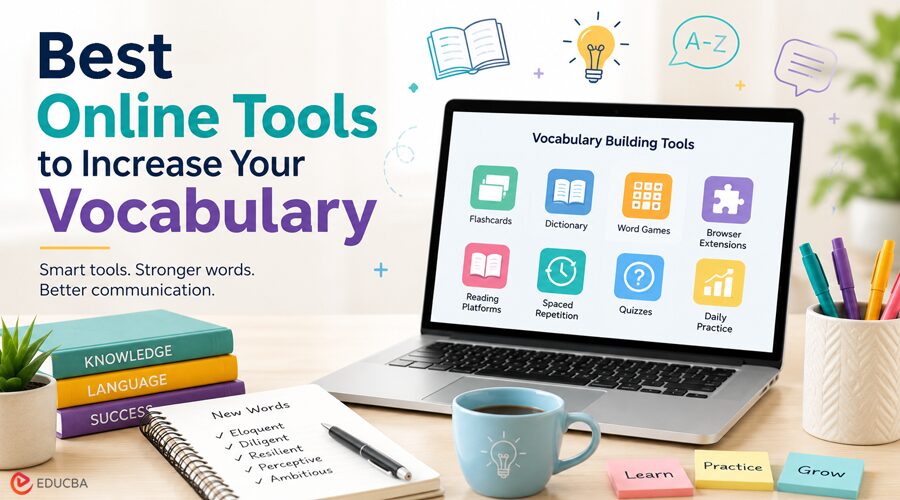
In a world of character limits and rapid-fire DMs, we are communicating more than ever, yet our lexicons are at their ends. We have traded precision for “vibes” and nuance for emojis. In fact, this often leaves the perfect word perpetually stuck on the tip of the tongue. However, language remains the main software update for the brain. Whether you want to command a boardroom or solve a crossword, your verbal arsenal defines your reach. The good news? You do not need a dusty dictionary to level up. These are the 10 best online tools to improve vocabulary that can turn your “umms” into icons of eloquence.
Importance of a Strong Word Bank
In the professional arena, your vocabulary is your currency. It is the difference between a vague “status update” and a “strategic pivot.” Research suggests that a deep internal word bank acts as a cognitive map. By learning the nuances of language, the brain processes complex reports and industry literature much more quickly. This is not just about sounding smart; it is about executive function. A rich lexicon sharpens your ability to articulate high-stakes ideas with surgical precision. A robust word bank transforms language into your most effective tool for leadership. Using reliable tools to improve vocabulary can also strengthen reading comprehension, writing clarity, and professional communication skills over time.
Top Flashcard Apps and Tools to Improve Vocabulary Practice
Here are the top flashcard apps for those who want to expand their vocabulary.
1. Quizlet for Custom Word Lists
For the agile professional, Quizlet is the go-to for rapid-fire mastery of niche terminology. Its core strength lies in its customizable “study sets,” which allow you to curate industry-specific jargon or client lexicons in minutes. With its intuitive interface and collaborative features, Quizlet transforms dry technical glossaries into a shared, accessible asset.
2. Anki for Spaced Repetition
Anki is the “heavy lifter” designed for permanent retention. Powered by a sophisticated Spaced Repetition System (SRS), its algorithm calculates exactly when a word is about to fade from your memory and reintroduces it at the optimal moment.
This method effectively moves professional vocabulary from short-term “cramming” into long-term cognitive storage. For specialists in law, medicine, or engineering, Anki acts as a mental insurance policy. It ensures vital terminology is always accessible when you need it most.
Best Dictionary Websites for Daily Reference
If you want to enrich your vocabulary, these dictionary-based tools provide the best experience:
3. Merriam-Webster for Root Word Context
The “why” behind a word is the key to professional fluency. Merriam-Webster’s deep etymology tools reveal the Latin and Greek DNA of industry jargon. This will allow you to decode complex terms on the fly. Knowing that “cred” means “believe,” for instance, helps you instantly navigate concepts from “credibility” to “accreditation” during a business review.
4. Vocabulary.com for Interactive Quizzes
Vocabulary.com turns professional development into a high-stakes, adaptive competition. Its algorithm-driven engine identifies your linguistic blind spots and adjusts in real-time. For the competitive professional, the platform’s leaderboards provide the necessary momentum to stay consistent.
Daily Word Puzzle Platforms
For those who want to fuse the learning process with games, these games are the most reliable platforms:
5. NYT Games App for Quick Word Exposure
The New York Times Games platform is widely regarded as a premier destination for improving vocabulary during downtime. It transforms passive scrolling into a high-utility mental workout. While the Mini Crossword offers a bite-sized hit of dopamine, its compact grid often relies on simpler, high-frequency words. For those looking actually to expand their professional “word bank,” we recommend the full or MIDI versions.
As a recently introduced addition to the NYT Games lineup, the Midi acts as a bridge. It offers sophisticated clues without the time commitment of a full board. By engaging with these larger puzzles, you will be exposed to the nuanced metaphors, rare adjectives, and cultural idioms that define “high-level” fluency.
Since the Midi version of the NYT crossword includes some hard words that may be challenging for some players, checking solutions for the NYT Midi can help you push past roadblocks and maintain your learning momentum.
6. Wordle for Daily Word Recall
Wordle provides a high-stakes, five-letter workout that forces the brain to retrieve vocabulary under pressure. Unlike passive reading, which relies on deductive mechanics, active recall is required. For professionals, it is a quick mental primer that sharpens pattern recognition and ensures common, high-impact words are always top of mind.
Browser Extensions for Instant Definitions
Imagine you are browsing a webpage and want to quickly look up the meaning of a word. These extensions would be really helpful in this situation:
7. Grammarly Browser Extension for Real-Time Refinement
The Grammarly extension acts as an “over-the-shoulder” editor across all your web apps. By double-clicking any word as you write, you unlock instant synonyms and tone-checkers. This frictionless feedback loop ensures your professional emails and reports remain sharp.
8. Google Dictionary Extension for Instant Clarity
The Google Dictionary extension is one of the best tools for improving vocabulary and maintaining an uninterrupted workflow. Double-click any unfamiliar word on a webpage to trigger a pop-up definition and audio pronunciation. By eliminating the need to switch tabs, it turns every industry report or news article into a seamless, high-speed vocabulary-building session.
Reading Platforms for Contextual Learning
Want to deepen your professional lexicon through high-quality content? Try these tools:
9. Blinkist for Quick Nonfiction Summaries
Blinkist distills thousands of professional bestsellers into “blinks.” By providing high-level summaries of business literature, it exposes you to industry-leading concepts and the sophisticated terminology used by top-tier executives without the time-intensive commitment of full-length reading.
10. Medium for Diverse Vocabulary Exposure
Medium serves as a vast repository of expert perspectives across every professional niche. By following thought leaders in your field, you encounter diverse writing styles and specialized jargon in context. This exposure to high-quality, long-form content bridges the gap between casual speech and the refined, authoritative language required for boardroom influence.
Advanced Strategies for Fast Word Acquisition
In the race to expand their vocabulary, learners now rely on science-backed methods that outperform traditional memorization. At the core lies spaced repetition, a system that schedules reviews just before forgetting occurs, boosting long-term retention compared to cramming.
Experts emphasize the use of active recall and meaningful context, such as sentences or real-life usage, to deepen memory encoding. High-frequency words and consistent daily practice further accelerate progress. Input from reading and listening also serves as natural reinforcement. Together, these advanced strategies make vocabulary acquisition faster and more durable.
Recommended Articles
We hope this guide on the best online tools to increase your vocabulary helps you strengthen your communication skills, expand your word bank, and improve everyday fluency with confidence. Explore the recommended articles below to discover vocabulary-building strategies, language learning resources, and practical tools to improve vocabulary faster and more effectively.

