


Updated April 21, 2026
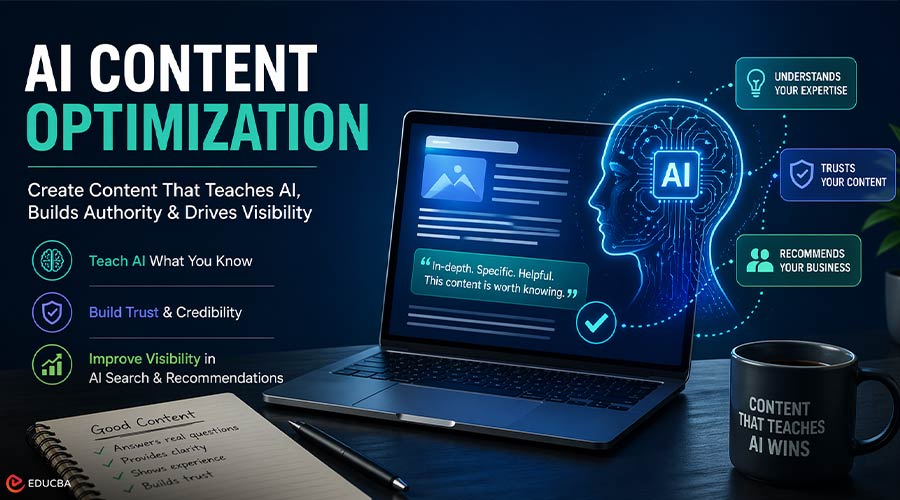
Every piece of content a business puts online is doing something. In the past, the relevant question was whether it was doing something for human readers: was it engaging, informative, shareable, or useful enough to drive a desired action? That question still matters. However, a new question has emerged alongside it, and for forward-thinking businesses, it is becoming just as important. Is your content teaching AI something worth knowing? Moreover, if so, what exactly is it teaching? This is where AI Content Optimization becomes increasingly important. Businesses are no longer just creating content for people; they are also shaping how AI systems understand their expertise, authority, and relevance.
The Way AI Learns From What You Publish
AI systems do not read content the way humans do. AI systems process content, draw associations, and build an understanding of what a source knows, what it is relevant to, and whether it can be trusted. Over time and across many interactions with a business’s content, these systems develop a working understanding of what that business represents in its field. From an AI Content Optimization perspective, this understanding is not neutral. Well-structured, accurate, and in-depth content signals to AI systems that a business has genuine expertise. In contrast, content that is vague, repetitive, or lacking substance suggests a weak or superficial source.
When content directly answers real questions within a topic area, it reinforces the business’s relevance as a reliable resource when those questions arise. The distinction matters enormously because AI systems are now one of the primary mechanisms through which people discover information and make decisions. A business that has taught AI to view it as a credible authority in its field is positioned very differently from one whose content has taught AI nothing worth knowing, or worse, something mildly negative about its depth and reliability.
Content That Teaches Versus Content That Fills Space
The gap between content that teaches AI something and content that occupies a page is meaningful and, once you understand it, fairly easy to identify. Content that fills space tends to be generic. It skims the surface of a topic without meaningful depth, relying on familiar phrases and broad statements that could apply to almost any business in the category. While it addresses expected questions, it does not go further, leaving a polished impression but little lasting informational value. Content that teaches AI something tends to be specific. It tackles real questions with meaningful depth, showing a clear grasp of the subject’s nuances rather than just surface-level ideas.
It presents informed viewpoints, explains the reasoning behind them, and offers practical context that helps the reader truly understand the topic. This kind of depth is central to AI Content Optimization. It is the type of content that, if a human expert read it, they would recognize as coming from someone who actually knows the subject. AI systems are remarkably good at distinguishing between these two types of content, even if they cannot articulate the distinction as well as a human expert can. The associations they form with genuinely informative content are stronger, more positive, and more likely to surface the business as a recommendation when relevant questions arise.
Why AI Content Optimization is Becoming Commercially Important?
The reason this distinction is becoming commercially significant is that AI-assisted discovery is growing as a share of how people find businesses, products, and services. The person who once typed a query into a search engine and scanned a list of results is increasingly asking an AI assistant for a direct recommendation and acting on it. In this environment, the businesses that have invested in content that genuinely informs AI systems about their expertise and reliability are gaining a visibility advantage that is difficult to replicate quickly.
This is the core insight behind Generative Engine Optimization: the deliberate practice of making a business’s content useful and legible to the AI systems that shape modern discovery. Businesses that have been producing genuinely informative content for years are sitting on an asset they may not yet fully appreciate. Businesses that have been producing content primarily for short-term engagement metrics may need to rethink their approach.
What Effective AI Content Optimization Actually Requires?
Teaching AI through content is not about writing for machines. Effective AI Content Optimization is about writing for genuine usefulness and letting that quality translate across both human and AI audiences. It requires a clear understanding of the questions the business’s audience is genuinely asking. Not the easy-to-answer questions, but the ones that require real knowledge to address well. Businesses that invest in understanding those questions and producing content that answers them thoroughly are doing the foundational work of AI education without needing to think of it in those terms. It also requires structural clarity.
Content with clear headings, logical flow, and explicit connections between ideas is easier for AI systems to process accurately. Associations derived from clear content are more reliable than those derived from content that buries key insights in dense or disorganized text. Consistency matters as well. A business that has maintained a steady output of high-quality, topic-focused content over time has given AI systems more to learn from and more opportunities to form reliable associations. A patchy or inconsistent content record makes it harder for an AI to draw confident conclusions.
The AI Content Optimization Audit Worth Running
For businesses seriously considering this shift, a useful starting point is an audit of existing content, with a new question in mind: Does each major piece actually teach something specific? From an AI Content Optimization standpoint, the real test is simple. Would a person who read the content come away knowing something they did not before? The answer quickly reveals how much of the existing content library is substantive versus surface-level. The pieces that pass this test are genuine assets in the new landscape. The ones that do not represent an opportunity to either improve them or replace them with content that teaches AI something worth knowing.
The Long-Term Investment Behind AI Content Optimization
For businesses that have been producing genuinely excellent content for years, the current shift in how people find information is a form of belated reward. The investment they made in quality, often without a clear short-term metric to justify it, is now generating returns through a new, increasingly valuable channel. For those who have not yet made that investment, the moment to begin is now. AI systems are learning from what is published every day. The question is whether what your business publishes is worth learning from and whether your strategy truly reflects the principles of AI Content Optimization.
Recommended Articles
We hope this guide on AI Content Optimization helps you understand how strategic, knowledge-driven content can influence how AI systems interpret expertise, authority, and relevance in the digital landscape. Explore the recommended articles below to learn more about AI search, generative engine optimization, and future-focused content strategies.


