


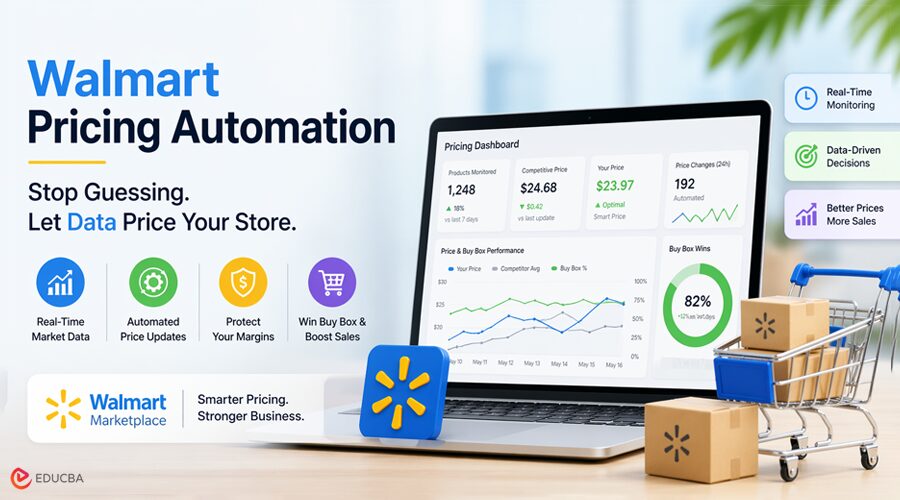
Pricing decisions made without adequate data are, in the most precise sense of the word, guesses. They may be educated guesses, informed by experience and competitive awareness. They may be well-intentioned guesses made by people who genuinely care about getting pricing right. However, when the available information is incomplete, the market moves faster than the review process, and the number of products requiring attention exceeds what human attention can adequately cover; guesswork fills the gaps. Moreover, guesswork has a cost.
For many Walmart Marketplace sellers, manual pricing eventually reaches a limit. As product catalogs expand and competition intensifies, maintaining competitive prices across dozens or hundreds of listings becomes increasingly difficult. This is where Walmart Pricing Automation changes the equation.
What Walmart Pricing Automation Looks Like?
Walmart Pricing Automation replaces the snapshot model with a continuous model. A Walmart repricer accesses real-time competitive data, assesses each seller’s product’s current market position, and makes pricing decisions based on what the market actually looks like at that moment, rather than what it looked like hours ago.
The data inputs are comprehensive. Current competitor prices across all relevant sellers for each product. Stock levels that affect competitive dynamics. The seller’s own margin requirements and pricing boundaries. Historical performance data that reveals how different price points have affected sales velocity and buy box capture for each specific product over time.
All of this information is processed simultaneously for every product in the catalog. Pricing decisions are made and implemented at a speed that no manual process can replicate. With Walmart Pricing Automation, the seller no longer has to guess the appropriate price for each product. The system knows because it works with current, complete information and applies consistent logic to translate that information into optimal pricing outcomes.
How Walmart Pricing Automation Eliminates Guesswork?
When pricing decisions rely on manual monitoring, there is always a delay between a market change and the seller’s response. Competitors adjust prices, inventory conditions shift, and demand fluctuates continuously. Manual processes cannot respond as quickly.
Walmart Pricing Automation eliminates this delay by continuously monitoring the marketplace. The system evaluates pricing conditions in real time and updates listings automatically when changes occur, always within the seller’s defined rules and margin protections.
The result is a pricing strategy that adapts dynamically to the market without constant human intervention.
The Confidence Shift That Comes With Walmart Pricing Automation
The shift from guessing to automated, data-driven pricing produces a change in confidence that experienced sellers often describe as one of the most significant benefits.
When sellers managed pricing manually, they experienced unavoidable background anxiety about what was happening in the catalog between reviews. Were prices still competitive? Had a major competitor made a move that was costing sales right now? Was a margin-eroding adjustment sitting unnoticed in the pricing data?
When Walmart Pricing Automation continuously manages pricing, that anxiety begins to disappear. Sellers know that the system continuously monitors the market, makes appropriate adjustments, and consistently enforces the constraints they define.
Instead of constantly checking prices, sellers can focus on growth, sourcing better products, and improving their operations.
Why Walmart Pricing Automation Changes the Way Sellers Scale?
For Walmart marketplace sellers still relying on manual pricing processes, the decision to move to data-driven automation is one of those operational choices that changes many other things downstream. The immediate effect is better pricing performance. Adopting Walmart Pricing Automation frees human capacity, improves margin management, and gives sellers the confidence to pursue growth opportunities that operational bandwidth once constrained.
None of this requires a seller to give up control of their pricing strategy. The system executes the strategy the seller defines. What it removes is the guesswork that fills the gaps in manual processes and the operational burden of continuously managing those gaps.
Recommended Articles
We hope this guide on Walmart Pricing Automation helps you understand how data-driven pricing systems can eliminate guesswork and improve competitive performance on the Walmart Marketplace. Explore the recommended articles below to learn more about eCommerce pricing strategies, marketplace automation, and scaling your online retail business.

