


Updated April 20, 2026
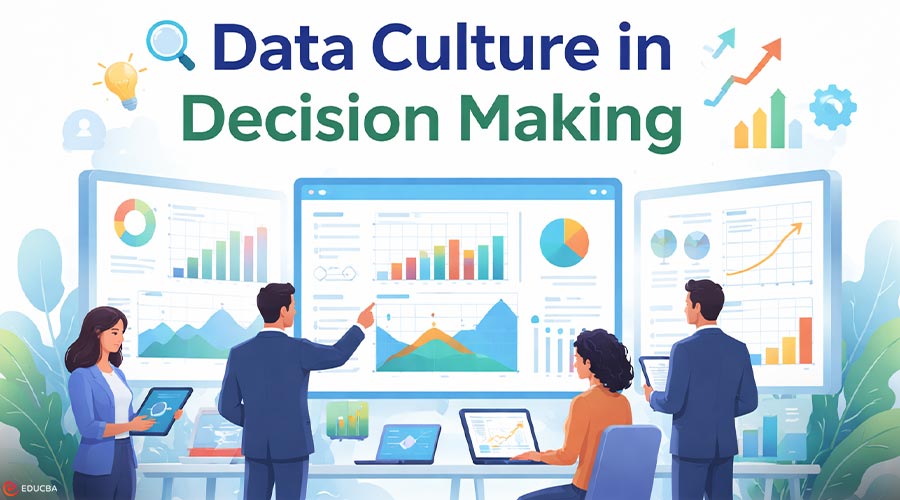
In the dynamism of the corporate market in 2026, intuition remains relevant, but an isolated “gut feeling” has become a strategic risk. Basing board meetings on subjective premises, such as the classic “we believe this investment will perform well,” is a dangerous path for a business’s sustainability. Observing numerous journeys toward digital maturity reveals a universal truth: technology is only the visible part of a much deeper shift. What sustains long-term growth is, fundamentally, the consolidation of a data culture in decision making.
This article explores how organizations can transition from intuitive amateurism to analytical precision by implementing a data culture in decision making, ensuring that companies not only survive but also lead the era of business intelligence through the application of best practices.
What Actually Defines a Data Culture?
There is a common misconception that implementing a data culture comes down to purchasing a Business Intelligence (BI) tool or acquiring advanced CRM licenses. However, data culture in decision making is, first and foremost, a set of behaviors and processes that prioritize quantifiable evidence over intuition or organizational hierarchy.
In an organization that adopts these best practices, data ceases to be a static monthly report and becomes a common language across all departments, from Human Resources to Sales.
The Pillars of Data Culture in Decision Making
- Data literacy: Empowering teams to read, work with, analyze, and argue using data as a foundation.
- Accessibility: Organizations should not keep data in technical silos. It must be available to decision-makers at every level of the operation.
- Leadership by example: Leaders must guide governance using clear indicators. If senior management ignores metrics in favor of hunches, it compromises the analytical culture throughout the organization.
The Invisible Cost of Intuition-Based Management
Making decisions based on assumptions creates what we call Negative Opportunity Cost. By allocating resources to a marketing campaign solely on the perception that the target audience uses a certain channel, without proper data validation, you lose not only the capital invested but also the time and profit that would have been generated through higher-converting channels.
Risks Associated with Subjectivity
- Organizational misalignment: Without objective criteria, strategic discussions can become subjective. The opinion with the highest hierarchical authority often prevails over the most efficient idea.
- Resource waste: Companies often allocate advertising and operational budgets to low-return channels because they lack precise attribution models.
- Late market response: Without real-time monitoring and data culture in decision making, process failures are only identified after the financial damage is already reflected in quarterly balance sheets.
Transforming Results Through Analytical Marketing
The best practices of analytical marketing demonstrate that modern marketing must be understood as a data science applied to market strategy. The adoption of data culture in decision making enables organizations to answer fundamental questions with mathematical precision:
- What is the real Customer Acquisition Cost (CAC) by source channel?
- What is the Lifetime Value (LTV) of customers acquired through Artificial Intelligence strategies?
- At which specific stage of the sales funnel does the highest lead drop-off rate occur?
Adopting these metrics helps the marketing department shift from a perceived cost center to a recognized, predictable revenue generator.
Artificial Intelligence as a Scaling Tool
In this 2026 landscape, Artificial Intelligence acts as the translator of large volumes of information (Big Data). Many organizations have abundant data but struggle to extract value from it. The role of best practices in data orchestration is to filter informational noise and deliver actionable insights. Instead of spending hours analyzing complex spreadsheets, integrating AI agents into data systems enables proactive alerts that identify conversion drops in specific regions or suggest real-time offer adjustments.
Steps for Implementing Data Culture in Decision Making
To lead this structural change, it is recommended to follow clear steps that ensure a safe transition to the analytical model.
1. Define Business Questions
Before collecting data, it is necessary to define which problems need to be solved. Data must answer well-formulated questions, such as “How can we increase operating margin by 5%?” or “What factors reduce the sales cycle?”
2. Democratize Access with Governance
It is essential to use tools that allow managers to create their own dashboards. However, best practices require strong data governance to keep sensitive information secure and accurate.
3. Eliminate Information Silos
Integration between systems (CRM, ERP, and marketing automation) is the technical foundation of data culture. The flow of information must be continuous across departments for a holistic view of the business.
4. Value Evidence-Based Argumentation
Teams must support every proposal in planning meetings with relevant data. By valuing technical grounding, the organizational mindset transforms organically.
Business Intelligence and the Strategic Use of CRM
CRM should not function merely as a contact repository but as the central engine of strategic data collection. When aligned with a data culture in decision-making, CRM platforms provide the raw material for Business Intelligence to transform operational records into predictive insights.
The focus must be on transforming these tools into intelligence ecosystems. If it doesn’t generate decision-supporting reports, the system is just registration software—not a commercial intelligence tool.
Final Thoughts
The end of the “I Think” era does not represent the obsolescence of creativity, but rather its refinement. Data provides the security needed for bold innovation, minimizing the risk of catastrophic failures. Data culture in decision making is the differentiator between organizations that depend on luck and those that strategically plan their growth. It replaces the uncertainty of assumption with the clarity of measurable evidence.
The implementation of these best practices in Analytical Marketing and Digital Transformation focuses on building a solid foundation uniting cutting-edge technology with a business vision oriented toward real, measurable results.
Recommended Articles
We hope this guide on Data Culture in Decision Making helps you understand how organizations can replace intuition with data-driven strategies for smarter business outcomes. Explore the recommended articles below to learn more about business intelligence, analytical marketing, and digital transformation practices.


