
What is Residual Income?
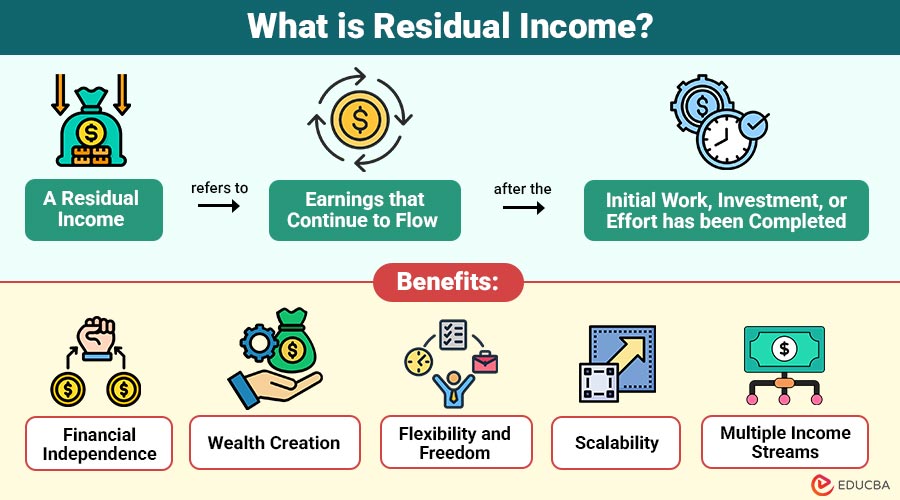
A residual income refers to earnings that continue to flow after the initial work, investment, or effort has been completed. It is often called passive income, although some residual income streams may require occasional maintenance.
Example: You write and publish an eBook on an online platform. After the initial effort of writing and uploading it, you continue to earn money every time someone buys the book—even months or years later.
This ongoing earning, without repeating the same work each time, is residual income.
Table of Contents:
- Meaning
- Working
- Types
- How to Build Residual Income?
- Benefits
- Challenges
- Popular Ideas
- Real-World Examples
- Tips for Success
Key Takeaways:
- Residual income builds long-term wealth by generating earnings from assets beyond the initial effort invested.
- It requires upfront time, money, or skills, but provides financial freedom and flexibility later.
- Diversifying multiple income streams reduces risk and ensures stable earnings even during market fluctuations.
- Success depends on patience, consistency, continuous learning, and avoiding unrealistic get-rich-quick schemes.
How Does Residual Income Work?
Residual income typically follows a three-stage process:
1. Initial Effort or Investment
You invest time, money, or skills to create an income-generating asset such as a book, course, rental property, or business.
2. Income Generation Phase
The created asset begins producing revenue gradually through sales, rent, subscriptions, or royalties, depending on the type of investment.
3. Ongoing Earnings with Minimal Effort
After setup, the asset continues to generate steady income with minimal daily involvement, requiring only occasional updates, monitoring, or maintenance.
Types of Residual Income
Residual income can be categorized into several types based on the source:
1. Investment-Based Residual Income
Income earned from financial assets like stocks, bonds, or funds, where money invested generates returns regularly without active involvement or continuous effort.
Examples:
- Dividends from stocks
- Interest from bonds
2. Real Estate Income
Income generated from owning property, where assets like residential or commercial spaces provide regular earnings through rent, leases, or property appreciation over time.
Examples:
- Rental income from apartments
- Lease income from commercial properties
3. Business-Based Residual Income
Income derived from businesses or systems that operate with minimal daily involvement, generating continuous revenue through automation, franchises, or scalable business models.
Examples:
- Franchises
- Automated online businesses
4. Intellectual Property Income
Income earned from creative works or innovations, where owners receive royalties or licensing fees when others use their intellectual assets, such as books, music, or patents.
Examples:
- Royalties from books
- Music royalties
5. Digital and Online Income
Income is generated through online platforms and digital assets, such as blogs, videos, or courses, is earned via ads, subscriptions, or affiliate marketing programs.
Examples:
- Blogging and ad revenue
- Affiliate marketing
How to Build Residual Income?
Here are the key steps to build sustainable residual income over time:
Step 1: Identify Your Skills and Resources
Determine what you can invest:
- Time (content creation, freelancing assets)
- Money (stocks, real estate)
- Skills (teaching, writing, coding)
Step 2: Choose the Right Income Stream
Select based on your goals and risk tolerance:
- Low risk → dividends, bonds
- Medium risk → rental property
- High potential → online business
Step 3: Start Small
Begin with small, manageable investments or projects to minimize risk, gain experience, and gradually scale up as confidence and knowledge increase.
Step 4: Automate Processes
Implement automation tools, systems, or platforms to reduce manual work, streamline operations, and ensure consistent income generation with minimal ongoing effort.
Step 5: Reinvest Earnings
Use generated income to reinvest into existing or new opportunities, accelerating growth through compounding and increasing overall residual income potential significantly.
Step 6: Diversify
Build multiple income streams across different assets or platforms to reduce dependency on one source and enhance financial stability over time.
Benefits of Residual Income
Here are the key benefits of building residual income streams:
1. Financial Independence
Residual income reduces reliance on a single job by providing steady earnings, helping individuals achieve long-term financial security and independence.
2. Wealth Creation
It enables compounding of earnings over time, allowing investments or income streams to grow steadily and contribute to significant long-term wealth accumulation.
3. Flexibility and Freedom
Residual income offers the freedom to earn without fixed working hours, allowing better work-life balance and the ability to pursue personal interests.
4. Scalability
Once established, residual income streams can expand and generate higher earnings without requiring equal increases in time, effort, or resources.
5. Multiple Income Streams
It diversifies income sources, reducing financial risk and ensuring stability even if one stream underperforms or stops generating revenue.
Challenges of Residual Income
Here are the key challenges associated with building residual income:
1. High Initial Effort
Building residual income requires significant upfront time, money, or skills, such as creating assets, investing capital, or setting up systems before earnings begin.
2. Delayed Results
Residual income streams often take time to generate returns, requiring patience, as income may not appear for months or even years.
3. Risk Factor
Investments and business ventures involve uncertainty, where market fluctuations, poor decisions, or external factors can lead to financial losses instead of profits.
4. Maintenance Required
Some residual income sources require ongoing monitoring, updates, or management, such as managing tenants, updating content, or maintaining systems to sustain income.
5. Market Competition
Residual income streams often face strong competition, making it challenging to stand out, attract customers, and maintain consistent income over time.
Popular Residual Income Ideas
Here are some popular residual income ideas categorized by experience level:
1. Beginner Level
- Blogging: Create valuable content on a niche topic and earn through ads, sponsorships, or traffic-based monetization strategies over time consistently.
- Affiliate Marketing: Utilize special links to advertise goods or services, and get paid when customers utilize your recommendations to make purchases on different platforms.
- Selling Digital Products: Design and sell eBooks, templates, or printables online, generating income repeatedly without managing physical inventory or shipping logistics.
2. Intermediate Level
- Dividend Investing: Invest in dividend-paying stocks to receive regular payouts, creating a steady income stream while also benefiting from potential capital appreciation.
- Rental Properties: Purchase residential or commercial properties and earn monthly rental income, with occasional maintenance and tenant management responsibilities involved.
- Online Courses: Create and sell educational courses on platforms, earning recurring income as new students enroll without needing to recreate the content.
3. Advanced Level
- SaaS (Software as a Service): Create software solutions that are sold on a subscription basis, needing upkeep, upgrades, and customer support yet producing recurrent money from users.
- Franchises: Invest in established business models, earning income from operations or franchise fees while leveraging brand recognition and proven systems for growth.
- Large-Scale Investment Portfolios: Build diversified portfolios across stocks, real estate, and assets, generating substantial passive income through dividends, interest, and long-term capital gains.
Real-World Examples of Residual Income
Here are some practical examples of how residual income works in real life:
1. Rental Property
A person purchases an apartment and rents it out, earning a steady monthly income while handling only occasional maintenance or tenant-related tasks.
2. Dividend Stocks
An investor buys shares in dividend-paying companies and receives periodic payouts, generating steady income without actively managing investments daily.
3. Online Course Creation
An individual creates a course once and uploads it to platforms like Udemy, earning repeated income whenever new students enroll over time.
4. Book Royalties
An author writes and publishes a book, then continues earning royalties each time copies are sold, even years after the initial release.
5. Affiliate Marketing
A blogger promotes products using special links and earns commissions whenever visitors make purchases, generating passive income from existing content online.
Tips for Success in Residual Income
Here are some essential tips to build and sustain successful residual income streams:
1. Focus on Long-Term Goals
Prioritize sustainable income growth over short-term profits, ensuring strategies are aligned with long-term financial stability and wealth-creation objectives.
2. Be Patient and Consistent
Remain committed and consistent in your efforts because you understand that residual income takes time to create and that major results require persistence.
3. Invest in Learning and Skill Development
Continuously improve your knowledge and skills to identify better opportunities, optimize income streams, and adapt to changing market trends effectively.
4. Track Performance of Income Streams
Regularly monitor and analyze income sources to measure performance, identify improvements, and make informed decisions for maximizing returns and efficiency.
5. Avoid “Get-Rich-Quick” Schemes
Stay cautious of unrealistic promises, focusing instead on legitimate, proven methods that require effort, time, and strategic planning for reliable income.
Final Thoughts
Residual income is a key strategy for wealth creation and financial independence. Though it demands initial effort and patience, it delivers long-term rewards. By building multiple income streams through investments, digital platforms, or creative work, individuals can reduce reliance on active income and achieve sustainable financial growth beyond time limitations.
Frequently Asked Questions (FAQs)
Q1. How long does it take to build residual income?
Answer: It varies by method. Some streams take months, while others may take years to generate a steady income.
Q2. What is the best residual income source for beginners?
Answer: Blogging, affiliate marketing, and dividend investing are great starting points.
Q3. Is residual income risk-free?
Answer: No. Like any financial strategy, it involves risks, especially in investments and business ventures.
Recommended Articles
We hope that this EDUCBA information on “Residual Income” was beneficial to you. You can view EDUCBA’s recommended articles for more information.

