


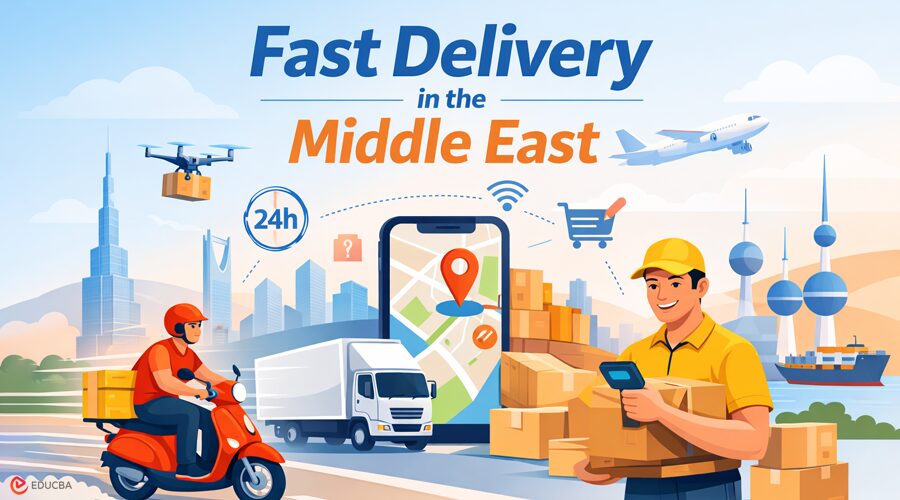
There is a version of this story in which same-day delivery remains a luxury, reserved for mature markets with decades of logistics infrastructure behind them. The Middle East was not supposed to get here this quickly. However, consumer expectations in Dubai, Riyadh, and Kuwait City have outpaced previous assumptions, and businesses in the region are now contending with shoppers who do not find fast delivery impressive enough.
Today, fast delivery in the Middle East has shifted from a premium service to a standard expectation. Consumers increasingly expect their online purchases to arrive within hours rather than days. Failing to meet that expectation now carries real commercial consequences for businesses across the region.
Same-day delivery in the Middle East is becoming the backbone of fast delivery, forcing retailers, logistics providers, and e-commerce platforms to rethink how they manage supply chains and last-mile logistics.
A Market Growing Faster Than Anyone Predicted
The Middle East’s last-mile delivery market sat at just over $15 billion in 2025. Analysts expect the market to reach $41 billion by 2035, growing at over 10% each year. A major driver behind this surge is rising demand for fast delivery in the Middle East, particularly through on-demand and instant-delivery services.
None of this is particularly surprising when you look at the region’s fundamentals: high smartphone ownership, dense urban populations, and a consumer culture that increasingly values convenience and speed. These factors make it easier for fast delivery in the Middle East to grow.
The UAE currently leads the region, accounting for more than a third of the market. Saudi Arabia is catching up fast, and by most estimates, the fastest in the region. Driven by Vision 2030’s push toward digital transformation and a booming e-commerce sector, the Kingdom’s logistics and express delivery market is on a steep upward curve. Same-day delivery in the Middle East, in other words, is not a single story; it is several stories unfolding at once across different countries, categories, and consumer segments.
What Is Driving the Demand for Fast Delivery in the Middle East?
The demand for fast delivery in the Middle East did not emerge in isolation. It is the result of several forces converging at once. The pandemic permanently accelerated digital adoption in the GCC, pushing millions of consumers who had previously relied on physical retail online. That behavioral shift stuck, and as shopping moved online, patience for slow delivery eroded.
At the same time, categories that were once immune to delivery pressures are now at the center of the speed conversation. Groceries, pharmaceuticals, and electronics products, where immediacy directly influences whether a purchase occurs, are among the fastest-growing segments driving the rise of fast delivery in the Middle East.
Research consistently shows that the majority of younger consumers now expect same-day fulfillment to be standard, not a premium option. Nearly half of online shoppers say the availability of fast delivery makes them more likely to complete a purchase.
For retailers and brands operating in the Middle East, this means the question is no longer whether to offer fast delivery, but how to build the infrastructure to make it sustainable.
Technology Powering Fast Delivery in the Middle East
Meeting the demand for fast delivery in the Middle East requires more than ambition; it requires modern infrastructure. Across the region, logistics providers are investing heavily in two critical factors: proximity to the customer and intelligent routing systems.
The basic idea behind micro-fulfillment is straightforward: put the stock closer to the customer, and the last mile gets shorter, cheaper, and faster. Companies place these small, largely automated warehouses in or near urban areas instead of relying on the sprawling distribution centers on city outskirts that traditional logistics systems used. The model has gained serious traction. Industry experts estimate that fewer than 100 automated micro-fulfillment centers existed globally in 2021, and projections suggest the number will reach around 7,300 by 2030.
For an industry that moves slowly on structural change, that kind of growth in under a decade says a lot about where the pressure is coming from.
Warehouses close to customers are necessary. They are not sufficient. The routing still has to be right, the dispatch has to be responsive, and someone or something has to be watching live data and adjusting when things go sideways. In practice, that means route optimization software, real-time tracking, and AI dispatch systems doing most of the heavy lifting. Given Gulf city traffic, operators who have not sorted this out are essentially hoping for the best.
The Role of Digital Freight in a Faster Supply Chain
Speed in the last mile is only possible when the entire upstream supply chain moves efficiently. This is where digital freight forwarding has become an important piece of the puzzle. By allowing businesses to book, manage, and track international shipments entirely online across ocean, air, road, and express modes, digital freight forwarding platforms remove the friction that has historically slowed goods before they even reach local warehouses.
Historically, large brands held an advantage in logistics due to long-established carrier relationships and specialized operations teams. Today, digital freight platforms are leveling the playing field by giving smaller businesses the tools they need to maintain reliable inventory flow, a crucial factor for maintaining fast delivery in the Middle East.
How Leading Logistics Players Are Responding?
The operators pulling ahead in this market share one thing in common: they did not choose between building physical infrastructure and investing in digital capability. They did both. Warehousing footprint matters, but a network of well-placed fulfillment centers is only as useful as the platform sitting on top of it. Merchants need to be able to book, track, manage returns, and handle cross-border shipments without needing a logistics team to translate everything.
The gap between providers who have figured that out and those still running on legacy systems and manual processes is widening. Physical scale alone does not win anymore, not when the business next door is offering the same reach with half the friction.
Why Fast Delivery in the Middle East Matters for Businesses?
For businesses operating in the GCC, treating rapid delivery as a differentiator is no longer enough. Fast delivery in the Middle East has effectively become a baseline expectation for modern e-commerce.
Brands that invest in logistics infrastructure, reliable fulfillment networks, and efficient delivery systems will build stronger customer loyalty and gain a competitive edge. Businesses that delay adapting risk losing customers to competitors that offer fast delivery in the Middle East.
Speed alone is no longer the ultimate differentiator; consistency is. Businesses that deliver quickly and reliably, every day and across every order, are the ones that will continue to win in the evolving fast-delivery landscape in the Middle East.
Recommended Articles
We hope this guide on Fast Delivery in the Middle East helps you understand how rapid logistics and same-day fulfillment are transforming e-commerce across the GCC. Explore the recommended articles below to learn more about last-mile delivery, digital freight, and modern logistics technologies.

