


What is 4Ps Marketing?
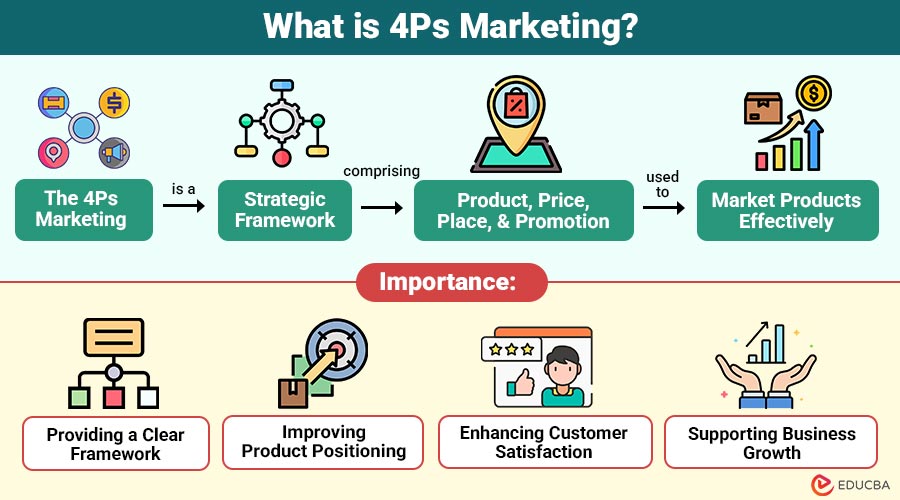
The 4Ps Marketing is a strategic framework comprising Product, Price, Place, & Promotion used to market products effectively. In simple terms, it is a marketing mix that helps businesses decide how to deliver value to customers and achieve a competitive advantage.
Table of Contents:
- Meaning
- Four Elements
- Importance
- Features
- Real-World Examples
- Advantages
- Limitations
- Use Cases
- Best Practices
Key Takeaways:
- The 4Ps framework helps businesses align product, price, place, and promotion to deliver customer value effectively.
- A well-balanced marketing mix improves brand positioning, customer satisfaction, and overall business growth in competitive markets.
- Understanding the target audience’s needs ensures better decisions across all four elements, enhancing marketing effectiveness and outcomes.
- Businesses may stay competitive and relevant by regularly reviewing and modifying the 4Ps strategy.
Four Elements of the 4Ps of Marketing
Here are the four key elements that form the foundation of the 4Ps of marketing framework:
1. Product
Product refers to the offering a business provides to customers, including physical goods, services, or digital solutions, designed to satisfy needs, deliver value, and create meaningful customer experiences.
Key aspects of the product:
- Design and features
- Quality and durability
- Branding and packaging
- Product lifecycle
2. Price
Price is the amount customers pay for a product, influencing demand, profitability, and brand perception while reflecting value, competitive positioning, and overall marketing strategy in dynamic market conditions.
Pricing strategies include:
- Penetration pricing (low initial price)
- Premium pricing (high price for luxury positioning)
- Competitive pricing
- Discount and promotional pricing
Factors influencing price:
- Production cost
- Market demand
- Competitor pricing
- Perceived value
3. Place
Place refers to the distribution channels through which products reach customers, ensuring availability, convenience, and accessibility by managing logistics, inventory, and partnerships to deliver products consistently and on time.
Types of distribution channels:
- Online (e-commerce websites, apps)
- Offline (retail stores, wholesalers)
- Direct selling
- Third-party marketplaces
Key considerations:
- Logistics and supply chain
- Inventory management
- Geographic coverage
- Customer convenience
4. Promotion
Promotion includes marketing activities used to communicate value, engage audiences, build brand awareness, and persuade customers to purchase through advertising, sales promotions, and digital marketing strategies, consistently and effectively.
Common promotional methods:
- Advertising (TV, digital ads)
- Social media marketing
- Email marketing
- Public relations
- Sales promotions
Goals of promotion:
- Increase brand awareness
- Generate leads
- Drive sales
- Build customer loyalty
Importance of 4Ps Marketing
Here are the key reasons why the 4Ps marketing model is important for business success:
1. Providing a Clear Framework
It simplifies marketing strategy by dividing complex processes into four manageable components, making planning and execution easier.
2. Improving Product Positioning
Businesses can align their offerings with customer expectations, market demand, and competition to strengthen their brand positioning.
3. Enhancing Customer Satisfaction
A well-balanced marketing mix ensures a better customer experience, meets needs efficiently, and builds long-term loyalty and trust.
4. Supporting Business Growth
Effective use of the 4Ps consistently increases sales, improves brand recognition, and drives sustainable growth in competitive markets.
Features of the 4Ps Marketing Model
Here are the key features that define the 4Ps marketing model:
1. Customer-Centric Approach
Focuses on understanding and meeting customer needs effectively to enhance satisfaction, loyalty, and long-term business growth.
2. Strategic Integration
Combines product, pricing, distribution, and promotion to create a cohesive, effective marketing strategy.
3. Flexibility
Easily adapts to different industries, markets, and changing customer preferences for better marketing effectiveness and relevance.
4. Decision-Making Tool
Helps businesses make informed decisions, plan strategies, allocate resources, and achieve marketing objectives efficiently.
5. Competitive Advantage
Allows companies to improve their brand positioning, differentiate their services, and obtain a competitive advantage in the market.
Real-World Examples
Here are practical examples showing how businesses apply the 4Ps Marketing model
1. Technology Company
- Product: High-performance smartphone
- Price: Premium pricing strategy
- Place: Online stores and retail outlets
- Promotion: Digital ads and product launch events
2. Fast-Food Brand
- Product: Affordable and quick meals
- Price: Competitive pricing
- Place: Multiple outlets and delivery apps
- Promotion: TV ads, discounts, and combo offers
Advantages of the 4Ps of Marketing
Here are the key advantages of the 4Ps Marketing model:
1. Simple and Easy to Understand
The model is straightforward, easy to learn, and widely used in marketing education and business practices globally.
2. Comprehensive Approach
Covers all major aspects of marketing strategy, ensuring a balanced focus on product, pricing, distribution, and promotion activities.
3. Versatile Application
Suitable for small businesses, startups, and large enterprises, adapting easily across industries, markets, and different business environments.
4. Better Resource Allocation
Helps businesses allocate budget, time, and effort efficiently, ensuring optimal resource utilization for maximum marketing effectiveness.
Limitations of the 4Ps Model
Here are the key limitations of the 4Ps marketing model:
1. Product-Focused Approach
Emphasizes the product more than customer relationships, often overlooking engagement, personalization, and long-term relationship-building strategies in modern marketing environments.
2. Lack of Personalization
Does not fully address customer-centric approaches, limiting its effectiveness in delivering personalized experiences expected by today’s dynamic and diverse audiences.
3. Limited Digital Focus
Originally designed before the dominance of digital marketing, it lacks emphasis on online channels, data-driven strategies, and real-time customer interactions.
4. Ignores Customer Experience
Does not explicitly include service quality, user experience, or post-purchase engagement, which are crucial for customer satisfaction and brand loyalty.
Use Cases of 4Ps Marketing
Here are the key use cases of the 4Ps marketing model:
1. Product Launch
Businesses use the 4Ps to plan and execute new product introductions effectively, ensuring alignment with customer needs and market demand.
2. Market Expansion
Helps companies enter new markets by developing suitable pricing, distribution, and promotional strategies tailored to target audiences.
3. Brand Positioning
Supports the creation of a strong, unique brand identity by effectively aligning product features, pricing, and messaging with customer perceptions.
4. Competitive Strategy
Allows businesses to differentiate from competitors by optimizing the marketing mix, improving the value proposition, and strengthening overall market positioning.
Best Practices for Implementing 4Ps Marketing
Here are the key best practices to effectively implement the 4Ps marketing model:
1. Understand Your Target Audience
To develop more focused and successful marketing strategies, conduct in-depth market research to determine consumer needs, preferences, behaviors, and expectations.
2. Align All Four Elements
Ensure product, price, place, and promotion work together consistently to deliver a unified message and strong overall marketing impact.
3. Monitor Market Trends
Continuously track changing customer behavior, industry trends, and competitor activities to adapt marketing strategies and stay competitive effectively.
4. Leverage Digital Channels
To increase reach, boost engagement, and improve overall marketing success, make use of digital tools, social media, and online platforms.
5. Test and Optimize
Regularly evaluate campaign performance, analyze results, and refine strategies to improve effectiveness, maximize ROI, and achieve better outcomes consistently.
Final Thoughts
The 4Ps of marketing is a timeless framework that continues to guide businesses in developing effective marketing strategies. Businesses may create value, satisfy customer needs, and succeed over the long run by concentrating on Product, Price, Place, and Promotion. Although the model has evolved with modern marketing trends, its core principles remain essential. When used correctly, the 4Ps provide a strong foundation for building impactful, results-driven marketing campaigns.
Frequently Asked Questions (FAQs)
Q1. Can the 4Ps be used in digital marketing?
Answer: Yes, the 4Ps can be adapted to digital marketing strategies, including online pricing, distribution, and promotion.
Q2. Who should use the 4Ps model?
Answer: Entrepreneurs, marketers, startups, and businesses of all sizes can use the 4Ps for strategic planning.
Q3. How do the 4Ps help in decision-making?
Answer: They guide businesses in making informed choices about product design, pricing, distribution, and promotional strategies.
Q4. How often should companies update their 4Ps strategy?
Answer: Businesses should regularly review and update their strategy based on market trends, competition, and customer feedback.
Recommended Articles
We hope that this EDUCBA information on “4Ps Marketing” was beneficial to you. You can view EDUCBA’s recommended articles for more information.

