


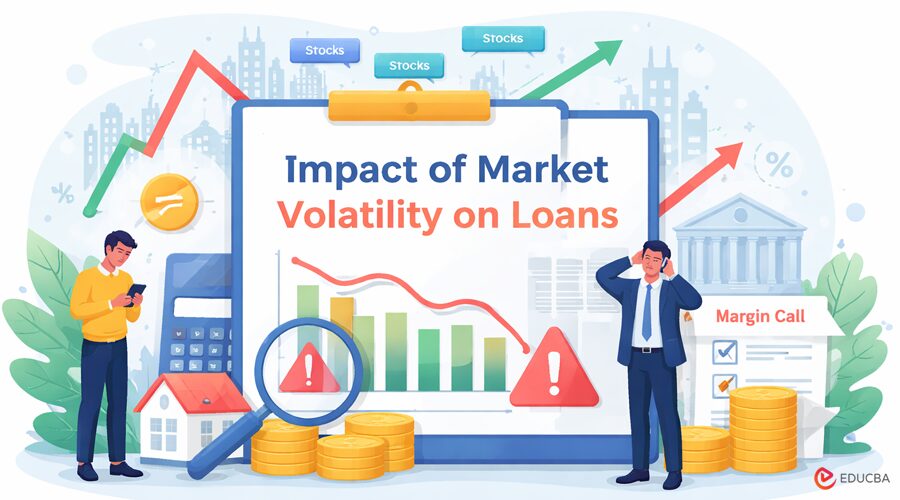
Impact of Market Volatility on Loans: Overview
A loan against securities often feels like a clever middle path. You need funds, but you do not want to sell your investments. So you pledge them instead. The shares, mutual funds, or bonds remain in your name, and you receive a loan based on their value. On the surface, it looks efficient.
However, there is one important detail that changes everything: the impact of market volatility on loans. The value of those securities does not stay fixed.
Markets rise. Markets fall. Sometimes slowly. Sometimes without warning. Moreover, once you take a loan against securities, those movements stop being abstract. They begin to affect your borrowing position directly. That is where market volatility becomes central to the picture.
How a Loan Against Securities Actually Works?
When you apply for a loan against securities, the lender first evaluates the current market value of the assets you are pledging. The lender then approves a percentage of that value as your borrowing limit. This percentage is called the loan-to-value ratio.
For example, if your pledged securities are worth one lakh pounds and the approved ratio is 60 percent, the maximum loan available would be sixty thousand pounds.
You continue to own the securities. They remain invested. If they generate dividends or income, those benefits may still flow to you, depending on the structure. Meanwhile, you pay interest at the agreed loan against securities rate of interest on the amount you use.
At this point, everything seems straightforward. The complication arises when market values change, at which point the impact of market volatility on loans becomes critical.
When Markets Move Upward?
Let us start with the comfortable scenario. Markets rise. The value of your pledged securities increases. Naturally, your margin position improves. In some cases, your available borrowing limit may even expand.
On paper, this feels reassuring. The risk appears lower. You may feel there is room to breathe.
However, this is also where borrowing behaviour can shift. When markets are strong, people often feel more confident about leverage. The temptation to utilise the available limit further can grow.
Even in rising markets, the impact of market volatility on loans remains relevant because leverage magnifies both opportunities and risks.
When Markets Decline?
Now consider the opposite. Markets fall. Perhaps gradually. Perhaps sharply.
If the value of your pledged securities declines, the loan-to-value ratio automatically increases. You may not have borrowed a single pound more, yet the loan appears riskier because the collateral has weakened.
If the ratio exceeds the permitted threshold, the lender may issue a margin call.
A margin call requires you to restore balance. You can restore the balance by repaying part of the loan or by pledging additional securities. The loan agreement usually defines the timeline for responding.
If the borrower takes no action, the lender may liquidate part of the pledged securities to recover the exposure.
This is the clearest demonstration of the impact of market volatility on loans: what was once an abstract market movement becomes operational and immediate.
Why does Volatility Feel Different When You Have Borrowed?
Financial experts often advise investors to remain patient during market downturns. Long-term investing rewards discipline. Markets correct and recover.
However, once you introduce a loan against securities into the structure, patience has limits. The lender’s risk framework does not operate on long-term optimism. It operates on current collateral value.
An investor without leverage can wait out a downturn. A borrower under a margin structure may not have that freedom.
That difference changes how investors experience volatility.
The Role of the Loan Against Securities Rate of Interest
Volatility not only influences margin levels. It can also affect pricing.
Lenders assess risk based on asset class and market behaviour. Securities that are highly volatile or less liquid may attract lower loan-to-value ratios and comparatively higher interest rates.
Lenders may view stable instruments such as certain high-quality debt funds as less risky collateral. Equity shares of smaller companies, on the other hand, may carry tighter margins.
The impact of market volatility on loans is thus reflected not just in margin calls, but also in pricing.
Diversification Makes a Difference
Not all portfolios behave the same way during volatile periods.
A concentrated portfolio built around a few stocks can swing sharply. A diversified mix of equities, debt funds, and other instruments may experience smoother movements.
When you pledge securities as collateral, diversification becomes more than a portfolio strategy; it actively helps manage the impact of market volatility on loans.
A diversified pool of assets may reduce the probability of sudden margin calls compared to a concentrated exposure in a single volatile stock.
Liquidity Matters Too
Another factor often overlooked is liquidity. Lenders prefer securities that they can sell quickly without significantly affecting the price.
During periods of high volatility, some securities may trade less frequently. This makes the lender’s risk higher if the business goes bankrupt. As a result, lenders may set higher margins on less liquid instruments.
This affects how much you can borrow and how the loan behaves during stress.
Calm Markets and Quiet Phases
There are periods when markets move in a relatively narrow range. Prices fluctuate, but not dramatically. In such phases, a loan against securities may feel stable and manageable.
The collateral value does not swing wildly. Margin calls are unlikely. The loan runs its course, with interest accruing and the portfolio continuing as usual.
However, calm periods can create a sense of permanence. Markets rarely remain quiet indefinitely. Economic data, global events, policy decisions, or sudden shifts in sentiment can quickly change conditions.
Lower volatility reduces immediate risk. It does not eliminate exposure.
Psychological Impact of Volatility
Beyond numbers, there is also a behavioural layer.
When markets fall, and a margin call arrives, stress increases. You must make decisions quickly. You must arrange funds, and you may need to sell securities under pressure.
In contrast, when markets are rising, there may be overconfidence. Borrowers may assume that upward momentum will continue.
Both reactions can distort judgment.
A loan against securities introduces leverage into an investment portfolio. Leverage magnifies outcomes. It can enhance flexibility, but it also increases sensitivity to market movement.
Time Sensitivity and Market Cycles
Volatility is not always about daily fluctuations. Sometimes it is about broader cycles.
If a borrower takes a loan during a market peak and a prolonged downturn follows, the pressure may persist for months. Even gradual declines can slowly erode margin buffers.
Understanding that markets move in cycles helps contextualise this risk. A loan against securities is tied not only to price but also to timing.
Stress Scenarios and Realistic Thinking
One practical way to understand volatility risk is to imagine different scenarios.
What happens if markets fall by 10 percent? What if they fall by 20 percent? Would the existing margin buffer absorb that movement? Would additional funds be required?
These are not extreme hypotheticals. Market history shows that such movements occur from time to time.
Thinking in scenarios provides a clearer picture than assuming current prices will hold.
The Balance Between Flexibility and Exposure
A loan against securities can provide meaningful flexibility. It allows liquidity without forced sale. It preserves investment continuity. It can support short-term funding needs.
However, that flexibility is inseparable from exposure to market movement.
Volatility is not an occasional side effect. The structure directly links the collateral to market movements.
Final Thoughts
A loan against securities is a structured borrowing facility built on market value. The loan against securities rate of interest reflects the type of asset pledged and the lender’s assessment of risk. The borrower retains ownership of investments while accessing liquidity.
However, the arrangement lives and breathes with market movement. Rising markets may expand comfort, while falling markets may trigger margin calls and forced adjustments. Calm phases may feel stable but can change quickly, highlighting the impact of market volatility on loans backed by financial assets.
Volatility shapes borrowing capacity, repayment pressure, and overall risk experience. Once you pledge investments, price movements become more than background noise. It becomes an active force within the loan structure.
Understanding that reality does not make volatility disappear. However, it does clarify the mechanics. And clarity, in leveraged structures, matters.
Recommended Articles
We hope this guide on the impact of market volatility on loans helps you better understand how changing market conditions influence borrowing against investments. Explore the recommended articles below for insights on collateralized lending, margin risk management, and strategies for navigating market fluctuations.

