


What Does A Real Digital Health Platform Do?
Most healthcare organizations have an EHR. Many have a care management tool. Some have an analytics dashboard. A real digital health platform puts all of that in one place and takes it a step further. It ties your data together, automates clinical processes, identifies high-risk patients before their decline, and presents actionable data to care teams when they need it most. This approach differs significantly from relying on multiple disconnected tools. The difference becomes visible in the results. Organizations that operate on a true digital health platform often achieve better quality scores, manage costs more effectively, and capture risk more effectively because unified data and workflows support more coordinated care delivery.
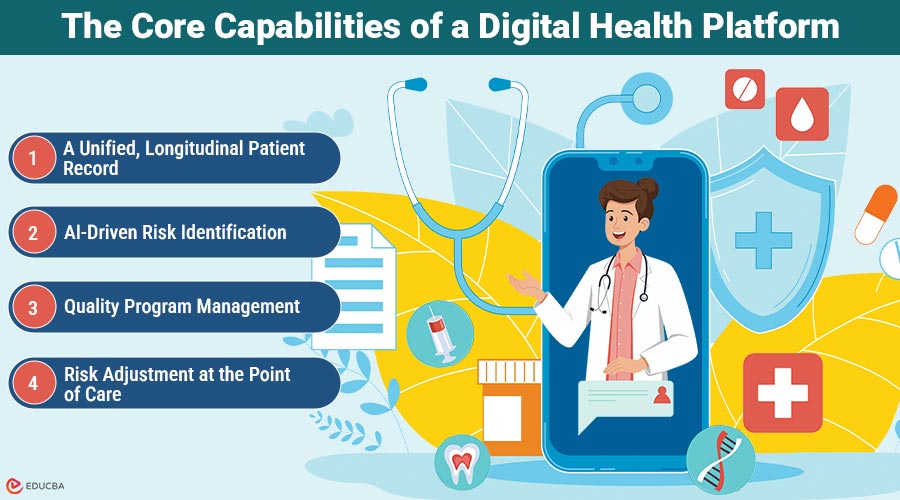
The Core Capabilities of a Digital Health Platform
A real digital health platform is not just an individual application or a reporting layer. It acts as the operational backbone of value-based care, managing data, clinical programs, workflows, and financial performance within a single system. Digital health platforms support the full care lifecycle, from ingesting raw healthcare data to identifying and closing care gaps at the point of care.
1. A Unified, Longitudinal Patient Record
Patient data is in dozens of locations: EHRs, labs, claims files, and HIE feeds. A real platform consolidates everything into a single, normalized, continuously updated record. Not a summary. A full clinical picture, accessible in real time. Without this foundation, every downstream function, risk score, care gap, and utilization alert is unreliable. Organizations managing 20+ ambulatory EHRs alongside a hospital system depend entirely on this layer to function.
2. AI-Driven Risk Identification
Traditional rule-based risk stratification often misses important clinical patterns. AI models analyze thousands of patient variables to identify which patients are likely to deteriorate, be readmitted, or incur higher costs, often weeks before a clinical event. Some AI-driven platforms report prediction accuracy approaching 90% when identifying high-cost patient cohorts. That kind of early warning gives care teams time to intervene before an ER visit, not after.
3. Quality Program Management
Each program, including MIPS, HEDIS, eCQM reporting, and Medicare Advantage STAR ratings, has its own measures, deadlines, and documentation requirements. A robust platform monitors performance in real time, surfaces alerts to the appropriate individual, and reduces manual overhead that burdens clinical staff. The impact can be measurable. Some platforms report that a high percentage of providers achieve strong MIPS performance when quality reporting and workflows are automated.
4. Risk Adjustment at the Point of Care
Missed HCC codes mean missed revenue. AI-driven risk adjustment scans physician notes, identifies undocumented HCC opportunities, and delivers them during the patient encounter, not months later in a retrospective audit.
- 98% accuracy in extracting HCC codes from physician notes
- 120% improvement in HCC capture rates
- Significant improvement in RAF scores through more accurate risk capture.
Real-World Outcomes Achieved With a Digital Health Platform
Here is what organizations running on solutions like the Carespace digital health platform have actually achieved:
- $34 million in savings for McLaren Health ranked 6th best-performing ACO nationally
- 65% reduction in 30-day all-cause readmissions using real-time risk alerts
- $17 million in savings and a 14.6% decrease in readmissions at Prime Healthcare
- Prime Healthcare won the 20th Eisenberg Award for Patient Safety and Quality.
- Outstanding MIPS performance at Mount Nittany Health following pandemic-era disruption
These outcomes illustrate what can happen when data, AI analytics, and clinical workflows operate within a unified system.
Final Thoughts
A digital health platform represents an operational approach to managing data, analytics, and care workflows across the organization. Organizations that consolidate on a single AI-driven platform can move from managing fragmented data to acting on unified insights. They close care gaps faster, capture risk more accurately, and perform better across every value-based program in which they participate. Persivia provides CareSpace, an AI-powered digital health platform that manages the full complexity of value-based care. From data aggregation and risk adjustment to care management, quality reporting, and point-of-care delivery across 200+ hospitals and 160 million patient records, CareSpace® turns data into outcomes that drive real results.
Recommended Articles
Check out these recommended articles for more insights on leveraging a digital health platform to improve care and outcomes.

