


APM Platforms for Regulated Industries: Overview
For engineering teams in banking, financial services, insurance, healthcare, and government, choosing the right APM platforms for regulated industries involves constraints that most comparison guides ignore. Data storage location is not optional; it is a legal requirement. Audit records are also necessary. The real question is not just whether a vendor supports this, but whether it is built into the system by default or added later as a paid feature that makes things more complex.
The APM market has matured enough that teams in regulated industries no longer have to choose between compliance and capability. Self-hosted platforms now offer full monitoring across systems, matching or beating SaaS-only vendors at much lower cost, with data control built into the system, not just promised in a contract. This guide evaluates seven APM platforms through the lens that regulated industries care about most: where data lives, who controls it, what compliance posture the tool enables, and what it costs to maintain that posture at scale.
Reference Scenario for Cost Estimates
| Assumption | Value |
| Monthly ingestion | 30TB (~20TB logs, 7TB traces, 3TB metrics) |
| Retention | 30 days |
| Log indexing | 30% indexed |
| Hosts | 100 |
| Users | 20 |
| Metric series | 500,000 |
| Scope | Core observability |
Estimates are directional, based on public rate cards as of early 2026. Vendor discounts and committed-use agreements can reduce SaaS costs. Regulated industries often require longer retention periods (90-365 days), which significantly increases costs for SaaS vendors.
What Regulated Industries Need from APM?
When evaluating APM platforms for regulated industries, the priorities differ from standard use cases:
- Data residency by default: Monitoring data must stay inside your system boundary or approved regions. This is not about preference – it is about regulatory mandates (RBI, HIPAA, FedRAMP, GDPR). SaaS-only vendors need contract guarantees, while self-hosted platforms give built-in guarantees.
- Audit trails and access control: Who accessed what data, when. Mature SSO/RBAC and audit logging are table stakes for compliance teams.
- Extended retention without cost cliffs: Regulated industries often require retention periods of 90-365 days for compliance. Vendors with short default retention (8-15 days) charge substantial premiums for extension.
- No third-party data exposure – telemetry data contains sensitive information about system architecture, transaction volumes, and customer behavior patterns. SaaS vendors process this data on their infrastructure.
- Vendor stability and support – regulated industries need confidence that the vendor will remain in business and continue to support the product throughout compliance commitments.
- Cost predictability for budget cycles – regulated organizations plan budgets annually. Unpredictable, complex pricing is hard for teams that must explain every cost to compliance and finance.
Best APM Platforms for Regulated Industries in 2026
Here are the top APM platforms for regulated industries in 2026, ranked by compliance, data residency, cost, and control.
1. CubeAPM
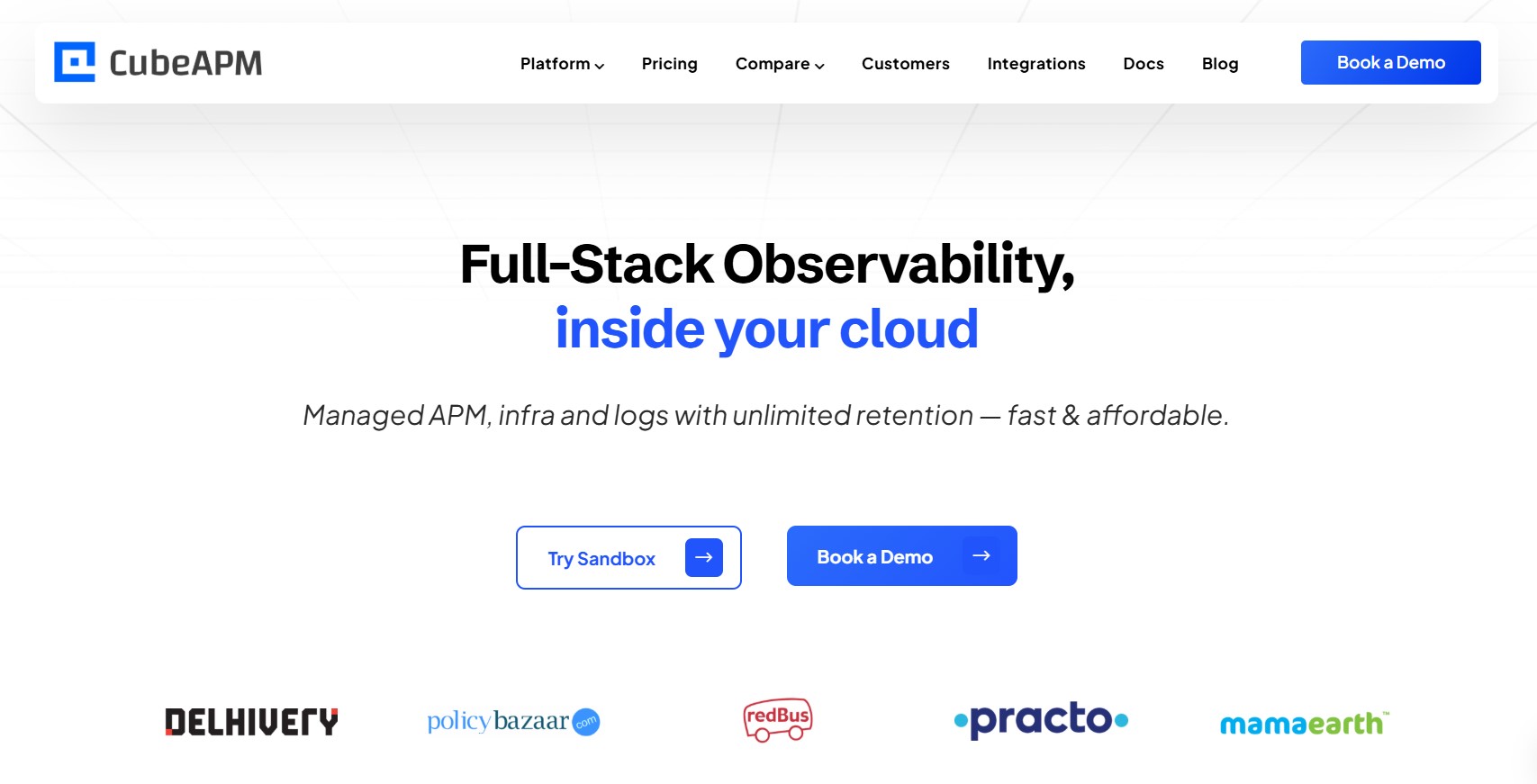
Image Source: CubeAPM
CubeAPM is a self-hosted, OpenTelemetry-native observability platform covering APM, logs, infrastructure, Kubernetes, RUM, synthetic monitoring, Kafka monitoring, and error tracking. Telemetry data never leaves your infrastructure – data sovereignty is the architectural default, not a paid tier or contractual add-on.
Named a High Performer in G2’s Spring 2026 APM Grid Report. Used by Policybazaar (insurance), Delhivery ($3.5B valuation, logistics), Mamaearth ($1.2B valuation), redBus (part of NASDAQ-listed MakeMyTrip), and Practo (healthcare) – several of which operate in regulated sectors.
Compliance Profile
- Data residency & Enterprise compliance: In regulated industries such as BFSI, healthcare, and government, data residency is often mandatory. Many SaaS monitoring vendors treat regional data control as a paid add-on or cannot guarantee it. CubeAPM’s self-hosted architecture ensures full control over data residency by design, while SOC 2 and ISO 27001 certifications demonstrate adherence to industry-recognized security and governance standards.
- Data Retention: No retention cliff or premium tier. Store telemetry in your own server for as long as compliance requires at the same per-GB rate.
- Third-party exposure: External systems process no telemetry data.
- Access control: SSO/RBAC available but less mature than enterprise SaaS incumbents – improving but worth evaluating against your compliance requirements.
- Cost predictability: Single dimension ($0.15/GB). Fully predictable for annual budget planning.
Pricing
$0.15/GB flat. No per-host, per-seat, or custom metrics fees. At 30TB/month: ~$5,100/month all-in. Delhivery documented 75% savings. Mamaearth: ~70% savings, migrated in under an hour. redBus: 4x faster dashboards, 50% faster MTTR.
Key Features
- Full-stack unified monitoring – APM, logs, infra, Kubernetes, Kafka, RUM, synthetics, error tracking
- OTel-native – no proprietary agents
- Multi-agent compatible – incremental migration from existing tools without re-instrumentation
- AI-based trace sampling
- Direct engineering support via shared channels
Pros
- Strongest data sovereignty posture – architectural, not contractual
- Unlimited retention at no additional cost – critical for compliance mandates
- 70-75% cheaper than enterprise APM – significant for organizations managing multiple compliance requirements
- No third-party data processing
Cons
- Requires internal infrastructure and deployment capability
- SSO/RBAC is less mature than enterprise SaaS – evaluate against your compliance requirements
- No autonomous anomaly detection
2. Datadog
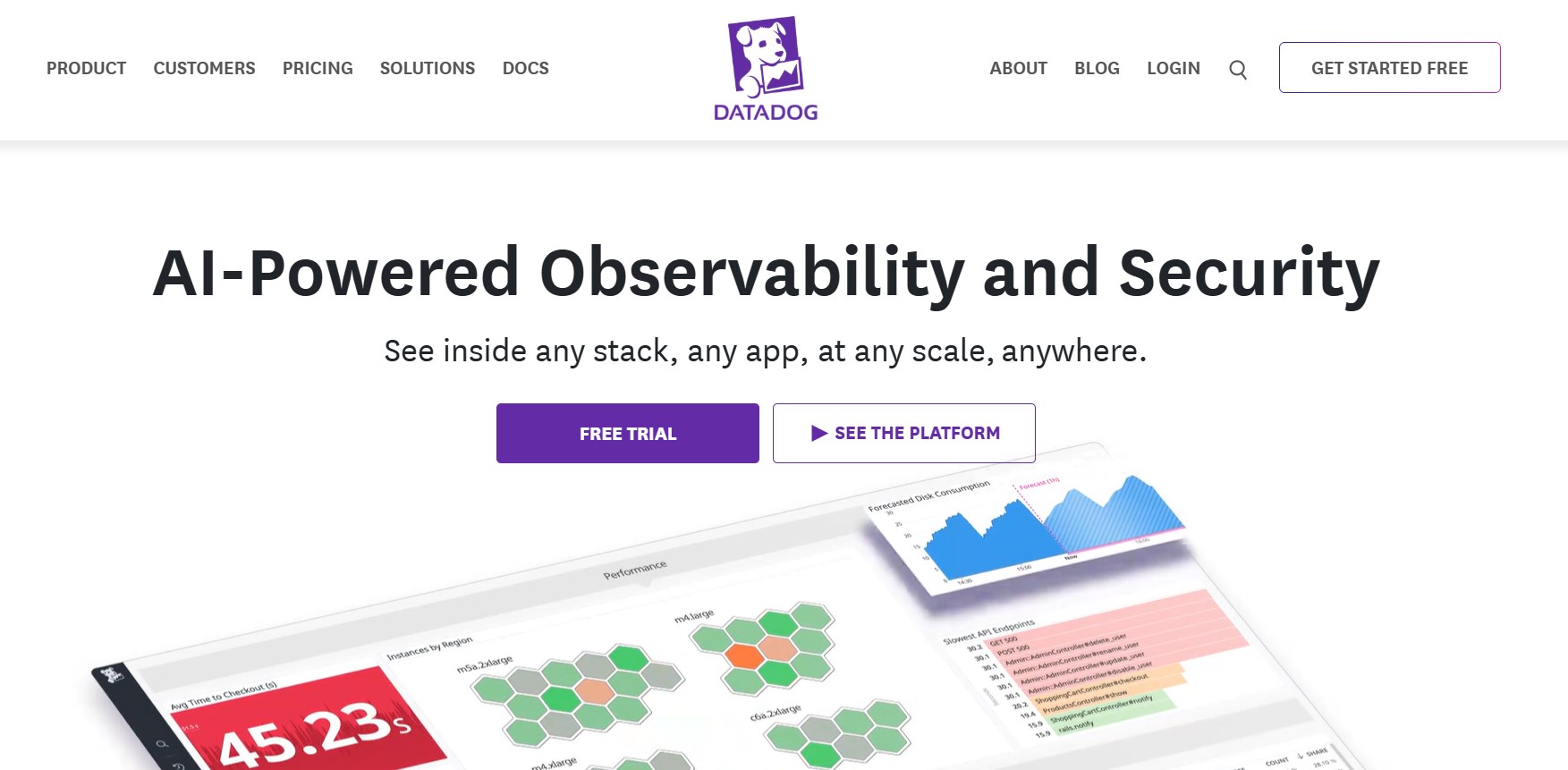
Image Source: Datadog
Datadog is the market leader with 700+ integrations and a polished platform. But it has no self-hosted option all monitoring data is sent to and handled in Datadog’s cloud. For regulated industries, this means compliance depends on contractual guarantees (BAAs, DPAs) rather than architectural control.
Compliance Profile
- Data residency: SaaS-only. Region selection is available, but Datadog processes data. No on-premises or BYOC option.
- Certifications: SOC 2 Type II, ISO 27001, HIPAA BAA available, FedRAMP Moderate (Gov Cloud).
- Retention: Limited to standard tiers. Extended retention adds cost.
- Third-party exposure: All telemetry processed by Datadog’s infrastructure.
- Access control: Mature SSO/RBAC, SAML, audit logs. Enterprise-grade access management.
Pricing
Multi-dimensional: hosts + custom metrics + log ingestion + log indexing + APM spans + RUM. Custom metrics = 30-52% of bill at scale. At 30TB/month: ~$30,000-$45,000+/month. Third-party calculators exist for modeling costs at scale.
Pros
- Best integration ecosystem and enterprise feature maturity
- Strong compliance certifications, including FedRAMP
- Mature SSO/RBAC and audit logging
- Watchdog AI for anomaly detection
Cons
- No self-hosted option – data sovereignty depends on contractual guarantees, not architecture (for teams that need architectural guarantees, self-hosted platforms like CubeAPM are worth evaluating)
- Multi-dimensional billing complicates annual budget planning.
- OTel metrics billed as custom metrics – adds cost for teams standardizing on open instrumentation.
- Extended retention adds high cost.
3. Dynatrace
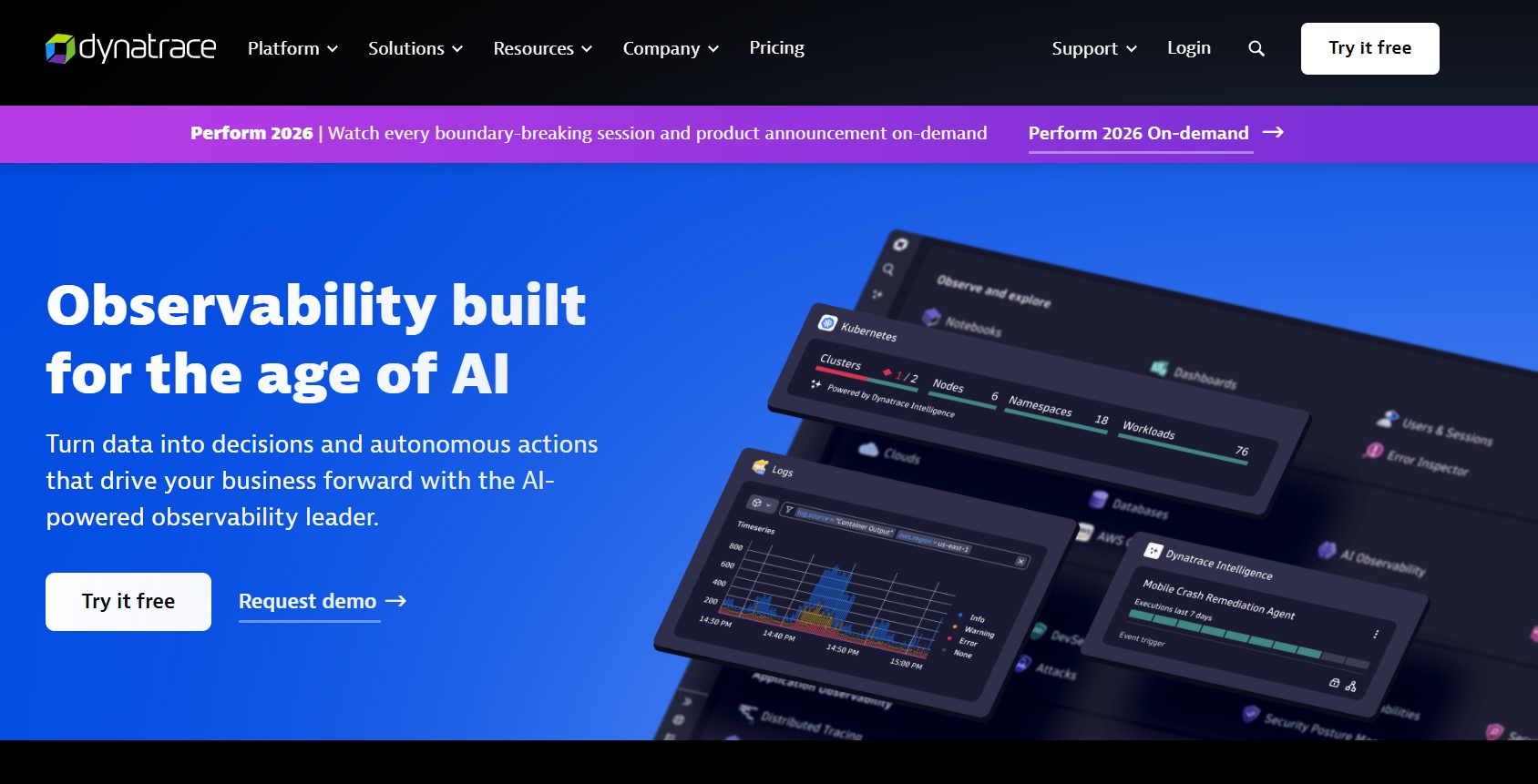
Image Source: Dynatrace
Dynatrace is unique among enterprise APM vendors in offering Dynatrace Managed – a full on-premises or BYOC deployment. For regulated industries that need Davis AI’s root cause analysis but can not send telemetry to an external cloud, this is the only enterprise-grade option that does not compromise on either capability or data control.
Compliance Profile
- Data residency: Dynatrace Managed keeps data on your infrastructure. The SaaS version offers region selection. Genuine self-hosted among enterprise vendors.
- Certifications: SOC 2 Type II, ISO 27001, FedRAMP High (SaaS), HIPAA eligible.
- Retention: Configurable, but retention costs add up via GiB-day pricing.
- Access control: Enterprise-grade SSO/RBAC, SAML, SCIM, audit logging. Most mature access control in this list.
Pricing
Consumption-based DPS with annual minimum (~$2,000/month). $0.08/hour per 8 GiB host, log ingest $0.20/GiB. 4 GiB minimum billing. At 30TB/month: ~$20,000-$35,000+/month
Pros
- Best automated root cause analysis (Davis AI)
- Genuine self-hosted option – rare among enterprise APM vendors
- Most mature SSO/RBAC and enterprise compliance features
- FedRAMP High certification
Cons
- Dynatrace Managed adds infrastructure cost on top of the license.
- Annual commitment required
- 4 GiB minimum billing for small containers
- Proprietary OneAgent creates vendor dependency.
4. New Relic
Image Source: New Relic
New Relic’s unified telemetry store and NRQL provide strong analytical capabilities. HIPAA eligibility and SOC 2 certification make it viable for some regulated use cases, but the SaaS-only deployment means data residency depends on contractual guarantees.
Compliance Profile
- Data residency: SaaS-only. US and EU region options. No self-hosted.
- Certifications: SOC 2 Type II, HIPAA BAA available, ISO 27001.
- Retention: 8-day default. 30/90 days via Data Plus at $0.60/GB – a 50% premium.
- Access control: SSO/SAML, RBAC, and audit logging available.
Pricing
$0.40/GB ingest + user fees ($49-$349/user/month). Data Plus $0.60/GB for extended retention. At 30TB/month: ~$20,000-$25,000+/month. Regulated industries typically need 90+ day retention. At Data Plus pricing, 30TB/month with 90-day retention: ~$18,000/month for data alone, before user fees.
Pros
- NRQL provides powerful ad-hoc analysis for compliance investigations
- HIPAA BAA available
- Good OTel support without custom metrics penalties
Cons
- SaaS-only – no data sovereignty guarantee by architecture
- 8-day default retention is inadequate for most compliance mandates
- Extended retention premiums increase TCO significantly.
- Per-user fees limit access; compliance teams may need read access without justifying the per-seat cost.
5. Grafana Cloud (LGTM Stack)
Image Source: Grafana Cloud
Grafana Cloud’s LGTM stack can be self-hosted at zero licensing cost, providing full data sovereignty for teams with the SRE capacity to operate it. The OTel-native architecture and absence of proprietary agents minimize vendor dependency. However, compliance certifications are less developed than those of established companies.
Compliance Profile
- Data residency: Self-hosted provides full sovereignty. Managed cloud offers region selection.
- Certifications: SOC 2 Type II for managed cloud. Self-hosted compliance depends on your infrastructure controls.
- Retention: 13-month metrics, 30-day logs/traces on Pro. Self-hosted: unlimited, you manage storage.
- Access control: SSO/RBAC available. Less enterprise-mature than Dynatrace or Datadog.
Pricing
$19/month base + usage. Logs ~$0.55/GB effective. Traces $0.50/GB. Metrics $8/1,000 series. At 30TB/month (managed): ~$15,000-$20,000+/month
Pros
- Self-hosted gives full data sovereignty at zero licensing cost
- OTel-native, no proprietary lock-in
- Adaptive Metrics/Logs reduce costs.
Cons
- Self-hosting at 30 TB requires significant investment in SRE.
- Enterprise compliance features are less mature than those in Dynatrace/Datadog.
- No built-in AI/ML anomaly detection
- APM is less mature than purpose-built tools
6. Elastic APM

Image Source: Elastic APM
Elastic APM’s self-hosted option provides data sovereignty for teams already running the Elastic Stack. The ML-based anomaly detection and log correlation are valuable for compliance monitoring. However, the 2021 SSPL licensing change requires careful review – some regulated environments have open-source compliance requirements that SSPL may not satisfy.
Compliance Profile
- Data residency: Self-hosted provides full sovereignty. Elastic Cloud offers region selection.
- Certifications: SOC 2 Type II, HIPAA, FedRAMP Moderate (Elastic Cloud).
- Retention: Self-hosted: unlimited, managed by storage tiers. Cloud: deployment-dependent.
- Licensing: SSPL since 2021 – review for compliance in environments with open-source mandates.
Pricing
Self-hosted free; Elastic Cloud deployment-based. At 30TB/month (Elastic Cloud): ~$8,000-$15,000/month
Pros
- Self-hosted keeps data on your infrastructure.
- Strong log + trace correlation for compliance investigations
- ML anomaly detection is useful for compliance monitoring.
- FedRAMP Moderate for cloud deployments
Cons
- SSPL licensing requires a compliance review for regulated environments
- Operational complexity at 30TB scale
- APM UX less polished than purpose-built tools like CubeAPM or Dynatrace
- Self-hosted support is available only to paid subscribers.
7. Splunk Observability Cloud
Image Source: Splunk Observability Cloud
Splunk’s greatest strength in regulated industries is its integration of observability and security (SIEM). For organizations where security events and performance data need to be correlated – SOC teams investigating incidents that span security and performance domains – Splunk is unmatched.
Compliance Profile
- Data residency: Limited for Observability Cloud (primarily SaaS). Splunk Enterprise (SIEM/logs) has self-hosted options.
- Certifications: SOC 2 Type II, FedRAMP High, HIPAA, ISO 27001. Strongest certification portfolio in this list.
- Security integration: Best-in-class SIEM + observability correlation.
- Access control: Enterprise-grade, mature RBAC, SSO, audit logging.
Pricing
$15/host/month base. APM and logs via enterprise contract. At 30TB/month: ~$35,000-$60,000+/month
Pros
- Strongest compliance certification portfolio
- Best security + observability integration for SOC/SRE convergence
- FedRAMP High – the highest certification level in this list
- Full-fidelity tracing
Cons
- Most expensive option – premium is justified only with the existing Splunk investment
- Observability Cloud is primarily SaaS, with stronger data sovereignty on the SIEM side.
- Significant vendor lock-in
- Deployment complexity
Cost Comparison of APM Platforms for Regulated Industries
| Tool | Cost @ 30TB/month | Data Residency | Self-Hosted |
| CubeAPM | $5,100 | Yes | Yes |
| Elastic APM | $8K–$15K | Yes | Yes |
| Grafana | $15K–$20K+ | Optional | Yes |
| New Relic | $20K–$25K+ | No | No |
| Dynatrace | $20K–$35K+ | Yes | Yes |
| Datadog | $30K–$45K+ | No | No |
| Splunk | $35K–$60K+ | Limited | Limited |
OTel metrics in Datadog are often billed as custom metrics. All estimates are based on the reference scenario above. Vendor discounts can reduce SaaS costs. Regulated industries should factor in extended retention costs (90-365 days), which significantly increase SaaS vendor pricing.
How to Choose for Regulated Environments?
Choosing between APM platforms for regulated industries depends on your priorities:
- CubeAPM: If full control over data and stable costs are top priorities. Built-in data location control with no contract talks, unlimited storage at fixed pricing, and the lowest cost at scale.
- Datadog: If your compliance framework accepts SaaS-based processing with contractual guarantees (BAA/DPA), and you need the broadest integration ecosystem. Budget for extended retention costs.
- Dynatrace: If you need strong compliance features and automatic root-cause analysis in a self-hosted setup. Dynatrace Managed is the best enterprise APM option for on-premises requirements.
- New Relic: if your compliance requirements are satisfied by SaaS with regional hosting, and you value NRQL for compliance investigations. Plan for Data Plus retention costs.
- Grafana Cloud self-hosted: If you have an SRE team and want full control of your data at no license cost, with easy vendor switching.
- Elastic APM: If you already use Elastic and want self-hosted monitoring, check SSPL licensing with your compliance needs.
- Splunk: If combining security and monitoring is the main goal, and your company already uses Splunk. It has the best compliance certifications in this list.
Final Thoughts
For organizations evaluating APM platforms for regulated industries, the decision ultimately comes down to control. Where does your telemetry data live? Who processes it? What happens to it when you need to prove compliance? The feature comparison matters, but it is secondary to these architectural questions. The market has shifted in favor of regulated teams. Self-hosted platforms now deliver full-stack observability with data sovereignty guaranteed by architecture, not by contract, not by region selection, not by paid add-on.
The cost advantage of these platforms (6-12x at scale) makes the compliance story even more compelling: you get stronger data control for a fraction of the price. For teams evaluating APM in regulated environments, the recommendation is to start with data residency as a hard filter, then evaluate cost and capability among the options that pass. The field narrows quickly, and the remaining choices are more straightforward than they appear.
Recommended Articles
We hope this comprehensive guide to APM platforms for regulated industries helps you make informed decisions around compliance, cost, and control. Check out these recommended articles for more insights and strategies to strengthen your observability and compliance framework.

