


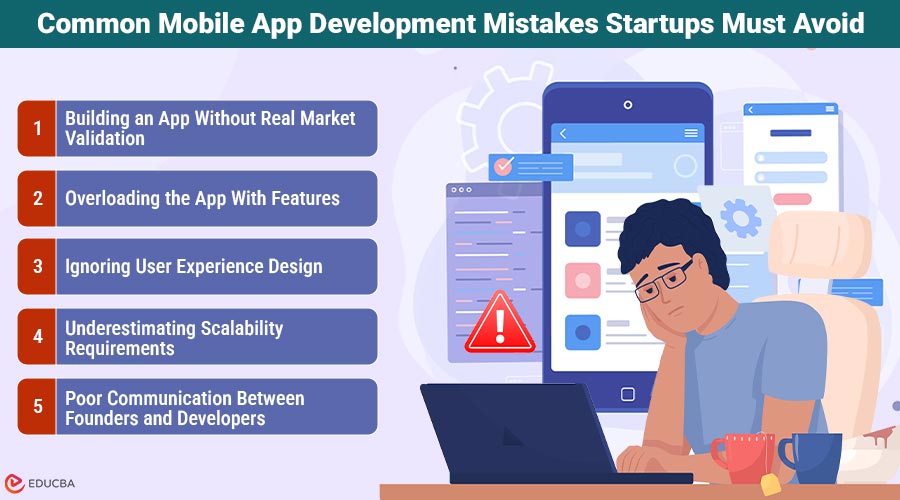
Mobile App Development Mistakes: Overview
The startup ecosystem moves fast. Product teams rush from idea to launch, investors demand traction, and founders often assume speed automatically translates to market success. Reality tells a harsher story: most mobile apps fail long before they reach meaningful adoption. A major reason lies in avoidable execution errors. Startups frequently underestimate the complexity of building, scaling, and maintaining mobile software. That gap in understanding often drives founders to seek guidance from mobile app development companies that have successfully navigated the challenges of launching real products. The difference between a successful product and an abandoned one rarely comes from the idea itself; it comes from how the team builds the product. Avoiding key mobile app development mistakes can dramatically improve the chances of success.
Common Mobile App Development Mistakes Startups Must Avoid
Key mobile app development mistakes startups face and how to avoid them:
1. Building an App Without Real Market Validation
Startups love bold ideas. Investors appreciate vision. Markets, however, reward solutions to real problems. One of the most destructive mistakes founders make is building an application before validating user demand. Teams spend months developing features only to discover that their audience never needed the product in the first place. The correct approach is brutally simple: validate first, build second. That validation process usually involves:
- Customer interviews
- Landing page testing
- Prototype feedback loops
- Early beta communities
Skipping this stage leads to wasted capital and development cycles. Experienced Mobile App Development Companies frequently encounter startups that arrive halfway through development only to realize their product lacks clear user demand. Fixing that problem later becomes dramatically more expensive.
2. Overloading the App With Features
Founders often believe their application must launch with dozens of features to compete with established platforms. This mindset creates a bloated product that is expensive to build and difficult to maintain. A successful startup app typically launches with a Minimum Viable Product (MVP). The MVP approach focuses on delivering one core solution extremely well rather than many features poorly. Early versions of Instagram, Uber, and Airbnb followed this exact philosophy. Feature overload introduces multiple problems:
- Longer development timelines
- Higher infrastructure costs
- Increased bug complexity
- Confusing user experiences
Simplification wins early-stage markets. Mature platforms can afford complexity. Startups cannot.
3. Ignoring User Experience Design
A powerful backend means nothing if users struggle to interact with the interface. UX design mistakes quietly destroy app retention. Confusing navigation, cluttered screens, and slow loading times these issues frustrate users within seconds. Users rarely provide feedback when they encounter poor design. They simply uninstall. Modern mobile users expect frictionless experiences.
Clear layouts, intuitive flows, and responsive performance are not luxury features; they are baseline expectations. Top Mobile App Development Companies now integrate UX research into the development cycle from the earliest planning stages. Wireframes, usability testing, and prototype feedback loops ensure that real users guide design decisions. Skipping UX validation almost always results in poor engagement metrics after launch.
4. Underestimating Scalability Requirements
Early traction creates a different problem: growth. Many startups build their first version of an app without considering scalability architecture. The platform functions perfectly with a few hundred users. Then traffic spikes. Suddenly, servers crash, APIs fail, and the application becomes unstable. This pattern is common among early-stage technology companies. Scalable infrastructure requires careful planning, including:
- Cloud architecture design
- Load balancing systems
- Database optimization
- Microservice deployment strategies
Startups that partner with experienced mobile app development companies typically avoid these pitfalls by embedding scalability planning into the development roadmap from the start. Ignoring scalability is manageable when user numbers are small. Once growth arrives, technical debt becomes painfully visible.
5. Poor Communication Between Founders and Developers
Another common issue emerges from communication gaps between founders and development teams. Founders often explain product ideas conceptually. Developers require precise technical requirements. When this communication fails, development teams end up building something entirely different from what the founder envisioned. The result is wasted time, additional revisions, and inflated budgets. Effective mobile product development requires clear documentation, such as:
- Product requirement documents (PRDs)
- Feature roadmaps
- Technical architecture outlines
- Sprint planning frameworks
Professional Mobile App Development Companies rely heavily on structured documentation to ensure founders, designers, and engineers remain aligned throughout the development process. Without this structure, misunderstandings multiply quickly.
6. Neglecting Marketing and App Store Visibility
Many startups assume that once their app launches, users will automatically discover it. Unfortunately, app marketplaces contain millions of applications competing for attention. Visibility requires strategy. Startups must invest in App Store Optimization (ASO), digital marketing campaigns, and organic growth channels to attract early users. Search visibility also plays a role in discovery.
The vast world of SEO can seem complex, but SEO tools and an expert seo agency in Yorkshire can make it easier to navigate. Combining SEO with app marketing strategies can significantly improve visibility, especially when startups publish educational content around their product’s core problem. Ignoring marketing until after launch often leaves great products buried under better-promoted competitors.
7. Failing to Plan Long-Term Maintenance
Launching an app represents only the beginning of its lifecycle. Mobile operating systems evolve constantly. Security vulnerabilities emerge. New devices introduce compatibility issues. User expectations shift. Applications require continuous updates and monitoring. Startups that fail to budget for post-launch maintenance frequently face serious problems within months. Bugs accumulate. Performance declines. User reviews turn negative. Sustainable development includes:
- Regular security updates
- Performance monitoring
- Feature improvements
- OS compatibility testing
Reputable Mobile App Development Companies typically include long-term support plans in their development packages to ensure the product continues to operate smoothly after launch. Ignoring maintenance essentially guarantees technical decline.
Final Thoughts
Mobile app success rarely depends on a single breakthrough feature; execution determines everything. Startups that rush development, ignore validation, or neglect scalability often see even great ideas fail under poor implementation. Building a reliable product requires:
- Technical expertise
- User-centered design
- Long-term planning
This is why many early-stage companies collaborate with Mobile App Development Companies that understand the full product lifecycle—from concept validation to post-launch optimization. Some startups also explore ready-made multi-service solutions, like a Gojek clone, to accelerate development while ensuring scalability with a proven app framework. In the competitive mobile ecosystem, avoiding these common mobile app development mistakes can mean the difference between an app that quietly disappears and one that becomes a lasting platform.
Recommended Articles
We hope this guide to common mobile app development mistakes helps you build better startup applications. Check out these recommended articles for more insights and strategies to avoid costly app development errors.


