


Updated August 12, 2026
Best AI Detectors for College Professors
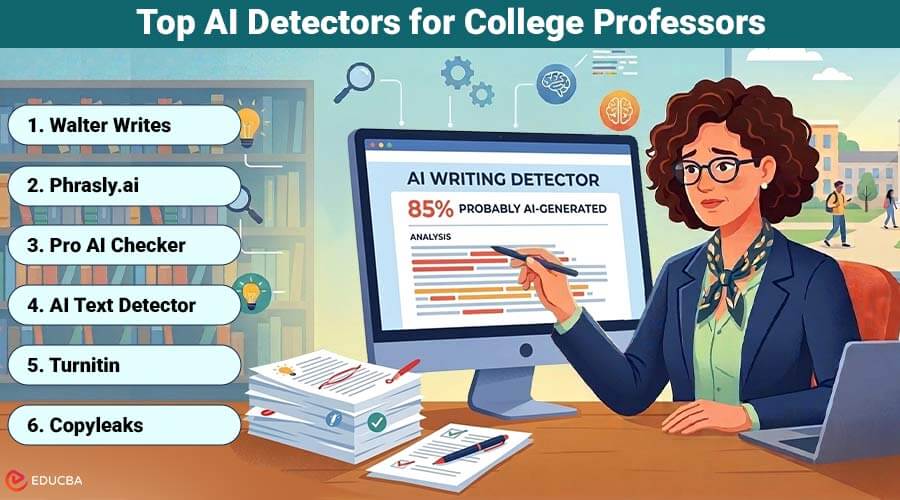
College instructors are facing a growing challenge in identifying AI-generated assignments. As AI writing tools become more advanced, students can generate essays, research summaries, and even technical reports that closely resemble human writing. Because of this, AI detectors for college professors have become essential for maintaining academic integrity.
Beyond just detection is the issue of assignment. These are students who understand academic style and writing conventions, know what academic writing should look like, how to properly cite sources, and how AI-generated documents affect the ease of proper identification. Some of your students might even be getting savvy and strategically using AI-generated answers in their assignments as bases before heavily editing them to make detection a headache.
Understanding Detection: College-Level Work
Detection of materials at the college level is a different animal from K-12 detection. The writing is better, the arguments are sharper, and the stakes are much higher when you misidentify someone and falsely accuse a student of cheating. A false positive not only can ruin a student’s academic career but also affect their career choices in the future and even hold you legally or before the administration to justify the grade you gave them. Detection tools analyze patterns in the material, which differ depending on whether a man or a machine wrote it. Essentially, they analyze vocabulary usage, variation in sentence structure, and related patterns.
AI writing, even good writing, produces statistical patterns that differ subtly but importantly from those of human writers. College-ready detectors need to detect discipline-specific writing, from STEM lab reports to humanities critical analyses to social science research papers. They need to keep in mind that college students are good writers whose work will naturally include the sophisticated language that good writers use, which can create false positives in less sophisticated detectors.
How AI Detection Tools Were Evaluated?
Researchers examined various types of academic writing to assess the performance of different tools. The evaluation included undergraduate and graduate-level assignments across multiple fields.
Examples of test materials included:
- Research papers
- Literature reviews
- Case studies
- Lab reports
- Thesis chapters
Testing also covered writing produced by students at different academic stages, from first-year undergraduates to PhD candidates.
Particular attention was given to how each tool handled:
- Technical terminology
- Academic citations
- Discipline-specific language
- Highly structured arguments
The evaluation favored AI detectors for college professors that provide probability scores instead of simple yes/no results, since academic writing often requires more nuanced analysis. Additional factors considered included system integration, processing speed, and pricing.
Summary of Top AI Detectors for College Professors
| Detector | Key Strength | Pricing | Best Use Case |
| Walter Writes | Cross-discipline accuracy | Free basic + premium | Various college assignments |
| Phrasly.AI | Detect + humanize in one tool | Free basic + premium | Essays, assignments, content writing |
| Pro AI Checker | Sentence-level AI detection | Free + premium | Detailed AI content checks |
| AI Text Detector | No sign-up required | Free | Quick first-pass checks |
| Turnitin | Institutional integration | University licensing | Institutions already using Turnitin |
| Copyleaks | Multi-language detection | Subscription/credits | Multilingual classrooms |
| GPTZero | Free detection access | Free + premium | Budget-conscious educators |
| Grammarly | Writing assistance + detection | Premium subscription | Existing Grammarly users |
| Originality.AI | Edited AI content detection | Pay-per-use credits | Occasional detection needs |
Top AI Detectors for College Professors
Here are the detectors that work for the complexity of college work. College professors need this flexibility because homework assignments change considerably across disciplines, course levels, and instructional objectives.
1. Walter Writes
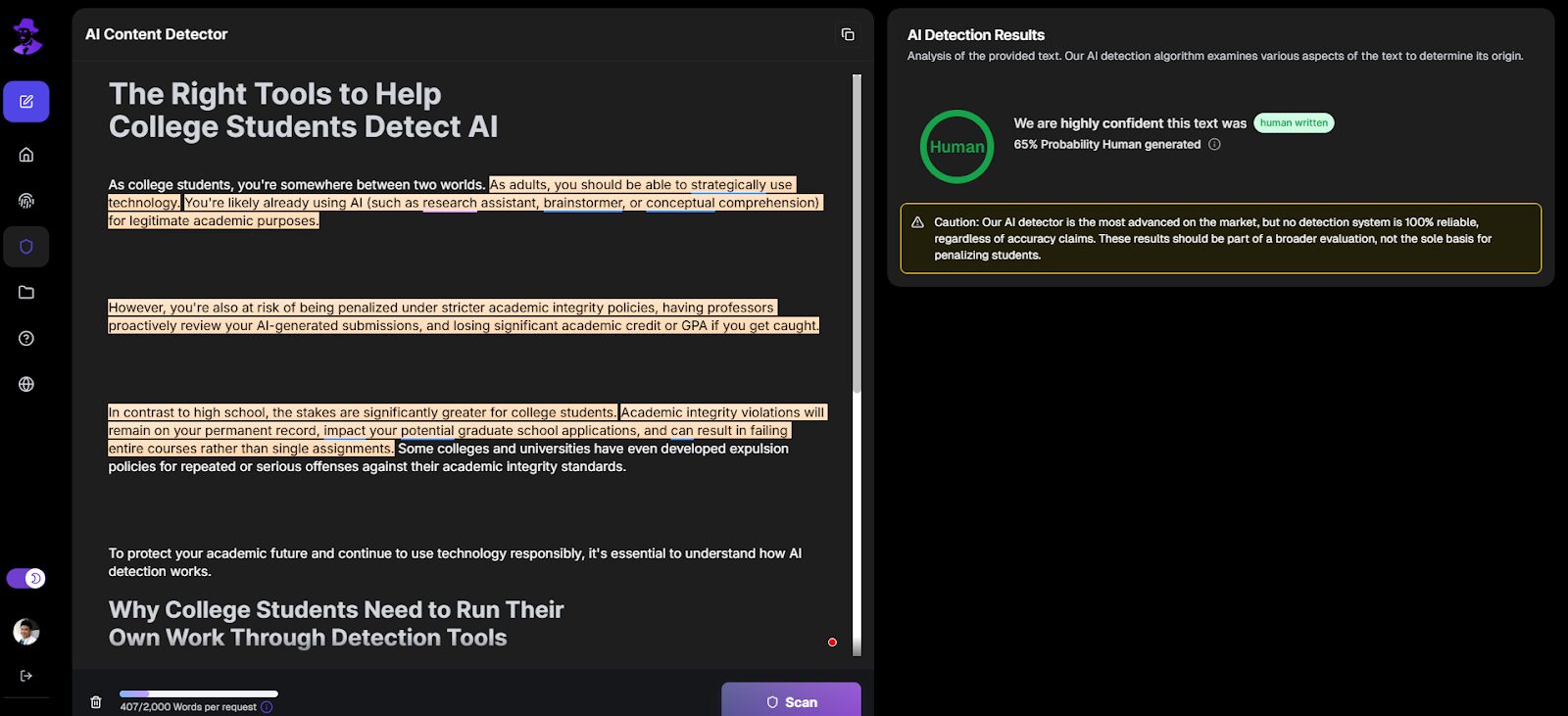
Image Source: Walter Writes
The AI detector for teachers decomposes text to identify markers of AI authorship, focusing on sentence structure, word choice, argument types, and style. Engineers designed it to avoid falsely flagging sophisticated human writing as AI-generated, a mistake many popular detectors still make even with strong sentences. Walter Writes also provides detailed percentage scores for the AI likelihood score by paper subsection, so you can pinpoint what triggered the detection, which is useful in cases where a student may use AI for one paragraph and write the next.
The detector handles long-form academic writing well. Send it a 20-page research paper or a brief response essay. The algorithms consider the length or density of passages. Processing is speedy, and results return in seconds, no matter the size of your document. It is free for basic access, so you can use it on student homework papers without needing department budget approval. Premium features include batch processing for checking multiple papers at once and LTI integration, so you can plug it right into a learning management system. The interface is friendly and requires little specialized knowledge or training.
- Best for: Professors looking for accurate detection across disciplines in college assignments
- Specialty: Reliable across virtually all writing types and subjects
- Cost: Free for basic, premium pricing available
2. Phrasly.AI
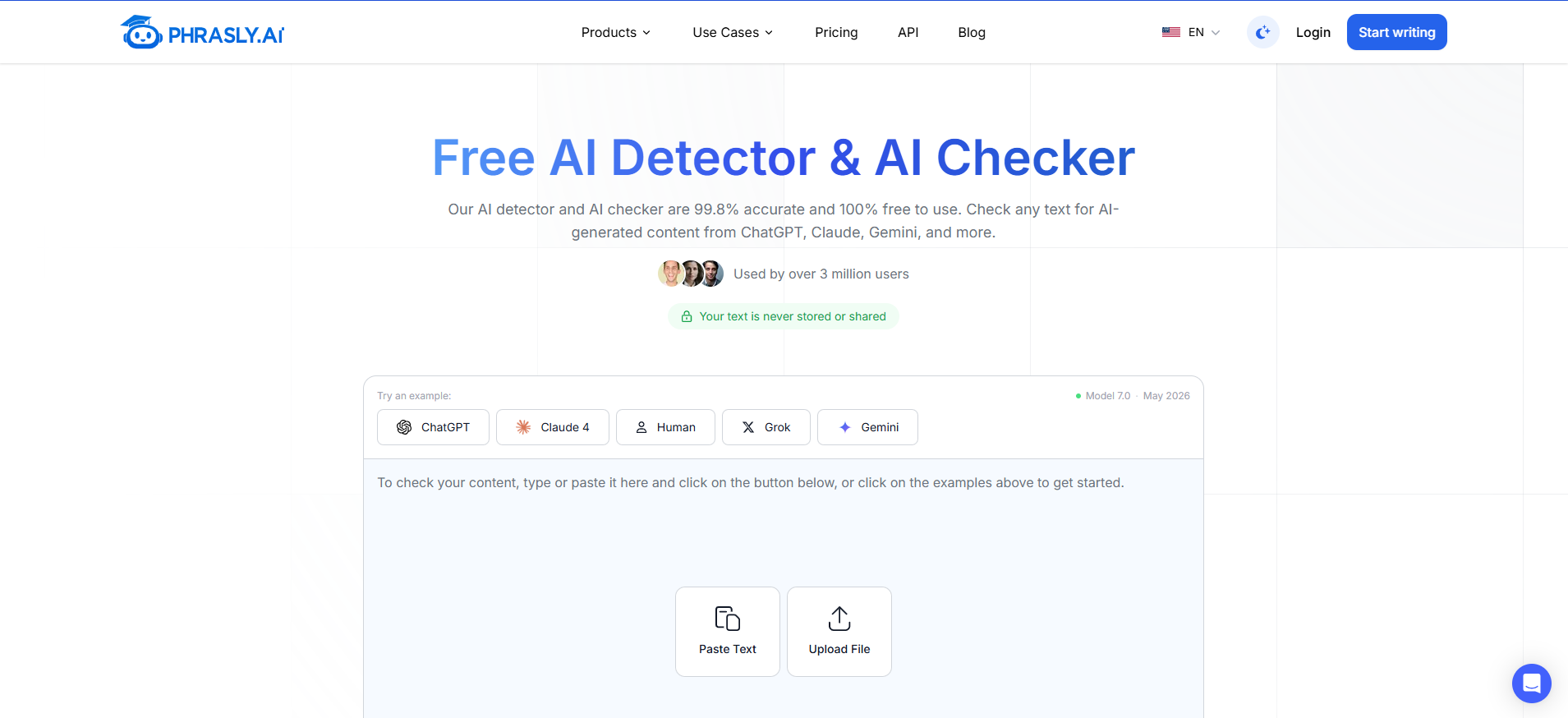
Image Source: Phrasly.AI
Phrasly.AI sits at the top of this list because it does something most standalone AI detector tools do not: it helps users detect AI text and then immediately improve it within the same platform. Rather than simply flagging AI-generated content and leaving students or writers to figure out the next step, Phrasly combines detection with an integrated humanizer built on proprietary models trained on real human writing. The detector itself achieves 99.8% accuracy and scans up to 2,000 words per check, covering outputs from GPT-4, Claude, and Gemini with consistent results across testing in 2026.
What separates Phrasly from tools like GPTZero or Originality.ai is the workflow it enables. A student can paste a draft, get an instant AI score, and humanize the flagged sections without switching platforms. That end-to-end experience reduces friction significantly for users who are not just auditing content but actively improving it. The free trial is available without a credit card, and paid plans start at a flat monthly rate rather than a per-credit model, making costs predictable for regular users.
The one limitation worth noting is that Phrasly’s detector is optimized for text content. It does not currently support image or code scanning, which may matter for technical or STEM-focused use cases.
- Covers: GPT-4, Claude, Gemini, and most major LLM outputs
- Sentence-level scoring: Yes
- Free tier: Yes (up to 300 words)
- Best for: Students and content creators who want to detect and fix AI writing inside a single, unified platform
3. Pro AI Checker
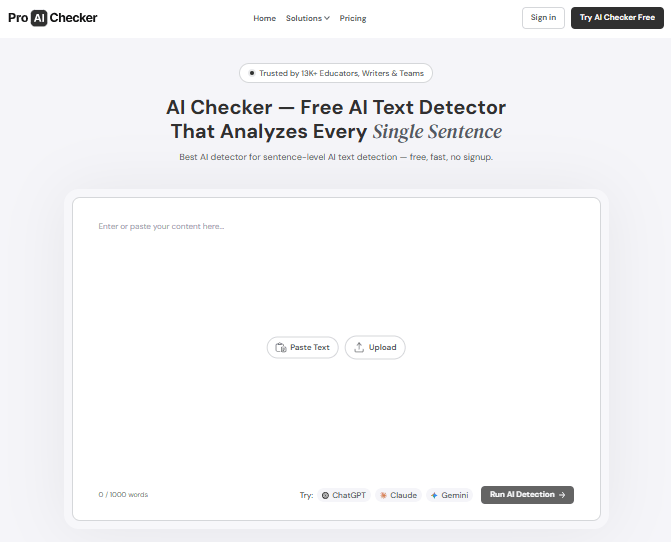
Pro AI Checker is an AI text checker designed to help professors, educators, writers, and content creators review written content for potential AI-generated patterns. It provides a straightforward way to analyze text and identify sections that may need closer human review, which can be useful when evaluating college assignments, essays, research papers, and other academic content.
The tool can be used as an initial screening step before making any conclusions about a student’s work. Instead of relying on a detection result alone, educators can use the insights alongside writing style, assignment history, and other evidence to make a more informed assessment. This approach is especially useful in academic environments where false positives can have serious consequences.
- Best for: Professors and educators who need a straightforward AI text checker for academic content
- Specialty: Quick AI content analysis for essays, assignments, and other written materials
- Cost: Free and paid options available
4. AI Text Detector
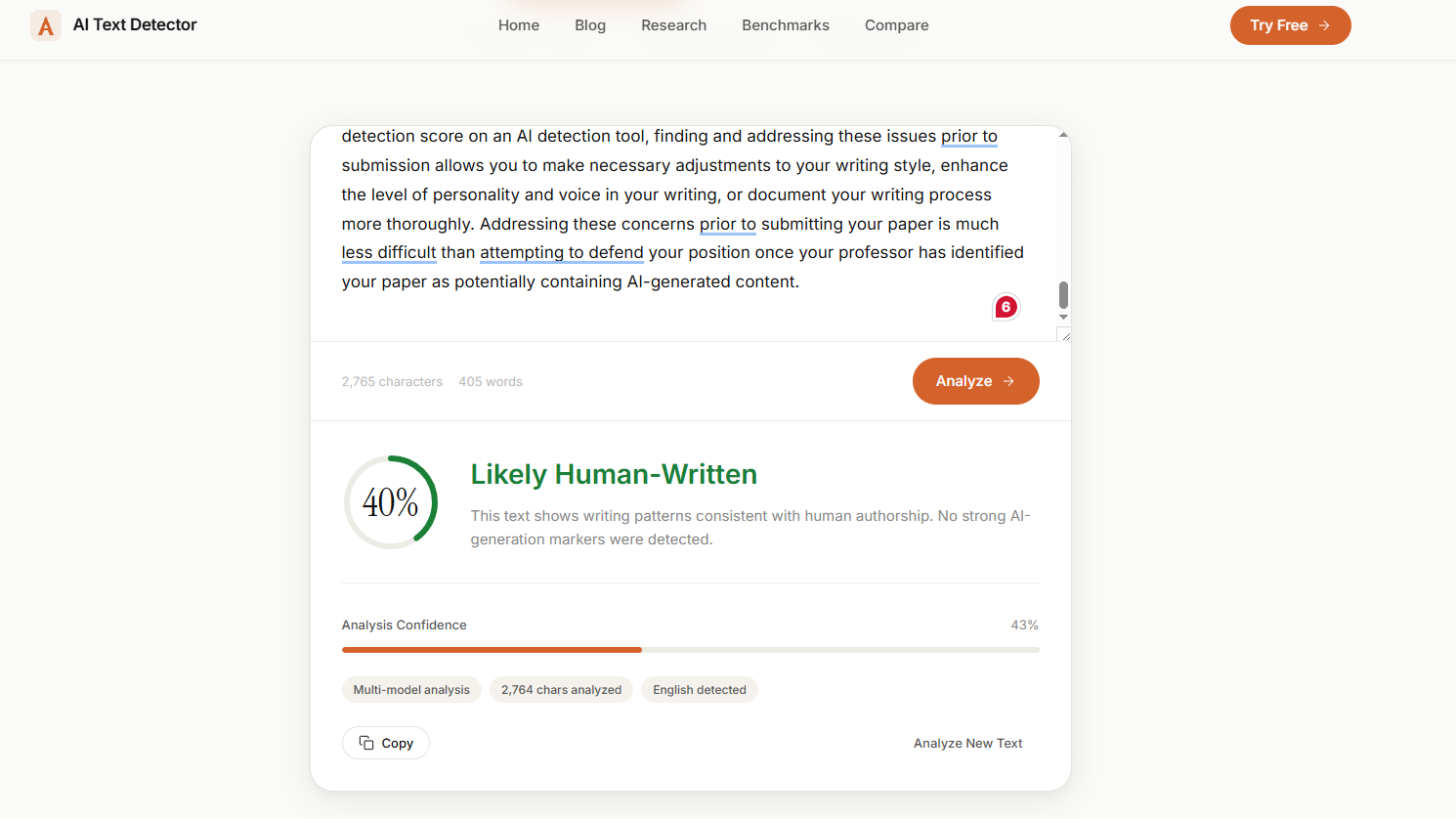
Image Source: AI Text Detector
AI Text Detector is a free tool available at aitextdetector.ai that requires no account or sign-up. Paste up to 50,000 characters of text and receive an immediate detection result. That character ceiling is generous enough to handle most undergraduate and graduate papers without truncation. For professors who want a fast, no-friction supplementary check before a more detailed review, it is a useful resource.
The absence of any registration barrier also makes it practical in institutional settings where procurement or IT approval for new tools can be slow. There is no onboarding, no subscription to manage, and no data entry beyond the text itself. Like any free tool, you should use it as one data point in a broader review process rather than as a standalone verdict. But for what it is, the accessibility and generous input limit make it worth keeping in your toolkit.
- Best for: Professors who need a fast, no-barrier first-pass check
- Specialty: Free, no registration, 50,000-character limit
- Cost: Free
5. Turnitin
Image Source: Turnitin
Turnitin remains the gold standard for plagiarism detection, and its AI detection leverages that infrastructure in the era of generative AI. Universities that already use Turnitin can enable AI detection as a simple add-on without additional integration work. Turnitin generates comprehensive reports identifying both traditional cases of copied content and AI-generated sections. It is all there in black and white, so you can do what is right if you have to go to infraction hearings or grade appeals.
Reports are detailed and may include the kind of documentation you need to address serious academic infractions. Turnitin integrates with Canvas, Blackboard, and Moodle, allowing students to submit work through the same channels they already use. Professors automatically see AI detection reports, in addition to plagiarism checks. No extra steps for anybody. Of course, institutional access is the biggest obstacle. Individual professors can not just subscribe to Turnitin. Your university must purchase licensing for the entire institution or department, and that must be approved and budgeted. If your university subscribes to Turnitin, it generally includes AI detection at no extra cost.
- Best for: Professors at institutions with existing Turnitin infrastructure
- Specialty: Detailed reporting, comprehensive integration with university systems
- Cost: Institutional licensing
6. Copyleaks
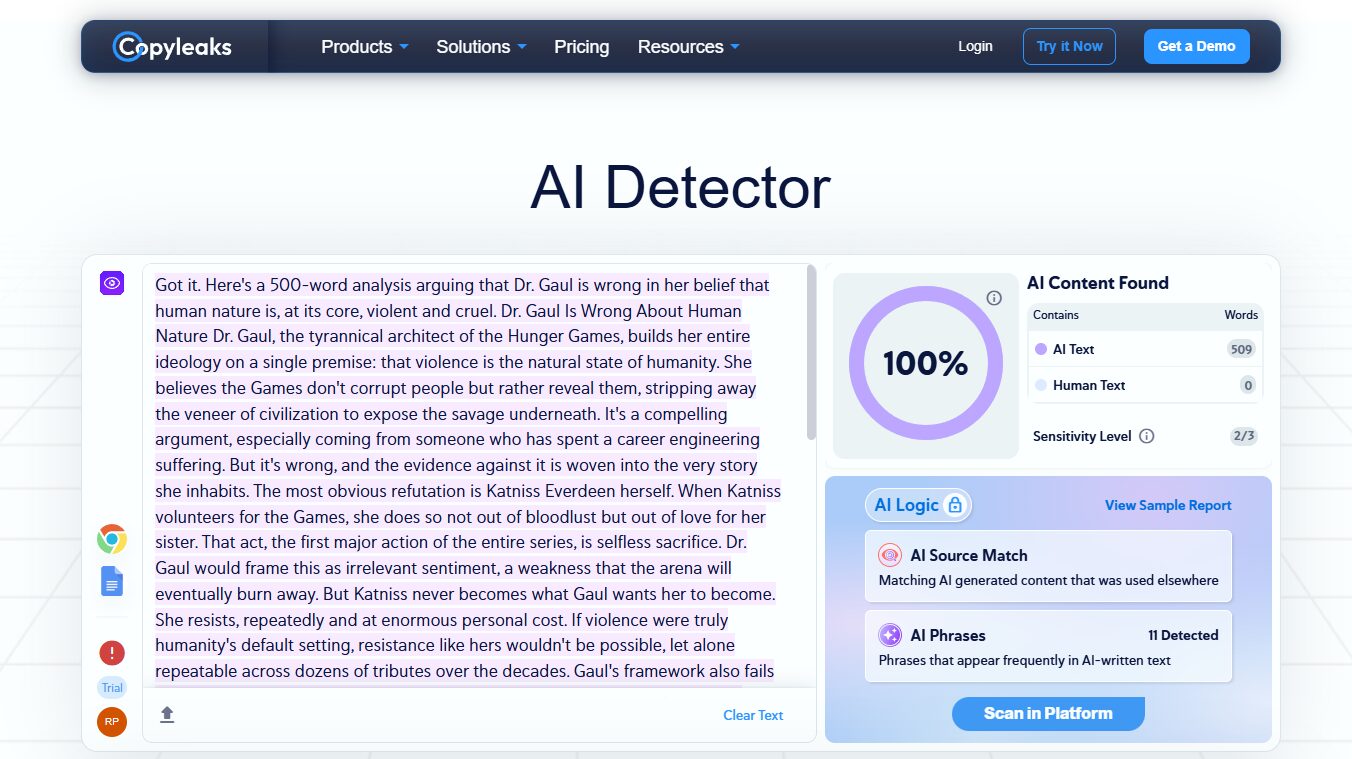
Image Source: Copyleaks
Copyleaks offers accessible, effective AI detection across more than 30 languages, making it ideal for professors teaching in multilingual settings or for those with international students. The platform can review writing in languages including Spanish, French, Mandarin, and Arabic. The system distinguishes AI-generated content from the natural patterns that appear in writing by non-native speakers, which matters because international students may use language that seems unusual to native speakers but is still human.
Copyleaks provides percentage-based AI probability scores, along with highlights of the sections that triggered it. They handle both plagiarism and AI, combining for a dual-use tool to protect academic integrity. You upload files or copy and paste text. Results are quick regardless of language or document length. You will be charged based on the number of pages that you scan. Each is charged separately, with subscription options or pay-as-you-go credits. For professors whose programs have large numbers of international students or who teach department courses in different languages, it is well worth the price.
- Best for: Professors with multilingual students or who teach in languages other than English
- Specialty: Detecting in several languages and remaining sensitive to non-native writing patterns
- Cost: Subscription or credit-based pricing
7. GPTZero
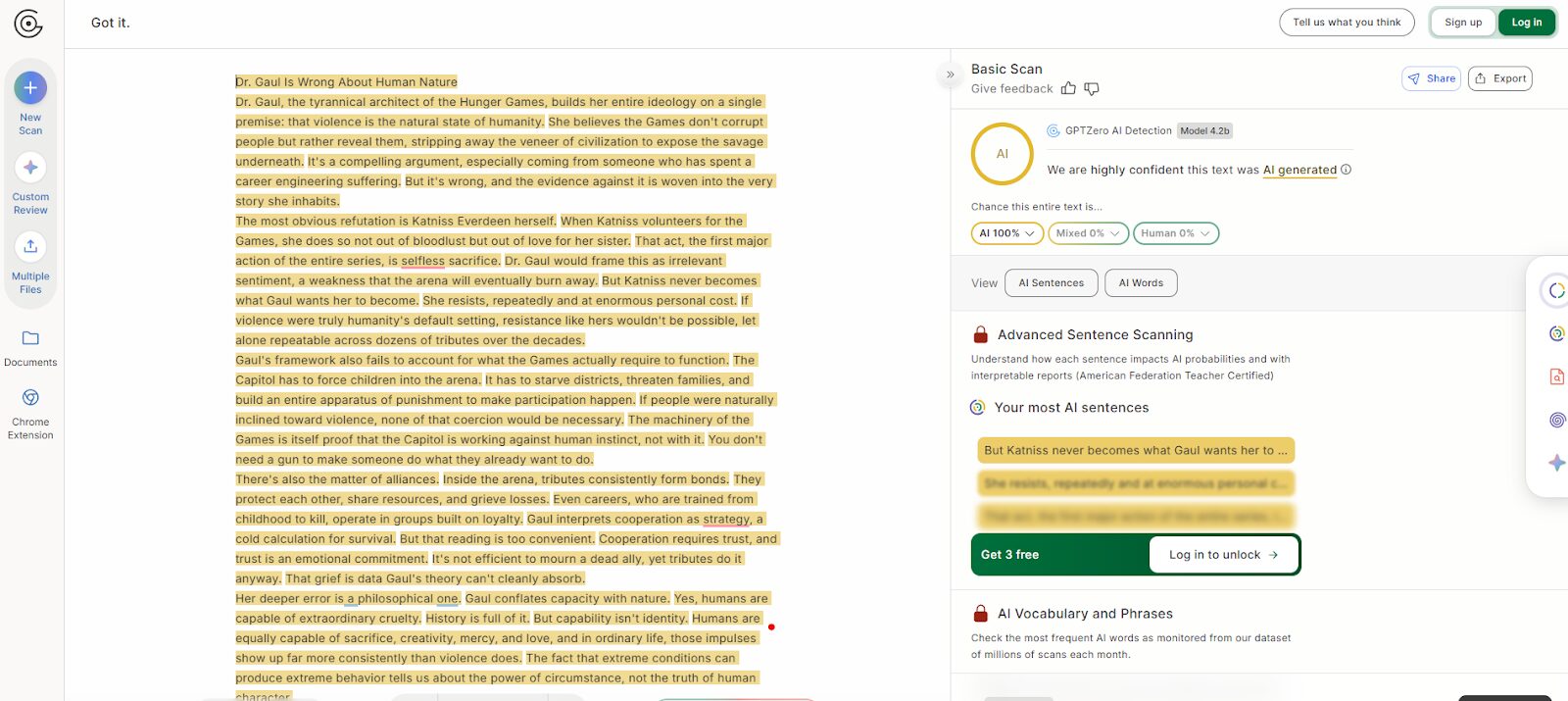
Image Source: GPTZero
Developers designed this platform solely to detect outputs from ChatGPT and similar large language models. Completely free for basic use, the platform eliminates budget constraints as a common obstacle to professors installing them. The process is simple. You just paste text or upload a document, and GPTZero looks for patterns in line with AI being present. The system provides document-level and sentence-level scores so you can see what was flagged and what appeared human.
GPTZero is very popular AI detector among teachers and students that performs well on larger chunks of academic prose, including research papers, literature reviews, and long essays that are sufficiently rich in text for its tools to analyze accurately. Very short answers make things difficult, as can highly technical writing with lots of specialized words, but for most papers, you should get solid accuracy. The free version offers basic detection but has limitations on processing speed and file size. Premium options for educators help speed up this process by letting professors batch-process files and receive API access to roll out detection into a custom workflow or tool. Many professors report that the free version is enough for most use.
- Best for: Professors who want reliable, free AI detection and who do not need their college to approve their tools
- Specialty: No cost barrier and picks focused specifically on ChatGPT
- Cost: Free basic version, paid premium options available
8. Grammarly
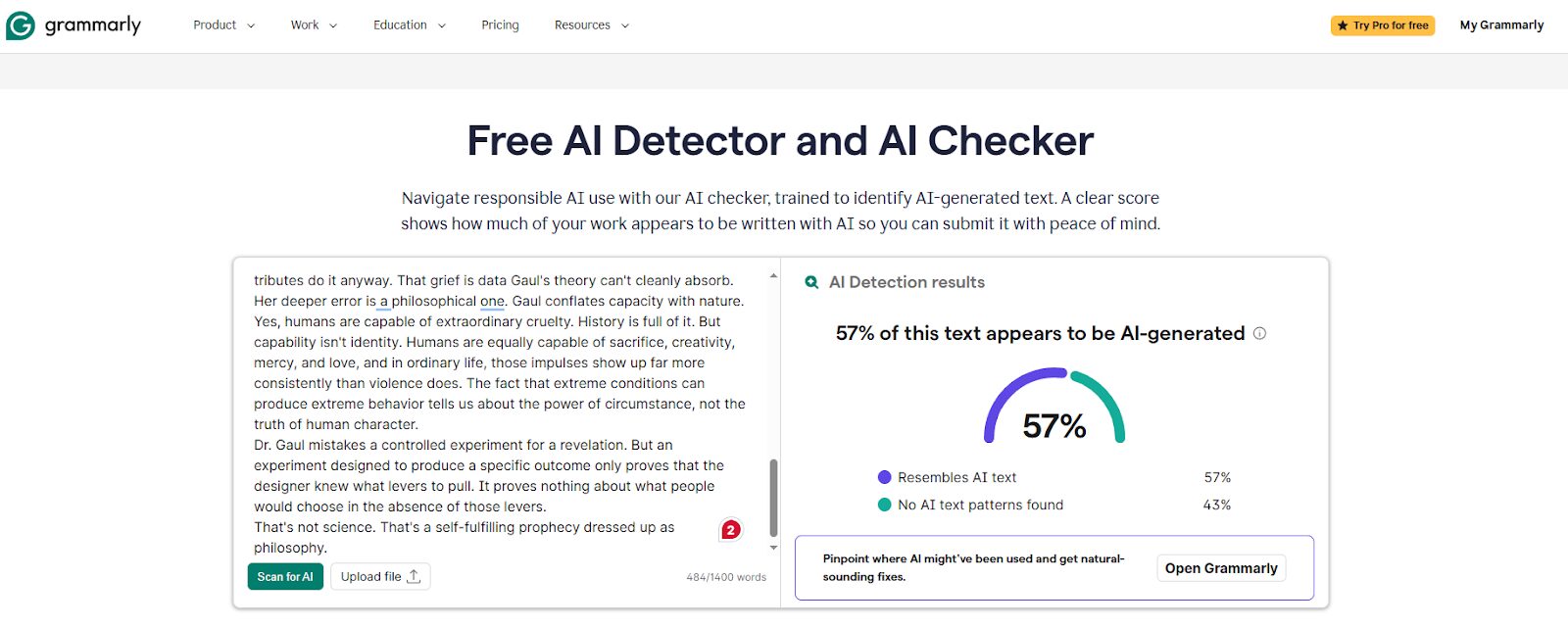
Image Source: Grammarly
Grammarly’s AI detector is not a separate tool you can access. It is attached to Grammarly’s whole toolset as an add-on to their writing assistance app, so if you already use Grammarly to provide feedback on student writing or for your own writing, having the AI detection feature in there makes this tool more convenient. Their detector analyzes text for signs of AI-generated content. It clearly tells you if the text seems human or AI-created. Because Grammarly is all about understanding writing quality, its detector considers how that relates to context rather than focusing solely on detection.
You will need a Grammarly Premium subscription for full AI detection. If you are already paying for the premium version to offer benefits to your students, that is just more value. If you have only been using the free version, you will have to decide whether AI detection is worth the cost of a subscription. Grammarly plugs into web browsers, Google Docs, Word, and other word processing applications so that you can check your content right where you already work. The interface will be a familiar sight for many students and professors, and the learning curve will be pretty low.
- Best for: Professors who already have Grammarly Premium for writing and feedback
- Specialty: Full writing assistance combined with a good AI detection tool
- Cost: Requires Grammarly Premium
9. Originality.AI
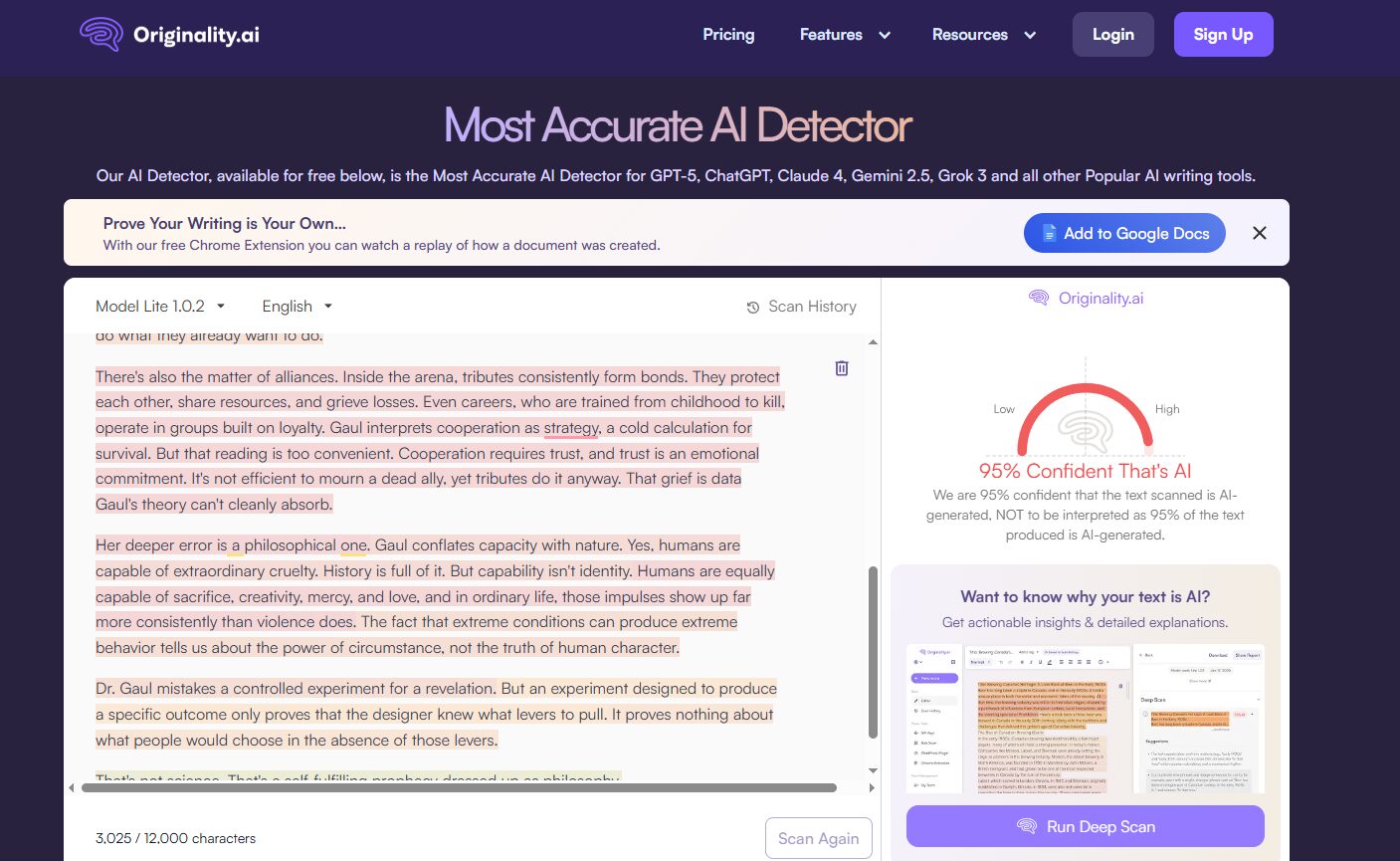
Image Source: Originality.ai
Developers did not specifically market this tool to the academic sector, but they designed it for content creators and publishers to detect AI-generated content. It works surprisingly well for academic prose and essays, and it is useful for content publishers. This tool detects AI-generated text that attempts to evade detection through sophisticated editing, making it useful for identifying such attempts in academic work. They will give you a report that shows you the probability, by percent, that the text is AI-generated, plus documents that highlight parts of the writing they think could be AI-generated. It helps detect AI-generated content that has gone undetected, so it does a good job of checking content that college students are trying to submit.
They use a credit system: you buy credits to scan content, so if you only want to check a paper here and there, this might be more economical than paying a monthly fee. They also offer plagiarism detection and a lot of other services, so this can be a good tool for general integrity checking. The interface is nice and really fast. You paste the text directly, or submit a document and get results basically instantly. They handle long documents well, for example, if you want to submit a chapter of your thesis or dissertation, or a long report or paper.
- Best for: Professors who want to be able to detect papers on a pay-per-use basis
- Specialty: Makes it easy to detect edited or modified AI works
- Cost: Credit-based, pay-as-you-go for full services
Before You Start Detecting
Before you start detecting, consider asking yourself the following questions:
1. Does your institution have any policies regarding the use of AI in coursework?
Before you implement detection tools, it would be helpful to understand the difference between acceptable AI assistance and academic dishonesty according to your institution. There is significant variability across institutions, so ensure your detection practices comply with your institution’s standards.
2. Are you prepared to have potentially difficult conversations with students based on the results of a detector?
Detection is most successful when the detection tool’s results prompt action. Plan how you will address flagged student work and determine what additional evidence you will require beyond the detector score.
3. Can you articulate clearly in your syllabus what constitutes acceptable and unacceptable AI usage?
Students should be aware of your expectations before they begin working on their assignments. Ambiguous restrictions on AI use are less likely to deter cheating than clearly articulated rules on acceptable and unacceptable usage.
4. Do you have enough time to review individual papers, or do you need to process large batches of papers?
Some detection tools allow you to upload multiple papers at once, whereas other detection tools require that you review each paper individually. Ensure the detection tool’s capabilities align with your workflow.
Limitations of AI Detection Tools for Educators
1. Accuracy and False Positives
All of the tools listed here return probability scores, not conclusions. The best AI detectors report accuracy rates in the 85-95% range, which means even under ideal conditions, a meaningful share of results will be wrong. At the college level, where students are writing sophisticated, well-structured arguments, the risk of false positives is higher than in simpler writing. Discipline-specific language, formal academic tone, and logical organization are all characteristics shared by strong student writing and AI-generated writing. A first-generation college student who has worked hard to master academic conventions may produce writing that a detector mistakenly flags as suspiciously polished.
2. Who is Most Affected
Students from non-Western educational backgrounds, multilingual students, and neurodivergent writers are all at elevated risk of false positives. Students trained in structured or formulaic writing traditions such as many international students or those from certain secondary school systems often produce prose that detectors interpret as unusually consistent. A false allegation based on a detection score has real consequences: grade penalties, academic misconduct records, and potential effects on financial aid or graduate school applications. The burden of proof often falls on the student, making the process stressful even when the outcome is in their favor.
3. What the Tools Can’t Do
No detection tool can reliably identify hybrid writing, where a student uses AI for structure or early drafts but writes the final version themselves. Substantially edited AI content often falls below detection thresholds. Conversely, very short or highly technical submissions may not contain enough text for accurate analysis, producing unreliable results regardless of the tool. Detection tools also can not evaluate intent. A student who used AI to check grammar or rephrase a sentence may trigger the same score as one who used AI to write the entire essay.
Ethical and Privacy Concerns
Submitting student work to third-party detection platforms raises questions about data handling. Some tools store submitted content or use it to improve detection models. It is worth reviewing the privacy policy of any tool before pasting student writing into it, particularly in courses where submissions contain sensitive content or identifiable information. There is also a structural power concern: detection tools shift the interpretive burden onto students and create environments where suspicion precedes conversation. That dynamic is at odds with the educational relationship most professors are trying to maintain.
When Not to Use These Tools?
Do not use detection scores as the primary or sole basis for academic misconduct proceedings. They can raise a flag and prompt a conversation, but the conversation is where actual evidence emerges. A high score alone without supporting indicators such as a sudden change in writing quality, difficulty discussing the work, or inconsistency with past submissions is not sufficient grounds for disciplinary action. If your institution has already established clear policies on AI use and communicated them to students, detection should function as one layer of a broader integrity framework, not as a substitute for that framework.
Recommended Articles
We hope this guide on AI detectors for college professors helps you better understand how to evaluate student work and maintain academic integrity. Explore the recommended articles below for more insights and practical strategies on AI detection in education.


