


Introduction to Competencies for Scaling a Business
Scaling a business is not just “doing more” of what worked at the start. It is a phase change. Your team grows, your customer base diversifies, your cash cycle stretches, and the market starts reacting to you rather than just ignoring you.
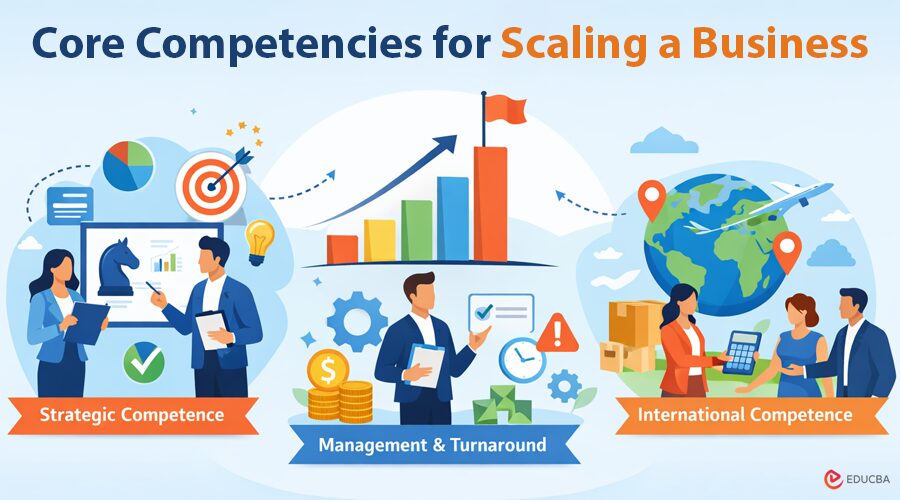
The founders who thrive through that shift usually do not rely on a single superpower. They deliberately build the right competencies for scaling a business, practical capabilities that reinforce each other over time:
- Strategic competence (clarity, positioning, ROI, and data discipline)
- Management & turnaround competence (building systems, controlling cash, and fixing what is broken)
- International competence (expanding to new markets without breaking the core).
Below is a field-tested roadmap of the three essential competencies for scaling a business, with frameworks you can apply whether you run a SaaS start-up, an e-commerce brand, or a service company.
Think of it as a mini-course you can revisit at each stage: validate, scale, professionalize.
Competencies for Scaling a Business
1. Strategic competence
Most start-ups do not fail because their ideas are “bad.” They fail because the team cannot translate vision into choices that compound. Strategy is not a slide deck; it is a set of decisions that make execution easier.
Among all competencies for scaling a business, strategic clarity is foundational. Without it, growth becomes expensive experimentation.
A practical definition: strategy is deciding whom you serve, what you promise, how you deliver it better than alternatives, and how you measure progress.
Start with a Sharp “Who” (ICP) Before you Obsess Over Channels
One of the most expensive mistakes is trying to fix acquisition before fixing targeting. Paid media, SEO, partnerships, and outbound, none of it scales sustainably if you have not nailed your Ideal Customer Profile (ICP).
A useful ICP exercise:
- Problem intensity: What urgent pain does your customer feel weekly?
- Trigger event: What happens that makes them start searching?
- Buying constraints: Budget, procurement, compliance, time to value.
- “Must have” outcomes: What result makes them renew or recommend you?
- Deal killers: What makes them churn fast?
Then write it as one sentence:
“We help [specific segment] achieve [measurable outcome] by [distinct mechanism], unlike [main alternative].”
That sentence becomes your filter for everything: content, sales scripts, roadmap, pricing, and hiring.
Build a Measurable Growth Model
Scale-up entrepreneurs learn to distinguish between leading indicators (activities) and lagging indicators (results). Early on, it is easy to feel productive while moving the wrong metric.
Creating a one-page growth model is one of the most practical competencies for scaling a business, because it connects ambition to unit economics:
- North Star Metric (NSM): the metric that reflects delivered value (e.g., weekly active teams, completed orders, retained users)
- 3 input levers: acquisition, activation, retention (or acquisition, conversion, margin)
- Unit economics: contribution margin per customer and payback period
Then ask a brutally clarifying question:
The answer tells you where strategy must become operational.
Make Data Trustworthy Before you Make it Fancy
In 2026, entrepreneurs have access to more dashboards than ever. The bottleneck is not data volume; it is data reliability.
Data discipline is one of the underestimated competencies for scaling a business. If metrics are not trusted, strategy becomes politics.
A practical baseline:
- Define 10–15 “source of truth” KPIs (revenue, gross margin, CAC, retention, cash runway, NPS, cycle time, pipeline coverage)
- Assign an owner to each KPI (not a department, one person)
- Standardize definitions (what counts as a “lead”? what counts as “active”?)
- Review them on a fixed cadence (weekly for execution, monthly for strategy).
If you are unsure where your blind spots are, start with a structured audit approach that forces clarity on positioning, channel mix, measurement, and ROI before you scale budgets or teams. For example, teams often begin with a documented methodology, such as strategic IA audits, to review what is working, what is missing, and what should change.
Use AI as a Multiplier, Not a Substitute for Thinking
Modern entrepreneurs do not ask, “Should we use AI?” They ask, “Where does AI reduce cycle time without reducing quality?”
High-leverage uses include:
- Market research synthesis (competitors, pricing pages, reviews)
- Sales enablement (objection libraries, proposal drafts)
- Creative iteration (concept variants for ads and landing pages)
- Customer support triage (routing, summarizing, tagging issues)
- Internal documentation (SOP drafts, meeting summaries).
The trap is letting AI produce volume that your strategy cannot absorb. If your positioning is unclear, AI amplifies confusion. If your funnel tracking is broken, AI will optimize the wrong metrics faster.
A Simple Strategic Routine that Keeps you Aligned While you Grow
Adopt a quarterly strategy-to-execution loop:
- Diagnose: What is the constraint right now? (traffic, conversion, retention, cash, hiring)
- Choose: What will we not do this quarter? (this is a strategy)
- Experiment: Run 3–5 focused bets with clear success metrics
- Systematize: Turn the winners into repeatable processes
- Review: What did we learn? What assumptions were wrong?
This routine prevents a classic scale-up failure mode: building a larger, faster version of a business that is still not aligned.
2. Management & Turnaround Competence: Building Resilience, Not Just Growth
Growth is fragile. It can hide structural weaknesses. A company can look “successful” while quietly accumulating operational debt: messy processes, unclear accountability, weak forecasting, or a culture that avoids hard conversations.
Entrepreneurs often underestimate operational resilience as an essential competency for scaling a business. The modern entrepreneur’s second critical capability is the ability to stabilize and revitalize the business when pressure hits because pressure always hits.
Know the Difference Between Management and Leadership
- Management is reliability: roles, routines, resources, metrics.
- Leadership is direction and energy: meaning, trust, and decisions under uncertainty.
Strong competencies for scaling a business require both.
A founder who stays in “hero mode” becomes the bottleneck. A founder who delegates without systems creates chaos. The goal is to build an operating rhythm where decisions happen quickly, information flows clearly, and execution is visible across the organization.
Install an “Operating System” Before You Need It
An operating system is not a tool; it is a cadence. Building this cadence is one of the most practical competencies for scaling a business because it reduces chaos as complexity increases.
A simple structure looks like this:
Weekly
- KPI review (30–45 minutes): numbers, not stories
- Pipeline review (sales): coverage, stage health, next actions
- Delivery review (ops/product): blockers, deadlines, quality signals.
Monthly
- Financial review: P&L, cash flow, runway, margin drivers
- People review: hiring pipeline, performance, culture risks.
Quarterly
- Strategy reset: priorities, resource allocation, major bets.
This cadence lowers the business’s emotional temperature. Problems become visible early when they are still cheap to solve. That early visibility is a defining feature of mature competencies for scaling a business.
Learn the Language of Cash
Many founders read a P&L but do not manage cash. In growth phases, cash is often the constraint: inventory, hiring, ad spend, payment terms, refunds, churn.
Two habits make a disproportionate difference:
- 13-week cash forecast: updated weekly, simple, brutally honest
- Cash conversion cycle awareness: days in inventory + days sales outstanding – days payables outstanding
When you can predict cash, you can act. When you cannot, you react, and reactions are expensive.
Turnaround Thinking
Turnaround competence is not only for failing companies. It is a mindset: the ability to recognize distress signals and regain control quickly.
This ability to reset under pressure is one of the more advanced competencies for scaling a business, because it prevents temporary setbacks from becoming structural decline.
Common distress signals:
- We delay decisions because we say, ‘we need more data.’
- Margins erode while revenue grows
- Customer complaints increase, but the team normalizes it
- Key people churn, and knowledge disappears with them
- Forecasts are consistently wrong (a sign of weak feedback loops).
A basic turnaround playbook:
- Stabilize: stop the bleeding (cash leaks, scope creep, unprofitable channels)
- Create visibility: daily/weekly reporting on critical metrics
- Re-focus: cut to the core offer and the core customer
- Rebuild structure: roles, accountability, decision rights
- Relaunch: new positioning or go-to-market with controlled spend.
This is where business revitalization becomes a real entrepreneurial skill: you do not just manage what is working, you know how to recover what is not, with clear priorities, measurable actions, and disciplined execution.
Change Management
Even the best plan fails if the team cannot adopt it. Change adoption is one of the most overlooked competencies for scaling a business.
At scale, change management means:
- Communicating the “why” without drama
- Setting clear expectations and non-negotiables
- Training people in the new way of working
- Measuring adoption (not just outcomes)
- Reinforcing with routines, not speeches.
Practical Tip: Do not announce 10 changes at once. Pick 2–3 behaviors you want to normalize (e.g., “we update KPIs weekly,” “we close feedback loops with customers,” “we escalate blockers within 24 hours”). Then build rituals around them.
Sustainable growth does not come from intensity. It comes from disciplined, repeatable behaviors, one of the defining characteristics of strong competencies for scaling a business.
3. International Competence
At some point, growth in your home market slows. Alternatively, you realize your offer has global demand. That is when international capability becomes one of the most advanced competencies for scaling a business.
International expansion is not only about translation and ads. It is a legal setup, financial operations, cultural adaptation, and competitive positioning all at once.
Strong international competencies for scaling a business ensure that expansion strengthens your core rather than destabilizes it.
Treat Expansion as a Portfolio of Hypotheses
A smart expansion plan starts with assumptions, not optimism. Mature competencies for scaling a business rely on structured experimentation rather than emotional decisions.
Before entering a new market, test these hypotheses:
- Market fit: Does the problem exist at the same intensity?
- Willingness to pay: Are budgets and pricing expectations comparable?
- Channel access: Can you reach customers efficiently in that market?
- Trust building: What proof is required (certifications, reviews, local partners)?
- Operational constraints: customer support, delivery times, compliance.
Pick one beachhead market and design a 90-day validation sprint. Success is not “we launched.” Success is “we proved acquisition + conversion with sustainable unit economics.”
The US Market
Many founders are attracted to the United States for clear reasons: scale, purchasing power, and strong ecosystems. However, the market also penalizes sloppy execution.
For entrepreneurs developing global competencies to scale a business, the US offers both opportunity and operational complexity. Competition is intense, expectations are high, and compliance nuances matter.
If the US is part of your roadmap, one of the first decisions is your legal and operating setup. For many international founders, an LLC in the US can be a practical way to establish a compliant footprint and separate business risk from personal assets.
(Important: consult qualified legal and tax professionals for your specific situation. This is educational guidance, not legal advice.)
A Practical US Entry Checklist for Entrepreneurs
Structured preparation is a defining trait of strong international competencies for scaling a business. Here is a simplified checklist many founders overlook:
Entity and compliance
- Choose a state based on your business reality (not hype)
- Appoint a registered agent and file formation documents
- Draft an operating agreement (even if you are solo)
- Obtain an EIN and set up compliant bookkeeping early
- Understand ongoing compliance obligations (annual reports, filings).
Banking and payments
- Choose banking/payment solutions compatible with non-residents (if relevant)
- Set up multi-currency reporting if you sell internationally
- Plan for chargebacks, refunds, and sales tax exposure (especially e-commerce).
Go-to-market and trust
- Localize your value proposition (not just language)
- Build US-relevant proof (case studies, testimonials, certifications)
- Adapt support hours and response expectations
- Align pricing with US reference points and competitor anchors.
The goal is to make the US market operationally boring. When you stabilize the legal and financial foundations, you can focus on your product and customers, where you create real value.
Operational stability is a core dimension of long-term business-scaling competencies.
Cultural Competence
International competence is also cultural. Even within the same language, expectations differ:
- Directness in sales conversations
- How quickly teams make decisions
- The role of contracts and procurement
- Service expectations (speed, documentation, guarantees)
- What “premium” means.
Cultural intelligence strengthens your global competencies for scaling a business; more importantly, misalignment in this area can silently destroy deals and partnerships.
The best founders treat culture like a product requirement: they learn, test, and adapt.
Build an International Learning Loop
Just like strategy and operations, international expansion needs a cadence:
- Weekly: track leading indicators (traffic quality, demo-to-close, refund rate)
- Monthly: review unit economics and operational stress (support load, delivery issues)
- Quarterly: decide whether to double down, pivot, or pause a market.
Expansion is not a one-time launch; it is a controlled experiment that becomes a system.
Simple Map for your Next 12 Months
If you want to operationalize these three skills, use this 12-month progression:
Months 1–3: Strategy first
- Clarify ICP, positioning, and NSM
- Fix measurement and KPI definitions
- Run 3–5 experiments with tight feedback loops.
Months 4–8: Build the machine
- Install operating rhythm and accountability
- Improve forecasting and cash control
- Document processes and reduce founder dependency.
Months 9–12: Expand with control
- Validate one new market (or one new segment)
- Build compliance and ops foundations early
- Scale only what is proven, systematized, and measurable.
The entrepreneurs who win in the long term are rarely the loudest visionaries.
They are the ones who deliberately build and refine their competencies for scaling a business, translating vision into strategy, strategy into execution, execution into systems, and systems into sustainable growth.
When these competencies mature, scaling stops feeling like a risky leap.
It becomes a repeatable process.
Recommended Articles
We hope this guide on competencies for scaling a business helps you build stronger strategic, management, and international growth capabilities. Explore these recommended articles for deeper insights, practical frameworks, and expert strategies to scale and manage your business successfully.

