
What is Market Disruption?
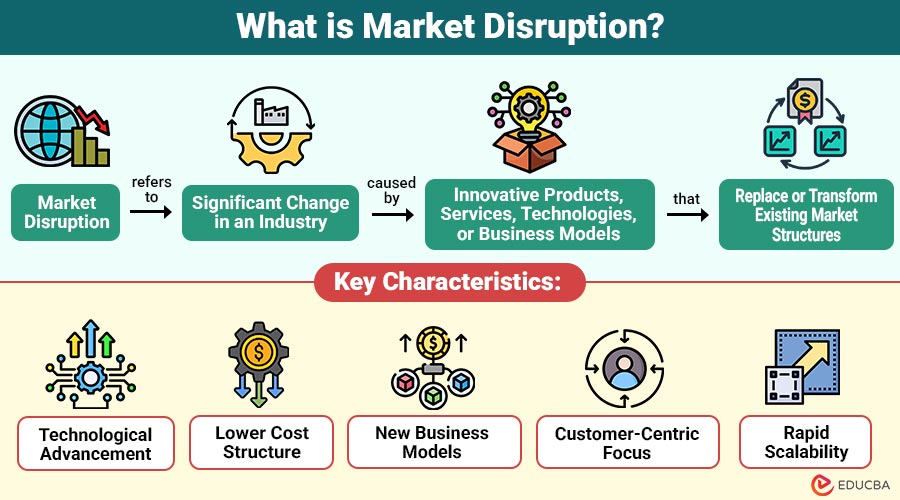
Market disruption refers to significant change in an industry caused by innovative products, services, technologies, or business models that replace or transform existing market structures.
Disruption often begins with smaller companies introducing affordable, accessible, or more efficient alternatives to traditional offerings. Over time, these innovations gain widespread adoption and redefine customer expectations.
Table of Contents:
- Meaning
- Key Characteristics
- Causes
- Types
- Real-World Examples
- Impact of Market Disruption on Businesses
- How Can Businesses Respond to Market Disruption?
- Challenges
Key Takeaways:
- Market disruption reshapes industries through innovation, transforming traditional business models and customer expectations.
- Technological advancements and evolving consumer behavior are primary drivers behind disruptive change.
- Businesses must embrace agility, digital transformation, and innovation to remain competitive.
- Disruption creates opportunities for growth while posing risks to unprepared organizations.
Key Characteristics of Market Disruption
Market disruption typically includes the following characteristics:
1. Technological Advancement
New technologies that enable creative solutions that transform markets and sectors include automation, blockchain, cloud computing, and artificial intelligence.
2. Lower Cost Structure
Disruptive companies reduce operational costs through efficiency and innovation, offering affordable alternatives that attract highly price-sensitive customer segments.
3. New Business Models
They introduce innovative revenue models such as subscriptions, freemium offerings, and digital platforms that transform traditional industry practices.
4. Customer-Centric Focus
Disruptors prioritize user convenience, seamless experiences, personalization, and accessibility to effectively meet evolving customer expectations.
5. Rapid Scalability
Digital infrastructure enables companies to expand quickly across global markets without heavy investment in physical assets or facilities.
Causes of Market Disruption
Several factors contribute to market disruption:
1. Technological Innovation
Rapid technological advancements enable new entrants to introduce innovative products and services that challenge established companies and traditional industry structures.
2. Changing Consumer Behavior
Evolving customer preferences for convenience, personalization, affordability, and instant digital access push businesses to adapt quickly or risk losing relevance.
3. Regulatory Changes
Government reforms, policy updates, and deregulation can lower entry barriers, encouraging competition and enabling innovative startups to enter markets.
4. Globalization
Increased global connectivity and trade expose domestic businesses to international competitors, intensifying competition and driving continuous innovation.
5. Economic Shifts
Economic downturns, inflation, market volatility, and supply chain disruptions force companies to restructure operations and embrace transformative strategies.
Types of Market Disruption
Market disruption can occur in various forms:
1. Low-End Disruption
Targets overlooked price-sensitive customers by offering simpler, affordable products that sacrifice premium features while maintaining acceptable performance standards.
2. New Market Disruption
Creates entirely new customer segments by introducing innovative solutions that make products accessible to non-consumers previously excluded.
3. Technological Disruption
Occurs when breakthrough technologies fundamentally change industry processes, products, and value delivery, replacing outdated systems and legacy solutions.
4. Business Model Disruption
Transforms how companies create, deliver, and capture value by introducing innovative revenue streams and operational structures.
Real-World Examples
Let us explore some famous examples of market disruption across industries:
1. Entertainment Industry
Netflix began as a DVD rental service but shifted to streaming, disrupting traditional television networks and movie rental stores like Blockbuster. Consumers gained on-demand access to content, eliminating the need for physical rentals.
2. Transportation Industry
Uber and Airbnb disrupted taxis and hotels by leveraging digital platforms and peer-to-peer models.
3. Retail Industry
Amazon changed consumer shopping habits by offering convenience, variety, and competitive pricing online. Traditional brick-and-mortar stores had to adapt or close.
4. Financial Services
Fintech firms and online payment systems like PayPal have revolutionized global money transfers.
Impact of Market Disruption on Businesses
Market disruption can have both positive and negative consequences.
Positive Impacts:
1. Increased Innovation
Market disruption encourages companies to innovate continuously, develop advanced technologies, and improve products to remain competitive.
2. Lower Prices for Consumers
By lowering operating expenses, disruptive models allow companies to provide goods and services at lower costs.
3. Improved Customer Experience
New technologies and customer-centric models enhance convenience, personalization, speed, and overall satisfaction for consumers.
4. New Job Creation in Emerging Sectors
While old roles decline, disruption generates employment opportunities in technology, digital services, and innovation-driven industries.
5. Greater Market Efficiency
Automation, digital platforms, and streamlined processes improve productivity, reduce waste, and optimize resource allocation.
Negative Impacts:
1. Job Losses in Traditional Industries
Automation and innovative business models replace traditional roles, causing unemployment in outdated sectors.
2. Business Closures
Established companies failing to adapt to disruption may lose market share and eventually shut down.
3. Economic Instability in the Short Term
Rapid industry shifts can create temporary uncertainty, financial losses, and market volatility.
4. Increased Competition Pressure
Disruption intensifies competition, forcing companies to lower margins and continuously innovate.
5. Skill Obsolescence
Employees’ existing skills may become outdated, requiring retraining and continuous learning to stay employable.
How Can Businesses Respond to Market Disruption?
To survive and thrive during disruption, companies should adopt proactive strategies:
1. Embrace Innovation
Continuously invest in research and development to create advanced solutions, improve offerings, and stay ahead of rapidly evolving technologies.
2. Adopt Digital Transformation
Leverage automation, cloud computing, artificial intelligence, and data analytics to enhance operational efficiency, reduce costs, and improve decision-making.
3. Focus on Customer Experience
Prioritize personalization, seamless service, and convenience to build stronger relationships, increase loyalty, and differentiate from competitors.
4. Diversify Revenue Stream
Develop alternative products, services, or subscription models to reduce reliance on traditional income sources.
5. Build Agile Organizations
Establish adaptable frameworks and give teams the freedom to act quickly and make decisions, adjusting to market changes.
6. Collaborate with Startups
Partner with innovative startups to access new technologies, fresh ideas, and competitive advantages.
Challenges of Market Disruption
Despite its benefits, disruption presents significant challenges:
1. Resistance to Change within Organizations
Employees and leadership may resist new technologies or processes, slowing transformation efforts and limiting successful adaptation to disruption.
2. High Initial Investment Costs
Implementing advanced technologies and innovative systems often requires substantial capital, increasing financial risk before measurable returns appear.
3. Regulatory Uncertainty
Rapid innovation may outpace government regulations, creating confusion about compliance, legal risks, and operational uncertainty for businesses.
4. Cybersecurity Risks
Digital transformation increases exposure to cyber threats, data breaches, and system vulnerabilities that can damage reputation.
5. Workforce Retraining Requirements
To remain relevant, workers must continually improve their skills, which requires training initiatives, time commitments, and additional organizational resources.
Final Thoughts
Market disruption is now a constant force in modern business, driven by technological advancements, evolving consumer expectations, and innovative business models. It reshapes industries, creating both opportunities and significant risks. Organizations that resist change may become obsolete, while those embracing innovation, agility, and customer focus can achieve sustainable growth and long-term competitive advantage in rapidly evolving markets.
Frequently Asked Questions (FAQs)
Q1. Is market disruption always caused by technology?
Answer: No. While technology is a major driver, regulatory changes, economic shifts, and evolving consumer behavior can also cause disruption.
Q2. How can small businesses survive market disruption?
Answer: By focusing on niche markets, adopting digital tools, and maintaining agility in operations.
Q3. Can established companies create disruption?
Answer: Yes. Companies like Apple and Amazon have disrupted markets multiple times through innovation.
Q4. Is disruption beneficial for consumers?
Answer: Generally, yes, as it often leads to lower prices, improved services, and greater accessibility.
Recommended Articles
We hope that this EDUCBA information on “Market Disruption” was beneficial to you. You can view EDUCBA’s recommended articles for more information.

