


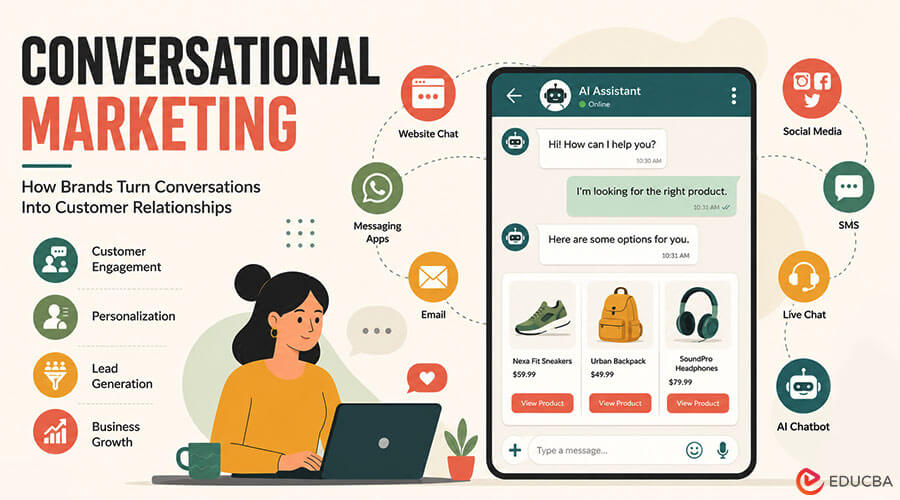
People no longer want to wait for a brand to respond after submitting a form, sending an email, or leaving a comment. They want answers while they research, compare, and decide. This shift has made conversational marketing an important part of modern digital marketing.
Conversational marketing uses two-way conversations to engage prospects and customers. Brands can use live chat, chatbots, messaging apps, social media, SMS, and conversational AI to answer questions, recommend products, qualify leads, and guide buyers toward the next step.
Unlike traditional marketing, which often sends the same message to a large audience, conversational marketing responds to individual needs. It lets customers ask questions and receive relevant answers throughout their buying journey.
For example, an online furniture store can ask a visitor what type of furniture they need instead of showing a generic “Shop Now” message. The visitor might answer, “I need a sofa for a small apartment.” The conversation can then suggest compact sofas, explain dimensions, show prices, and help the customer choose a suitable option.
This approach does more than generate leads. It can reduce friction, improve the customer experience, reveal customer preferences, and help sales teams focus on people with genuine buying intent.
Table of Contents
- Meaning
- Conversational Marketing Vs. Traditional Marketing
- Importance
- Key Elements
- Types
- How Does It Work?
- Real-World Examples
- How to Create a Strategy?
- Best Practices
- Metrics to Track
- Common Mistakes
- Conversational Marketing and AI
- Benefits
- Future
Key Takeaways
- Conversational marketing uses two-way communication to engage customers and prospects.
- It can happen through websites, chatbots, messaging apps, social media, SMS, email, and other channels.
- The approach focuses on relevance, speed, personalization, and customer intent.
- Businesses can use conversations to generate leads, recommend products, answer questions, and improve customer experiences.
- AI can help businesses manage conversations at scale, but human support remains important.
- Businesses should connect conversational tools with their CRM and other relevant systems.
- Strong strategies measure business outcomes, not conversation volume alone.
- The best conversations help customers solve problems instead of pushing them toward a sale.
- Continuous testing and customer feedback can improve conversational experiences over time.
What Is Conversational Marketing?
Conversational marketing is a customer-focused approach that uses direct, personalized conversations to engage prospects and customers.
These conversations can happen through:
- Website live chat
- AI-powered chatbots
- Facebook Messenger
- Instagram messaging
- SMS
- Voice assistants
- Social media conversations
- In-app messaging
The goal is not simply to automate communication. The goal is to make the customer interaction more useful and relevant.
A good conversational marketing experience answers a customer’s immediate question, understands their intent, and helps them move forward.
For instance, a SaaS company could ask a website visitor:
“What are you looking for today?”
The visitor could select:
- Compare plans
- Learn about features
- Get technical help
- Book a demo
The company can then guide the visitor toward the appropriate information or team.
Conversational marketing therefore changes the customer journey from “find information yourself” to “let us help you find the right information.”
Industry sources describe conversational marketing as a real-time, two-way approach that can support lead generation, customer engagement, sales, and service.
How Conversational Marketing Differs From Traditional Marketing
Traditional marketing usually starts with a message.
A company creates an advertisement, email, landing page, social media post, or campaign and distributes it to an audience. Customers then decide whether to respond.
Conversational marketing reverses part of this process. It invites customers to participate.
| Traditional Marketing | Conversational Marketing |
| Mostly one-way communication | Two-way communication |
| Uses broad messaging | Uses personalized messaging |
| Customer searches for answers | Brand can guide the customer |
| Often relies on forms | Can collect information through dialogue |
| Follow-up may happen later | Responses can happen immediately |
| Focuses heavily on reach | Focuses heavily on interaction |
| Uses fixed content | Can adapt to customer responses |
This does not mean businesses should abandon traditional marketing. Conversational marketing works alongside content marketing, SEO, advertising, email marketing, and other channels.
A company might attract a visitor through Google Search, educate them through a blog post, and then use a chatbot to help them choose the right product.
That creates a connected customer journey.
Why Is Conversational Marketing Important?
Customers have more choices than ever. They can compare products, read reviews, check prices, and switch between competitors within minutes.
A slow or confusing buying experience can therefore cost a business a potential customer.
Conversational marketing addresses this problem by reducing the distance between a customer’s question and the company’s answer.
1. It Reduces Customer Friction
Suppose someone visits an online clothing store and wants to know whether a particular jacket suits winter.
Without conversational support, the customer may need to search through product descriptions, FAQs, reviews, and shipping information.
A conversational tool can answer the question immediately.
The easier the process becomes, the fewer obstacles the customer faces.
2. It Creates More Personalized Experiences
A customer asking about running shoes has different needs from someone shopping for casual footwear.
A conversational system can ask questions such as:
- What type of running do you do?
- How often do you run?
- Do you prefer cushioning or a lightweight shoe?
- What size do you need?
The brand can then provide recommendations based on those answers.
3. It Helps Qualify Leads
Not every website visitor represents an equally valuable sales opportunity.
A conversational tool can ask qualifying questions before sending a prospect to sales.
For example:
Bot: “Are you looking for software for yourself or your company?”
Visitor: “My company.”
Bot: “How many employees will use it?”
Visitor: “Around 100.”
Bot: “Would you like to see plans designed for teams of this size?”
The company gains useful context without forcing the prospect to complete a long form.
Conversational interactions can also help sales teams identify stronger prospects and move them toward the appropriate next step.
4. It Captures Customer Insights
Customers reveal valuable information during conversations.
They may explain:
- Why they need a product
- What problem they want to solve
- Why they hesitate to buy
- Which feature matters most
- What price they consider reasonable
- What competitors they are comparing
- What information they cannot find
Marketing teams can analyze these conversations and use the insights to improve campaigns, landing pages, products, and customer experiences.
5. It Keeps Customers Engaged
A static page may not answer every customer’s question.
A conversation creates an opportunity to continue the interaction.
Instead of leaving after reading a product page, a visitor might ask about delivery, compatibility, pricing, or returns.
That extra interaction can keep the customer moving through the buying journey.
Key Elements of Conversational Marketing
A successful conversational marketing strategy needs more than a chatbot.
1. Real-Time Interaction
Customers should get quick responses, especially to high-intent questions.
Someone asking “How much does this cost?” may be close to buying. Delays can weaken that buying momentum.
2. Personalization
The conversation should reflect the customer’s situation.
A first-time visitor should not receive the same message as an existing customer who has already purchased.
Personalization can use information such as:
- Previous interactions
- Product interests
- Website behavior
- Purchase history
- Customer segment
- Conversation responses
3. Context
A useful conversation remembers what the customer has already said.
If a customer says they need accounting software for a small business, the system should not repeatedly ask whether they need accounting software.
Context makes the interaction feel more natural.
4. Human Handoff
Automation should not attempt to solve every problem.
When a customer asks a complicated question or shows strong purchase intent, the system should transfer the conversation to a human representative.
The handoff should also include conversation history so the customer does not need to repeat everything.
5. Clear Next Steps
Every conversation should have a purpose.
The next step might be:
- Book a meeting
- View a product
- Start a trial
- Request a quote
- Speak with an expert
- Complete a purchase
- Read a relevant guide
A conversation without direction can create unnecessary interaction without creating business value.
Types of Conversational Marketing
Businesses can use several formats depending on their audience and goals.
Website Chatbots
Website chatbots can greet visitors, answer common questions, recommend products, collect information, and route leads.
For example, a software website might ask visitors whether they want pricing information, product details, or a demo.
Live Chat
Live chat connects customers with human representatives.
It works particularly well for high-value products and complex purchasing decisions where customers need detailed answers.
Conversational Forms
Traditional forms ask customers to fill in several fields at once.
Conversational forms break that process into smaller questions.
Instead of showing:
Name | Email | Company | Phone | Budget | Requirement
the experience might ask one question at a time.
This can make lead capture feel less like paperwork and more like an interaction.
Messaging Apps
Messaging platforms allow brands to communicate with customers through channels they already use.
Businesses can use messaging for product questions, order updates, recommendations, appointment confirmations, and follow-ups.
Social Media Conversations
Customers frequently ask brands questions through social platforms.
A brand can respond publicly when appropriate or move the conversation into a private channel for account-specific issues.
Social conversations can therefore become both marketing and customer service opportunities.
Conversational AI
AI can help businesses manage large volumes of conversations.
Modern conversational AI can understand natural-language questions, use context, summarize interactions, and provide responses based on approved information.
However, businesses still need human oversight, clear escalation rules, and quality checks.
How Does Conversational Marketing Work?
A typical conversational marketing journey follows several stages.
Step 1: Attract the Customer
The customer arrives through a search engine, an advertisement, a social media post, email, a referral, or another channel.
Step 2: Start the Conversation
A chatbot, live-chat option, messaging prompt, or interactive element invites the customer to engage.
For example:
“Looking for the right plan? I can help you compare the options.”
Step 3: Understand Intent
The system asks relevant questions.
For example:
“What are you hoping to accomplish?”
The customer might choose:
- Generate more leads
- Automate customer support
- Improve reporting
- Manage customer data
Step 4: Provide Relevant Information
The system responds based on the customer’s answer.
It may recommend a product, explain a feature, provide educational content, or answer a question.
Step 5: Qualify the Opportunity
For sales-focused conversations, the system can collect information such as company size, budget, requirements, or purchase timeline.
Step 6: Take the Next Action
The customer can then:
- Buy
- Book a demo
- Request a quote
- Contact sales
- Start a trial
- Continue researching
Step 7: Learn From the Conversation
The business analyzes the interaction.
Teams can identify common questions, objections, product gaps, and conversion patterns.
That information can improve future conversations.
Real-World Examples of Conversational Marketing
Example 1: Amazon
Amazon uses conversational experiences across its shopping ecosystem to help customers find information and products.
A customer may search for a product, compare options, ask questions, or interact with AI-supported shopping features.
Amazon Ads describes conversational marketing as a way to provide relevant information during high-intent moments, such as product comparison and product research.
Example 2: HubSpot
HubSpot has long promoted conversational marketing as part of inbound marketing.
Its approach extends beyond website chat. Conversational interactions can happen through channels such as email, messaging, social platforms, and community spaces.
Example 3: Sephora
Sephora provides a useful example of conversational commerce in the beauty industry.
Beauty shoppers often need help choosing products because their preferences depend on factors such as skin type, makeup style, shade, and occasion.
A conversational experience can ask about those needs and narrow down suitable products.
Example 4: A B2B Software Company
Imagine a cybersecurity software company that receives hundreds of website visitors every day.
Instead of asking every visitor to complete a long contact form, it starts with:
“What would you like help with?”
The visitor selects:
“I want to protect 500+ employees.”
The system then asks about the company’s environment and priorities.
If the visitor demonstrates strong purchase intent, the system can offer a meeting with a sales specialist.
Example 5: An Online Travel Company
Imagine a travel company that receives visitors searching for weekend trips.
Instead of asking customers to browse hundreds of destinations, the company could ask:
“Where would you like to travel?”
Then:
“How many days do you have?”
Then:
“What matters most: beaches, sightseeing, food, or nightlife?”
The system can use those answers to recommend relevant destinations or packages.
How to Create a Conversational Marketing Strategy?
1. Define the Business Goal
Do not start with technology.
Start with the problem.
You might want to:
- Generate more qualified leads
- Increase product sales
- Reduce abandoned carts
- Improve customer support
- Increase demo bookings
- Improve customer retention
- Collect customer feedback
One clear objective makes the strategy easier to measure.
2. Understand Your Audience
Study what customers ask before, during, and after a purchase.
Review:
- Sales calls
- Customer support tickets
- Search queries
- Social media comments
- Reviews
- Live-chat transcripts
- Frequently asked questions
These sources can reveal the conversations customers actually want to have.
3. Choose the Right Channel
Do not add a chatbot everywhere just because the technology exists.
Choose channels based on customer behavior.
A B2B company may prioritize website chat and email, while a consumer brand may benefit more from messaging and social platforms.
4. Design the Conversation
Create simple conversation paths.
For example:
Visitor → Question → Intent → Recommendation → Next step
Avoid complicated decision trees unless the business genuinely needs them.
5. Give Customers Useful Choices
Buttons can speed up simple conversations.
For example:
What do you need?
- Product recommendation
- Pricing
- Shipping information
- Speak to an expert
Customers can quickly choose a path instead of typing a long message.
6. Add Human Support
Create clear rules for escalation.
Transfer customers when they:
- Ask a complex question
- Become frustrated
- Need account-specific assistance
- Want to negotiate
- Request a human representative
- Show strong buying intent
7. Connect the Conversation to Your CRM
A conversation becomes more valuable when the business can use its information later.
For example, a CRM can record:
- Customer name
- Contact information
- Product interest
- Conversation topic
- Lead qualification
- Sales stage
This prevents sales teams from starting every interaction from zero.
8. Test and Improve
Track where customers leave conversations.
If 70% of users abandon the interaction after the third question, investigate that step.
The question may require too much effort from the customer. In some cases, they may not understand what it means. Another issue is that the conversation asks for information before offering enough value.
Small improvements can make the experience more effective.
Best Practices for Conversational Marketing
1. Keep the Language Natural
Use clear, friendly wording that sounds natural and easy for customers to understand. Avoid complicated or overly formal phrases that can make interactions feel robotic.
Instead of:
“Please select the appropriate category for your intended product requirement.”
Use:
“What are you looking for?”
Clear language makes conversations easier to understand and reduces friction.
2. Ask One Question at a Time
Avoid overwhelming customers with several questions in a single message. Ask one relevant question at a time to keep the conversation clear and manageable.
3. Provide Value Before Asking for Information
Avoid immediately requesting details such as a phone number, email address, company size, or budget. First, provide useful information or assistance. Then, ask for the details needed to move the conversation forward.
4. Be Transparent About Automation
Let customers know when they are interacting with an AI assistant or automated chatbot. Clear communication helps them understand the system’s capabilities and when they may need human assistance.
5. Avoid False Personalization
Avoid generic labels such as “valued customer” when they don’t accurately describe the relationship. Personalize conversations only when you have relevant information that genuinely improves the customer experience.
6. Protect Customer Data
Conversational interactions may involve personal or business information. Collect only the data you need, protect it appropriately, and follow applicable privacy and data protection requirements.
7. Measure Outcomes, Not Just Conversations
A high number of conversations does not necessarily indicate success. Track meaningful outcomes such as qualified leads, conversions, customer satisfaction, resolved queries, and revenue generated through conversational interactions.
Conversational Marketing Metrics to Track
Tracking the right metrics helps businesses see whether their conversational marketing efforts improve engagement, generate leads, and drive business results.
1. Conversation Rate
This metric shows the percentage of eligible visitors who initiate a conversation with your brand.
Formula:
2. Lead Conversion Rate
This measures how effectively conversations turn visitors into qualified leads.
Formula:
3. Appointment or Demo Booking Rate
B2B businesses can track the percentage of conversations that result in booked meetings, consultations, or product demonstrations.
4. Conversion Rate
Track the number of conversations that result in key actions, such as making a purchase, starting a trial, or sending an inquiry.
5. Response Time
For conversations handled by human representatives, monitor how quickly the team responds to customer messages. Faster responses can help maintain customer interest and reduce delays.
6. Resolution Rate
This metric shows how many customer queries the conversational system resolves without requiring escalation to a human representative.
7. Customer Satisfaction
Collect customer feedback after conversations to determine whether the interaction was useful, clear, and satisfactory.
8. Revenue Influenced
When reliable attribution is available, track the revenue generated or influenced by conversational interactions. This helps connect conversational marketing efforts to measurable business results.
Common Conversational Marketing Mistakes
Conversational marketing can improve customer engagement, but poor implementation can create friction and reduce its effectiveness. Avoid these common mistakes to build more useful and customer-focused conversations.
1. Treating a Chatbot as the Entire Strategy
A chatbot is only one component of a conversational marketing strategy. The overall approach should identify the customer problem, define the conversation’s purpose, choose the right channel, establish escalation options, and determine how you’ll measure success.
2. Making Every Conversation Sales-Focused
Not every customer interaction should aim for an immediate sale. Some customers simply need information or assistance. Helpful answers can build trust and strengthen relationships, even when the conversation doesn’t result in an instant purchase.
3. Creating Long Conversation Flows
Too many questions can make a chatbot feel like a lengthy form. Keep conversations focused, ask only relevant questions, and guide customers toward the next useful step.
4. Ignoring Human Handoffs
Automation works more effectively when it identifies situations that require human assistance. Always provide customers with a straightforward option to connect with a real representative when needed.
5. Using Generic Responses
Sending identical responses to every customer can make conversations feel impersonal. Use relevant customer information and conversation context to provide more useful and personalized responses.
6. Measuring Vanity Metrics
A large number of chatbot interactions does not necessarily indicate success. Instead, focus on meaningful business outcomes such as qualified leads, purchases, customer satisfaction, resolution rates, and revenue generated.
Conversational Marketing and AI
AI has expanded what conversational marketing can accomplish.
Traditional rule-based chatbots typically follow predefined paths.
For example:
Customer: “Where is my order?”
Bot: “Please select an option.”
- Track order
- Change address
- Contact support
AI-powered systems can understand more natural questions and respond based on context.
For example:
Customer: “My delivery was due yesterday. Could you please check its current status?”
An AI system can potentially identify the intent, retrieve relevant information from connected systems, and provide an appropriate response.
However, businesses should not assume that AI can operate without supervision. They need accurate knowledge sources, clear boundaries, escalation rules, monitoring, and regular testing.
AI should make conversations more useful, not just more automated.
Benefits of Conversational Marketing for Different Businesses
E-Commerce
E-commerce companies can use conversations for:
- Product recommendations
- Size guidance
- Shipping questions
- Returns
- Cart recovery
- Product comparisons
SaaS
SaaS companies can use conversations to:
- Qualify leads
- Explain features
- Compare plans
- Book demos
- Answer technical questions
- Guide trial users
Healthcare
Healthcare organizations can use conversational tools for appropriate administrative interactions, such as appointment scheduling, basic service information, and reminders.
They should apply strict privacy and safety controls when conversations involve sensitive information.
Financial Services
Banks and financial platforms can use conversational experiences to help customers navigate services, understand processes, and obtain general information.
Sensitive financial decisions should receive appropriate human oversight.
Travel and Hospitality
Travel businesses can use conversations for:
- Destination discovery
- Booking assistance
- Itinerary questions
- Hotel information
- Travel updates
- Post-booking support
The Future of Conversational Marketing
Conversational marketing will continue moving toward more connected and context-aware experiences.
Customers may start a conversation through an advertisement, continue it on a website, receive follow-up information through a messaging platform, and later speak with a human sales representative.
The key shift isn’t simply from humans to AI.
It is a shift from static marketing experiences to interactive customer journeys.
AI can help businesses scale these interactions, but the strongest strategies will still depend on good customer understanding, accurate information, useful content, privacy, and thoughtful human involvement.
The companies that succeed will not simply ask, “Where can we add a chatbot?”
They will ask:
“Where does our customer need help, and how can a conversation remove that difficulty?”
That question leads to better conversational marketing.
Final Thoughts
Conversational marketing helps businesses turn passive customer journeys into meaningful, two-way experiences. Instead of making customers search for answers or complete lengthy forms, brands can provide timely and relevant support through direct conversations.
The real value comes from understanding customer needs and guiding them toward the right information, product, or solution. Businesses that combine personalization, automation, human support, and responsible data practices can create smoother experiences while building stronger customer relationships.
Conversational marketing is more than a chatbot. It is a customer-focused approach that helps brands communicate faster, more relevantly, and more helpfully.
Frequently Asked Questions (FAQ’s)
Q1. How does conversational marketing differ from conversational commerce?
Answer: Conversational marketing uses two-way communication to engage and support customers at different stages of their journey. Conversational commerce has a narrower focus, using conversations to assist with product discovery, decision-making, and purchases.
Q2. Can conversational marketing be used after a purchase?
Answer: Yes. Businesses can use it for onboarding, product guidance, feedback collection, loyalty programs, and recommendations for relevant products or services.
Q3. How can conversational marketing recover abandoned carts?
Answer: Businesses can start a timely conversation to identify obstacles such as payment issues, shipping concerns, product confusion, or unanswered questions that may have stopped the customer from completing the purchase.
Q4. How can businesses make automated conversations feel more human?
Answer: Use natural language, remember relevant context, provide concise responses, show appropriate empathy, and prevent customers from having to provide the same details more than once.
Q5. How can conversational marketing support customer loyalty?
Answer: Brands can use conversations to help customers understand loyalty benefits, check rewards, redeem points, receive personalized offers, and discover relevant products based on their previous interactions.
Recommended Articles
We hope this guide on conversational marketing helps you create more engaging customer experiences and build stronger relationships. Explore these recommended articles for additional insights and strategies to improve your marketing and customer engagement efforts.

