


Updated February 5, 2026
How to Build an Accurate IT Cost Forecasting Model for 2026?
For many small and mid-sized businesses, IT budgeting has historically been a backward-looking exercise. Last year’s spend becomes this year’s baseline, with a modest buffer added for “unexpected issues.” That approach no longer works. By 2026, the IT cost forecasting model must account for an environment defined by cloud sprawl, subscription-based tooling, heightened cybersecurity risk, AI adoption, and growing compliance pressure. Costs are no longer static, linear, or confined to a single department. They are dynamic, interconnected, and often hidden until something breaks.
From the perspective of MSP teams working daily in SMB environments, inaccurate IT forecasting is rarely due to poor math. Incomplete visibility, outdated assumptions, and failure to model how modern IT behaves under real operational conditions cause it. An accurate forecasting model does not just predict spend. It explains why costs change, where risk resides, and how the technology decisions affect financial outcomes tomorrow.
Why Traditional IT Budgeting Fails in 2026?
The pace of change in IT has outstripped the budgeting models designed to manage it. Many organizations still rely on fixed annual budgets built around hardware refresh cycles and headcount-based assumptions. Meanwhile, the underlying cost drivers have shifted. Cloud infrastructure scales continuously. Security tooling multiplies as threats increase. Vendors move to per-user, per-device, or usage-based pricing. AI workloads introduce compute volatility that did not exist even two years ago.
This is why “set it and forget it” budgets break. In a late 2023 survey, Flexera reported that managing cloud spend remains a top challenge, and that many organizations struggle to stay within cloud budgets as environments grow and overlap. Forecasting fails when organizations treat IT as a static cost center instead of a dynamic system that responds to business growth, risk exposure, and regulatory demands.
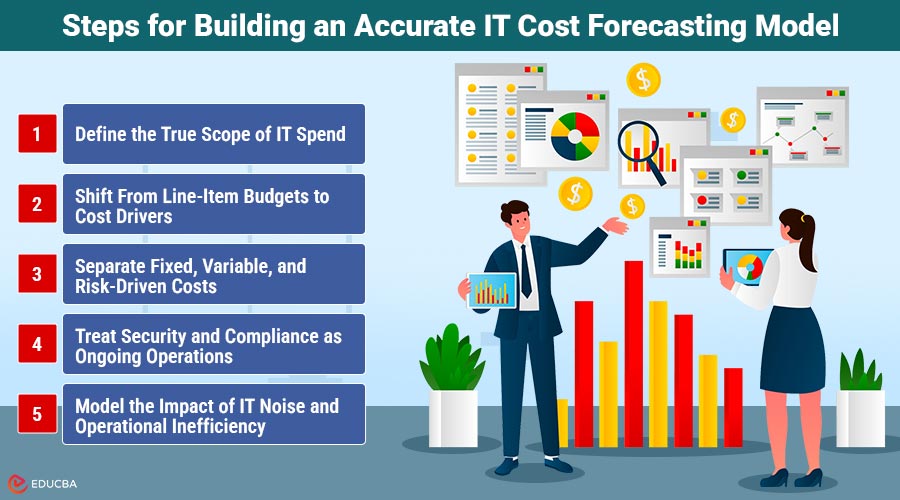
Steps for Building an Accurate IT Cost Forecasting Model
Here are the key points to follow for creating an effective and reliable forecasting model.
1. Define the True Scope of IT Spend
Before forecasting can begin, organizations must define what “IT costs” actually include. This is where most models quietly fall apart. IT spend is not limited to infrastructure and support contracts. It includes direct, indirect, visible, and hidden costs that accumulate across departments and workflows. A complete forecasting model should account for:
- Core infrastructure (servers, networks, endpoints, cloud resources)
- Security controls (identity, monitoring, detection/response, backups)
- Software and SaaS subscriptions across teams
- Compliance, audit, and regulatory overhead
- Internal labor time spent on IT-related work
- Downtime, incidents, and productivity loss
The indirect costs are often the largest blind spot. IBM’s report emphasizes that breach costs rise with disruption and discusses how business disruption contributes to higher overall breach impact. Accurate models start by acknowledging that IT spend extends beyond invoices.
2. Shift From Line-Item Budgets to Cost Drivers
Forecasting improves dramatically when organizations stop focusing only on line items and start modeling cost drivers. A cost driver is any variable that causes IT spend to increase or decrease over time. In modern environments, common drivers include workforce size, device count, data volume, security maturity, and compliance scope. Adding 10 employees rarely increases IT costs by 10%. It can require additional licenses, security coverage, monitoring capacity, identity overhead, and more support demand.
Those costs compound in hybrid environments. The point is to forecast “what causes spending to move,” not just “what we paid last year.” Your model becomes stronger when you can explain how headcount, endpoint growth, app adoption, and data-handling requirements shift costs across categories.
3. Separate Fixed, Variable, and Risk-Driven Costs
One practical improvement that consistently increases forecast accuracy is separating IT expenses into three categories: fixed, variable, and risk-driven.
- Fixed costs are predictable and contractual.
- Variable costs scale with usage or growth.
- Risk-driven costs appear when controls fail or threats materialize.
Risk-driven costs are the most underestimated and the most damaging when they occur unexpectedly. Verizon’s DBIR continues to highlight how common human-driven error types are in breaches, including misconfiguration and misdelivery/mistakes, reinforcing why “risk” must be treated as a financial variable, not a footnote. A credible IT forecasting model acknowledges that risk has a financial profile, even if the exact timing is uncertain.
4. Treat Security and Compliance as Ongoing Operations
Security is no longer a one-time project. It is an operational function with recurring costs that rise as threats evolve, requirements tighten, and environments become more complex. Most SMBs now operate under contractual, regulatory, or insurance-driven security expectations. That means ongoing costs for monitoring, patching cadence, access control, incident response readiness, audit support, and policy upkeep.
CISA’s guidance and programs reinforce continuous diagnostics and continuous monitoring as a posture not an event especially for resilience and readiness. Forecasting models should treat security and compliance as living systems. Underfunding them does not reduce costs it shifts them into higher-impact, higher-urgency spending later.
5. Model the Impact of IT Noise and Operational Inefficiency
One of the least visible drivers of IT overspend is operational noise: alert fatigue, redundant tooling, and reactive workflows that consume time and slow response. Alert overload slows resolution, overlapping tools raise costs, and noisy monitoring causes engineers to ignore signals allowing real issues to slip through.
Google’s SRE guidance is blunt about this: frequent paging trains people to ignore alerts and prolong outages. A forecasting model that includes efficiency metrics ticket volume trends, mean time to resolve, tooling overlap, after-hours incidents produces more realistic “future cost” projections by accounting for both human and technical systems.
6. Use Scenario-Based Forecasting Instead of Single Estimates
The most resilient IT cost models do not aim for one “perfect” number. They model scenarios.
At minimum, plan for:
- Expected case (steady-state growth, normal incident rate)
- Conservative case (growth + moderate risk event)
- Stress case (vendor price changes, major incident, compliance push)
This is especially important for AI adoption. Organizations are still working through operational “growing pains” as they scale AI beyond pilots, which affects tooling, governance, data handling, and, at times, infrastructure costs. Scenario forecasting does not create fear. It creates preparedness.
7. Translate Technical Spend Into Business Language
Forecasting works when leadership understands it. Executives do not budget for “endpoint detection.” They budget for reduced downtime, reduced risk, compliance readiness, and predictable operating costs. So your model must translate technical investment into business outcomes: avoided disruption, fewer recovery hours, fewer high-severity incidents, and more stable delivery.
Framework-led planning helps here, especially when you need a shared baseline for estimating IT costs, understanding IT spend, and forecasting IT expenses without turning the conversation into vendor debates. A practical way to structure those inputs is to use a neutral baseline calculator as a starting point, then refine with your environment’s drivers: forecasting IT expenses. That single step connecting spend to outcomes often unlocks budget alignment, because the conversation shifts from tool-and-ticket to risk-and-performance.
8. Review and Adjust Forecasts Quarterly
Annual budgets alone increasingly misalign with operational reality. Teams review and adjust the most accurate forecasting models quarterly. This cadence allows organizations to respond to changes in staffing, threat activity, regulatory updates, and vendor pricing. It also surfaces inefficiencies early, before they harden into long-term waste.
Deloitte’s tech investment research shows that technology spending and value realization depend on leadership discipline and continuous alignment, not one-time budgeting. Forecasting is not a one-time exercise. It is a governance discipline.
What Accurate IT Forecasting Enables?
Accurate IT forecasting does more than prevent budget overruns. It enables better planning, fewer surprise outages, a stronger security posture, and smoother collaboration between IT and finance. Organizations gain clarity on trade-offs, visibility into risk, and confidence in their technology roadmap. They move from reactive spending to intentional investment. In an environment where technology underpins nearly every business function, that shift is no longer optional.
Final Thoughts
Building an accurate IT cost forecasting model for 2026 requires a mindset shift as much as a spreadsheet shift. IT is not a static budget line it is a dynamic system shaped by business growth, risk exposure, and human attention. The best models are grounded in operational reality, informed by trustworthy benchmarks, and flexible enough to adapt. They do not promise certainty. They provide preparedness. For SMBs navigating an increasingly complex digital landscape, that preparedness is what turns IT from a recurring surprise into a strategic advantage.
Recommended Articles
We hope this guide to building an accurate IT cost forecasting model helps you plan and manage your IT spend effectively. Explore these recommended articles for more insights and strategies to optimize your IT budgeting and forecasting practices.


