


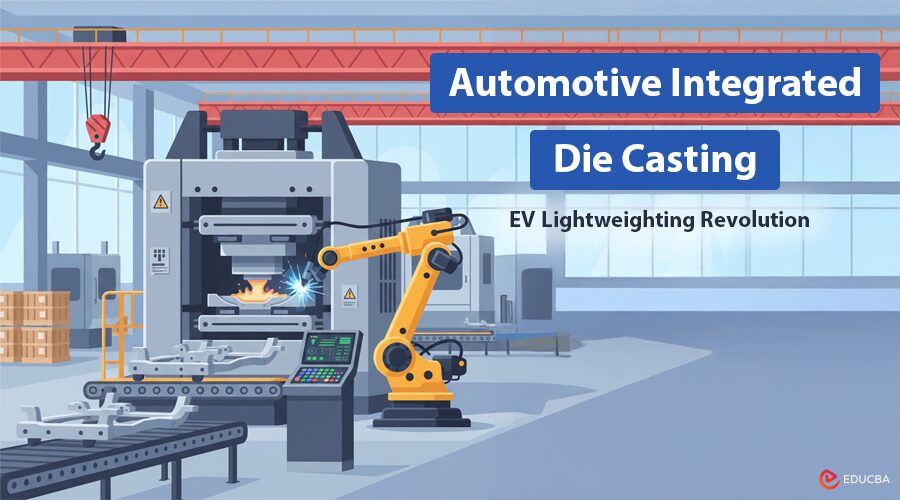
Revolution of Automotive Integrated Die Casting
The automotive industry experienced two major manufacturing revolutions when Ford invented the assembly line and Toyota developed lean production, both of which optimized the vehicle assembly process.
So rather than finding ways to shorten the assembly process, why not eliminate it? This is exactly the direction Tesla explored with automotive integrated die casting technology, pioneering the trend in the new energy vehicle (NEV) industry.
Introduction to Automotive Integrated Die Casting Technology
Automotive integrated die casting is an efficient process that produces strong, precise, and complex metal parts for the automotive industry.
The machine injects molten metal into a mold at high pressure and speed, and it quickly hardens into the desired shape. Compared with traditional multi-part assembly, automotive integrated die casting allows the creation of a single component that is more compact, lighter, and significantly stronger.
Features of Automotive Integrated Die Casting
- High efficiency: Forming the part in a single operation significantly reduces production time and costs, while also minimizing material waste.
- High strength: Integrated die-cast parts offer better structural continuity, enabling them to withstand higher loads and stresses, thereby improving the durability and service life of the final product.
- Ability to produce complex shapes: This technology can manufacture parts with intricate geometries, thin walls, and tight dimensional tolerances, which are very difficult to achieve with conventional manufacturing methods.
- Weight reduction: Integrated design reduces part weight without sacrificing strength or functionality, thereby improving energy efficiency and reducing energy consumption.
Application of Automotive Integrated Die Casting in New Energy Vehicles
Automotive integrated die casting has become a major innovation in electric vehicle (EV) manufacturing in recent years. This technology allows automakers to produce large, complex structural components in a single operation, dramatically improving efficiency and reducing costs.
Using ultra-large-tonnage die-casting machines, manufacturers inject molten metal into high-precision molds to form critical structural parts such as:
- Vehicle underbodies
- Frames
- Other complex components.
This process consolidates dozens or even hundreds of individual parts previously assembled using multi-part stamping, welding, and assembly into a single, integrated component. By eliminating the traditional “stamping + welding” steps, automotive integrated die casting:
- Reduces the number of parts
- Simplifies production steps
- Lowers labor and factory space requirements
- Achieves substantial cost savings.
In 2020, Tesla first applied 6,000-ton integrated die-casting technology to the rear floor of the Model Y. Soon after, other automakers, including EV newcomers like Xiaomi, NIO, Li Auto, XPeng, AITO, Neta, and Gaohe, as well as traditional brands like Volvo, Volkswagen, Audi, and Mercedes-Benz, adopted the technology.
Today, many manufacturers are actively increasing the locking force (tonnage) of their large die-casting machines to produce even larger and more complex structural components, demonstrating the growing influence of automotive integrated die casting in the EV industry.
Driving Forces Behind Integrated Die Casting
The main driver of automotive integrated die casting is vehicle lightweighting, especially for electric vehicles (EVs). Concerns over EV range anxiety have further accelerated the push for lighter designs.
In traditional gasoline vehicles, engines are relatively light:
- 4-cylinder: 90–160 kg
- 6-cylinder: 140–200 kg
- 8-cylinder: 180–320 kg
For example, a BMW 3 Series with a 4-cylinder engine has a curb weight of 1,587 kg, and the engine accounts for roughly 5.7%–10.1% of the total weight.
In contrast, EV battery systems are much heavier, weighing between 209 and 669 kg, about 15.1%–28.3% of the vehicle’s total weight. As battery capacity increases to extend driving range, both battery weight and overall curb weight also rise.
This makes lightweighting crucial for electric vehicles, as reducing weight allows EVs to travel farther on a single charge and lowers energy costs.
Advantages and Disadvantages of Automotive Integrated Die Casting
Automotive integrated die casting service is particularly well-suited for producing complex-shaped, high-strength vehicle components. By consolidating multiple parts into a single die-cast piece, it significantly reduces assembly work and improves part consistency.
Below is a detailed look at the advantages and disadvantages of integrated die-casting in new energy vehicles.
Advantages
- Weight reduction: Integrated die-casting enables more compact and optimized structural designs, reducing overall component weight, which is critical for improving energy efficiency and dynamic performance.
- Improved strength and durability: Fewer parts and fewer joints/welds result in greater overall structural strength and rigidity, enhancing durability and service life.
- Lower production cost and time: Reduced part count and assembly time lead to higher production efficiency. It also minimizes material waste and lowers manufacturing costs.
- Higher precision and consistency: The die-casting process produces dimensionally accurate, complex-shaped parts with less need for secondary machining. Fewer components also improve product consistency and repeatability.
- Greater design freedom: Designers gain more flexibility to create highly integrated and functionally complex parts.
Disadvantages
- High initial investment: Specialized molds and large-scale equipment lead to significantly higher upfront costs than other methods.
- Difficult design changes: Once manufacturers make the mold, modifying the design becomes extremely expensive and difficult, limiting development flexibility.
- Material limitations: While many metals can be die-cast, not all materials are suitable for die-casting, which may limit design options.
- Difficult repairs: If a die-cast part is damaged, repair is usually challenging and sometimes impossible, often requiring complete replacement and increasing costs.
- Lower yield rate: Integrated die-casting has high technical barriers. It is not simply a matter of injecting material and pressing. Mold design must incorporate inert gas protection, vacuum degassing, and other measures. Cooling, heat treatment, and other processes follow. Any minor deviation in temperature, density, or metal flow velocity can affect the precision and quality of the casting.
Overall, automotive integrated die-casting is a highly efficient, cost-saving production method, especially suited to high-volume production of complex parts.
What Does it Mean for Car Buyers?
The advantages and disadvantages discussed above are primarily from the automakers’ perspective. From the end-user (car buyer) perspective, what are the implications of vehicles using integrated die-casting technology?
Advantages for Users
- Improved vehicle performance: Vehicles with integrated die-cast parts typically offer better structural strength and rigidity, resulting in higher driving stability and safety. Weight reduction can also enhance acceleration and energy efficiency.
- Higher reliability: Fewer parts and fewer joints reduce the likelihood of loosening or wear, improving overall vehicle reliability and longevity.
- Potentially lower maintenance costs: A simplified structure means fewer parts to disassemble during service and potentially lower failure rates, reducing routine maintenance and repair costs.
- Better driving experience: Enhanced overall performance and structural rigidity deliver a smoother, more responsive driving feel.
Disadvantages for Users
- High repair costs: While routine maintenance may be easier, repairing or replacing a major integrated casting can be costly. Since it is a single integrated part, even minor local damage often requires replacing the entire component.
- Difficulty sourcing replacement parts: Due to the integrated design, finding compatible replacements is often more difficult and expensive than with traditional designs.
- Higher insurance premiums: If insurers assess that repairing or replacing integrated die-cast parts is more expensive, this can lead to higher insurance costs.
In summary, while integrated die-casting offers significant performance and reliability improvements for car owners, it also poses challenges in terms of repair costs and complexity.
Material Selection for Automotive Integrated Die Casting
On the path to automotive lightweighting, material lightweighting delivers the greatest impact and is the primary approach.
Engineers generally divide automotive lightweighting methods into three categories:
- Structural lightweighting: Achieving minimal material usage through optimal structural design while meeting strength requirements.
- Process lightweighting: Using more precise processing techniques to reduce material consumption.
- Material lightweighting: Replacing heavier materials (such as steel) with lighter alternatives or hybrid approaches.
Typical material distribution in vehicles:
The typical material composition of a vehicle is approximately:
- Steel: 64%
- Polymers and composites: 9%
- Aluminum: 8%
- Elastomers: 4%
- Glass: 3%
- Copper: 2%
- Other materials: 10%
Steel makes up most of the powertrain, body, chassis, and suspension, which together account for more than 70% of the vehicle’s total weight.
Common automotive lightweight materials:
- Aluminum: Density is about one-third that of steel. It offers excellent thermal conductivity, good corrosion resistance, and superior processability. Aluminum alloys can absorb roughly twice as much crash energy as steel, significantly improving vehicle safety in collisions.
- Magnesium: Density is two-thirds that of aluminum and one-quarter that of steel, the lightest structural metal in practical use. It provides very high specific strength and specific stiffness, along with good damping, heat dissipation, and recyclability.
- Carbon fiber: Even lower density than aluminum, with excellent corrosion resistance, extremely high specific strength, and specific stiffness.
Why do Most Automakers Currently Choose Aluminum Alloys?
Automakers favor aluminum alloys for vehicle lightweighting because they offer a low density at a relatively low cost, making them ideal for widespread use.
In comparison, carbon fiber is much more expensive, which limits its adoption despite its superior strength-to-weight ratio.
Approximate price comparison:
- Magnesium ingot: ~27,000 CNY/ton
- Cast aluminum alloy: ~20,300 CNY/ton
- Steel rebar: ~4,090 CNY/ton
While aluminum costs roughly 5 times more than pig iron and magnesium about 6.7 times more, aluminum provides the best balance between performance and cost.
Looking at the lightweighting strategies of Volkswagen, Audi, and other European brands:
- Aluminum alloys can reduce body weight by ~40%
- Magnesium alloys can achieve around ~49% weight reduction
Both materials are effective for lightweighting, but aluminum alloys offer a better cost-performance ratio and fully meet the weight reduction targets set by automotive industry associations for 2035.
About the Author
The author is a manufacturing strategist at Getzshape, a company dedicated to helping engineers bridge the gap between complex design concepts and high-precision production. By using advanced manufacturing technologies and a rigorous quality-first mindset, Getzshape specializes in delivering custom components for industries where reliability is non-negotiable. Their mission is to empower innovators by solving the most demanding structural and mechanical challenges.
Recommended Articles
We hope this guide to automotive integrated die casting helps you understand its technology, benefits, and impact on EV manufacturing. Explore these recommended articles for expert insights, trends, and innovations in automotive technology, lightweighting, and electric vehicles.

