
What is Organizational Health?
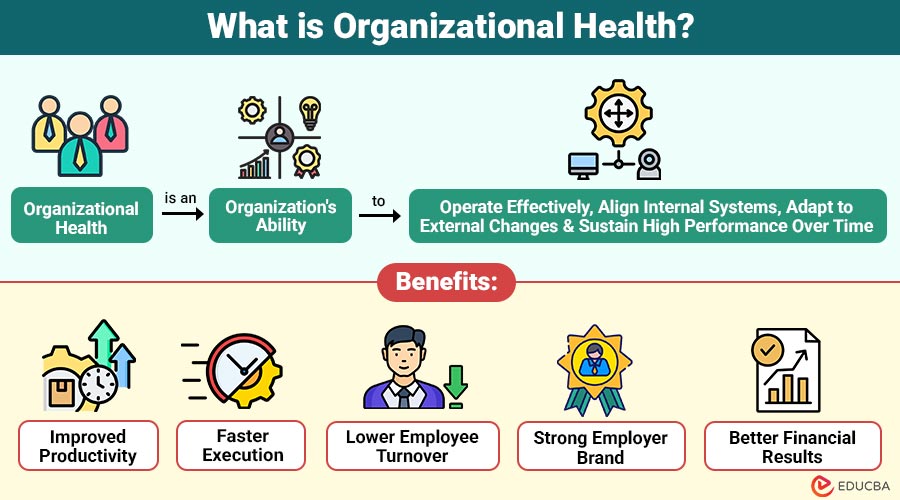
Organizational health is an organization’s ability to operate effectively, align internal systems, adapt to external changes, and sustain high performance over time.
It goes beyond short-term results to evaluate how well an organization:
- Makes decisions
- Executes strategy
- Engages employees
- Builds trust and accountability
- Learns and evolves
Table of Contents:
- Meaning
- Why Does Organizational Health Matter?
- Key Dimensions
- Difference
- Benefits
- Challenges
- Real-World Examples
- How to Improve Organizational Health
Key Takeaways:
- Organizational health builds resilience by strengthening leadership alignment, culture, and systems beyond short-term financial results metrics.
- Healthy organizations empower people, clarify decisions, and enable faster adaptation amid uncertainty and constantly changing environments.
- Long-term success depends on consistently investing in trust, capabilities, and engagement, not on isolated performance initiatives.
- Measuring organizational health guides smarter leadership actions, revealing hidden issues before they damage execution and morale.
Why Does Organizational Health Matter?
Here are the key reasons organizational health is critical for long-term success and sustained business excellence.
1. Sustainable Performance
Healthy organizations consistently achieve long-term results by balancing strong execution with continuous capability development.
2. Employee Engagement and Retention
Positive culture, clear roles, trusted leadership, and growth opportunities boost morale, productivity, and employee retention.
3. Agility and Resilience
Clear decision-making and empowered teams enable organizations to adapt quickly to market, technology, and economic changes.
4. Better Decision-Making
Defined accountability, governance, and reliable data support faster decisions, minimizing friction, confusion, and operational delays.
5. Customer Satisfaction
Aligned teams and engaged employees consistently deliver superior customer experiences, driving loyalty and sustainable revenue growth.
Key Dimensions of Organizational Health
It is multi-dimensional and extends beyond HR policies. The following dimensions are commonly used to assess organizational health:
1. Direction and Strategy
Clear vision, goals, and priorities align daily work with strategy, helping employees understand organizational direction.
2. Leadership and Culture
Trustworthy leadership and strong values foster ethical behavior, transparency, accountability, and psychological safety across teams.
3. Accountability and Governance
Defined roles, ownership, and performance management reduce confusion, improve clarity, and accelerate execution speed.
4. Capabilities and Skills
The right talent, continuous learning, and knowledge sharing build capabilities that enable faster innovation and adaptability.
5. Motivation and Engagement
Recognition, growth opportunities, and purpose motivate employees to exceed expectations and contribute discretionary effort.
6. Coordination and Control
Effective processes, collaboration, and data-driven tracking reduce silos, improve alignment, and increase operational efficiency.
Difference Between Organizational Health and Organizational Performance
Here is a clear comparison highlighting how organizational health and organizational performance differ across key aspects.
| Aspect | Organizational Health | Organizational Performance |
| Focus | Long-term sustainability | Short-term outcomes |
| Nature | Qualitative and cultural | Quantitative and financial |
| Time Horizon | Long-term | Immediate to medium-term |
| Measurement | Engagement, leadership, culture | Revenue, profit, KPIs |
| Dependency | Enables performance | Result of health and execution |
Benefits of Strong Organizational Health
Here are the key benefits that demonstrate how strong it drives people, performance, and long-term business success.
1. Improved Productivity
Healthy organizations reduce internal friction, enabling teams to focus on meaningful work rather than resolving conflicts or navigating unclear processes.
2. Faster Execution
Clear priorities and empowered decision-making accelerate execution across teams.
3. Lower Employee Turnover
Engaged employees are more loyal, reducing recruitment costs and knowledge loss.
4. Strong Employer Brand
Organizations known for healthy cultures attract high-quality talent more easily.
5. Better Financial Results
Research consistently shows that healthy organizations outperform peers in revenue growth, profitability, and total shareholder returns.
Challenges in Building Organizational Health
Despite its benefits, improving organizational health is not without challenges:
1. Resistance to Cultural Change
Employees and leaders often resist new behaviors, mindsets, and processes that challenge established organizational norms.
2. Short-Term Performance Pressure
Immediate revenue targets and quarterly goals overshadow long-term investments in people, culture, and capabilities.
3. Lack of Leadership Alignment
Misaligned leadership priorities create confusion, weaken execution, and undermine organizational trust and strategic focus.
4. Difficulty Measuring Intangible Factors
Culture, engagement, and trust are difficult to quantify, making progress tracking and accountability challenging.
5. Siloed Organizational Structures
Disconnected teams and functions limit collaboration, slow decision-making, and reduce overall organizational effectiveness.
Real-World Examples
Here are practical examples illustrating how improving organizational health drives better outcomes across industries.
1. Technology Company
A fast-growing tech startup faced decision bottlenecks and burnout. By redefining decision rights, introducing flexible work policies, and strengthening leadership coaching, the organization improved engagement scores and accelerated product delivery cycles.
2. Healthcare Organization
A hospital system improved patient outcomes by focusing on organizational health—enhancing teamwork, leadership trust, and cross-department coordination—thereby improving care quality and staff satisfaction.
How to Improve Organizational Health?
Organizations can strengthen their health by:
1. Leadership Alignment
Align leaders around shared values and goals to ensure consistent direction, decisions, and organizational behavior.
2. Clear Strategy Communication
Communicate strategy clearly and consistently so employees understand priorities, expectations, and how their work contributes.
3. Employee Empowerment
Empower employees with decision-making authority to increase ownership, accountability, agility, and engagement.
4. Leadership Development
Invest in leadership development and continuous learning to build strong capabilities across organizational levels.
5. Measure Engagement Regularly
Measure employee engagement and organizational culture regularly to identify gaps and guide improvement initiatives.
Final Thoughts
Organizational health is a critical driver of long-term success, enabling companies to perform consistently, adapt to change, and engage employees effectively. While performance metrics show results, it determines whether those results can be sustained. By prioritizing leadership alignment, employee engagement, accountability, and adaptability, organizations can build a resilient foundation for growth in an increasingly complex business landscape.
Frequently Asked Questions (FAQs)
Q1. How can organizational health be measured?
Answer: Through employee engagement surveys, leadership assessments, retention rates, collaboration metrics, and performance consistency over time.
Q2. Who is responsible for organizational health?
Answer: Leadership teams play the primary role, but HR, managers, and employees collectively contribute to organizational health.
Q3. Can small organizations focus on organizational health?
Answer: Yes. Organizational health is equally important for startups and SMEs and can provide a competitive advantage.
Q4. How long does it take to improve organizational health?
Answer: Meaningful improvement typically requires sustained effort over months or years, not weeks.
Recommended Articles
We hope that this EDUCBA information on “Organizational Health” was beneficial to you. You can view EDUCBA’s recommended articles for more information.

