
What is Marketing Attribution?
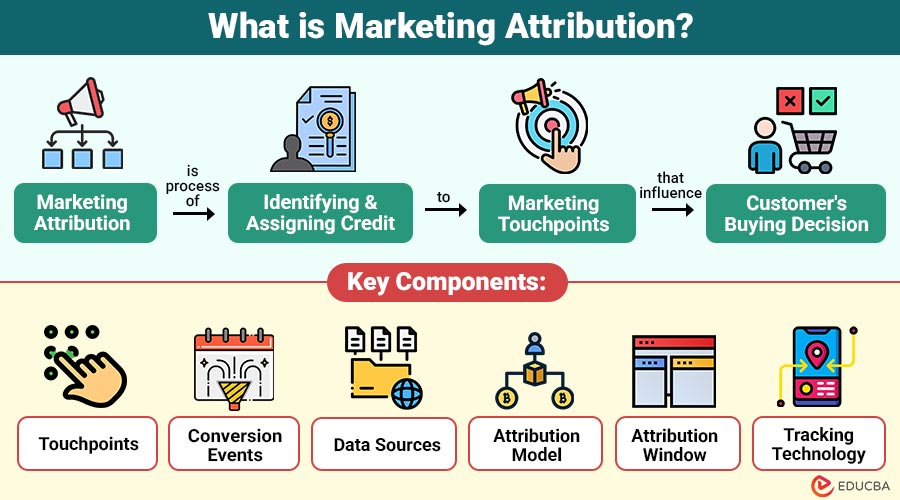
Marketing attribution is process of identifying and assigning credit to marketing touchpoints that influence a customer’s buying decision. It helps determine which channel contributed how much to a final conversion (e.g., purchase, sign-up, download, inquiry).
In simple terms:
Marketing attribution answers the question —
“Which marketing activities drove my results?”
Table of Contents:
- Meaning
- Why Marketing Attribution Matters?
- Key Components
- Marketing Attribution Models
- Working
- Benefits
- Challenges
- Tools
- Real-World Examples
Key Takeaways:
- Marketing attribution clarifies which channels truly drive conversions, enabling smarter, evidence-based marketing investment decisions and success overall.
- Using appropriate attribution models improves budget allocation, performance optimization, and understanding of complex customer journey behavior.
- Data-driven attribution delivers more accurate, unbiased insights by leveraging real user behavior across multiple touchpoints and channels.
- Successful attribution requires integrated data, privacy-aware tracking, and continuous optimization aligned with business goals and growth strategies.
Why Marketing Attribution Matters?
Here is why businesses rely on attribution:
1. Accurate ROI Measurement
Accurately measures ROI by revealing which marketing channels and campaigns generate the highest revenue and business impact.
2. Optimized Marketing Spend
Optimizes marketing spend by reallocating budgets away from underperforming channels toward strategies that consistently drive better results.
3. Better Customer Journey Insights
Provides clear customer journey insights by mapping interactions across multiple touchpoints before conversions occur.
4. Improved Personalization
Improves personalization by using behavioral data to deliver relevant content, offers, and messaging to each audience segment.
5. Enhanced Strategy & Forecasting
Enhances strategic planning and forecasting by guiding budget allocation decisions based on proven marketing performance data insights.
6. Cross-Channel Performance Comparison
Enables cross-channel performance comparison by consolidating data across paid, owned, and earned media platforms into a unified view.
Key Components of Marketing Attribution
Here are the main components that make up marketing attribution:
1. Touchpoints
Customer interactions across ads, emails, websites, social media, and other brand engagement channels throughout the journey.
2. Conversion Events
Desired customer actions such as purchases, sign-ups, form submissions, or downloads that indicate successful marketing outcomes.
3. Data Sources
Platforms collecting interaction data include analytics tools, CRM systems, advertising platforms, and offline sales records.
4. Attribution Model
Defined rules determining how marketing credit is assigned across touchpoints, influencing conversions in customer journeys.
5. Attribution Window
Specified time period during which prior marketing interactions are eligible for conversion credit assignment.
6. Tracking Technology
Tools like cookies, pixels, UTM parameters, server-side tracking, and AI models enable accurate attribution measurement.
Marketing Attribution Models
Here are the main types of marketing attribution models used to evaluate and optimize customer journeys:
1. Single-Touch Attribution Models
Single-touch attribution models assign 100% of conversion credit to a single touchpoint in the customer journey.
a. First-Touch Attribution: Assigns full credit to the first interaction that introduces a user to the brand.
- Best for: Brand awareness and top-of-funnel campaigns
- Advantage: Clearly identifies channels driving initial discovery
- Limitation: Ignores all subsequent interactions that influence conversion
b. Last-Touch Attribution: Gives the last interaction before conversion full credit.
- Best for: Conversion-focused and bottom-of-funnel analysis
- Advantage: Simple to implement and easy to understand
- Limitation: Overlooks awareness and consideration-stage touchpoints
2. Multi-Touch Attribution Models
Multi-touch attribution models distribute conversion credit across multiple touchpoints, reflecting the full customer journey.
a. Linear Attribution: Gives equal credit to each of the journey’s touchpoints.
- Best for: Balanced journey analysis with consistent engagement
- Advantage: Fair and simple representation of all interactions
- Limitation: Treats all touchpoints equally, regardless of actual influence
b. Time-Decay Attribution: Assigns increasing credit to touchpoints closer to conversion.
- Best for: Short sales cycles and conversion-driven campaigns
- Advantage: Emphasizes interactions that directly drive conversions
- Limitation: Undervalues early-stage awareness efforts
c. Position-Based (U-Shaped) Attribution: Allocates higher credit to the first and last touchpoints, with remaining credit shared among the middle interactions.
- Best for: Journeys where discovery and conversion are equally important
- Advantage: Balances awareness and closing touchpoints effectively
- Limitation: May oversimplify complex, non-linear customer journeys
3. Data-Driven Attribution
Data-driven attribution allocates credit according to each touchpoint’s true impact using machine learning techniques.
a. Data-Driven Attribution Model: Evaluates actual user activity and quantitatively gives touchpoints credit according to how much they contribute to conversions.
- Best for: Large businesses with complex, multi-channel journeys
- Advantage: Highly accurate and unbiased
- Limitation: Requires large volumes of high-quality data
How Marketing Attribution Works?
Here is how marketing attribution works step by step to track, measure, and optimize the impact of marketing efforts across multiple channels.
1. Track Customer Touchpoints
Track customer touchpoints by capturing ad clicks, impressions, page visits, email opens, and other interactions accurately and consistently.
2. Merge Multi-channel Data
Merge multi-channel data from CRM systems, analytics platforms, advertising tools, and offline store visits seamlessly into dashboards.
3. Identify Conversion Events
Identify conversion events such as purchases, qualified leads, subscriptions, sign-ups, or completed actions across digital channels accurately.
4. Apply Attribution Model
Apply an attribution model using rule-based logic or algorithmic methods to assign conversion credit effectively across touchpoints.
5. Analyze Channel Contribution
Analyze channel contribution to measure campaign impact, influence, efficiency, and revenue contribution throughout the customer journey lifecycle.
6. Optimize Campaigns and Spend
Optimize campaigns and marketing spend by continuously shifting budgets toward the highest-converting, highest-value channels to improve performance.
Benefits of Marketing Attribution
Here are the key benefits of marketing attribution that help businesses optimize performance and maximize returns:
1. Improved Budget Allocation
Improve budget allocation by stopping spending on low-value channels and consistently reallocating funds to high-performing, revenue-driving efforts.
2. Increase Revenue & Conversions
Increase revenue and conversions by focusing efforts on channels that consistently drive measurable, high-quality business results growth.
3. Shorter Sales Cycles
Shorter sales cycles occur when optimized touchpoints efficiently guide prospects, reducing friction and accelerating conversion decision timelines.
4. Enhanced Customer Experience
Enhanced customer experience emerges from personalized journeys created using attribution insights, delivering relevant content at every stage.
5. Better Cross-Channel Strategy
A better cross-channel strategy is developed by understanding how channels interact, complement each other, and collectively influence conversions effectively.
Challenges in Marketing Attribution
Despite its advantages, attribution has challenges.
1. Data Silos
Different marketing platforms store customer data separately, creating fragmented insights and limiting the accuracy of holistic attribution analysis.
2. Cross-Device Tracking Issues
Users frequently switch devices during journeys, making consistent tracking and accurate attribution across sessions particularly challenging.
3. Privacy Restrictions
Privacy restrictions like cookies, GDPR, and iOS tracking transparency significantly reduce data availability for attribution modeling.
4. Offline & Online Integration
Integrating offline purchases with online interactions is complex, limiting the effective measurement of omnichannel marketing impact.
5. Choosing the Right Model
Businesses often struggle to select the right attribution model aligned with their goals, data maturity, and journey complexity.
6. Attribution Bias
Rule-based attribution models oversimplify customer behavior, ignoring nuanced interactions and producing performance insights that are often misleading.
Popular Marketing Attribution Tools
Here are some widely used marketing attribution tools that help businesses track, analyze, and optimize marketing performance across channels:
1. Google Analytics 4
Provides data-driven attribution and cross-channel insights to understand complete customer journeys across platforms.
2. HubSpot
Offers multi-touch attribution focused on inbound marketing, effectively connecting content, leads, and revenue performance.
3. Adobe Analytics
Delivers advanced attribution modeling and deep segmentation for enterprise-level customer behavior and marketing performance analysis.
4. Rockerbox
Combines D2C attribution with marketing mix modeling to measure incrementality and optimize advertising effectiveness.
5. Wicked Reports
Tracks eCommerce attribution and ROAS by connecting ads, customer journeys, and revenue across channels.
6. Adjust
Enables mobile attribution and in-app analytics to accurately track installs, engagement, and conversion performance.
Real-World Examples
Here are real-world examples showing how marketing attribution drives smarter decisions and measurable business impact:
1. eCommerce Brand Boosts ROAS
A D2C fashion brand found that Google Search and Instagram Ads had the strongest combined influence. They shifted budgets and increased ROAS by 45%.
2. SaaS Company Improves Lead Quality
Attribution analysis showed webinar attendees converted 3x more. Result: more budgets allocated to webinar promotions.
3. Travel Company Reduces Wasted Spend
Time-decay attribution showed that email retargeting accounted for 60% of bookings. They increased email investment by 30%.
Frequently Asked Questions (FAQs)
Q1. What is the purpose of marketing attribution?
Answer: To identify which channels contribute to conversions and optimize spending accordingly.
Q2. Which attribution model is the best?
Answer: For most modern businesses, data-driven attribution is the most accurate.
Q3. Can attribution work without cookies?
Answer: Yes—through server-side tracking, first-party data, and AI-based modeling.
Q4. Is marketing attribution only for digital channels?
Answer: No—modern systems integrate offline channels such as call centers and stores.
Recommended Articles
We hope that this EDUCBA information on “Marketing Attribution” was beneficial to you. You can view EDUCBA’s recommended articles for more information.


