


What You Need to Know Before Choosing a Hospitality School?
In the highly competitive world of hospitality education, rankings often grab attention first. Those “Top 10 hotel schools” lists, bold badges declaring “#1 worldwide,” and glowing numbers can make any school seem like the obvious choice. For students and parents, it is tempting to assume: “This school must be good.” However, when it comes to choosing a hospitality school, rankings only tell part of the story. To make the best decision, you need to dig deeper and ask questions that numbers alone cannot answer.
Why Rankings Matter, But Not Completely?
Scores from bodies like Quacquarelli Symonds (QS) or CEOWORLD Magazine are undeniably useful. For example, QS’s “Hospitality & Leisure Management” ranking highlights academic reputation, employer reputation, citations per paper, and faculty impact. These metrics provide a snapshot of institutional performance at a macro level showing global perception, research impact, and recruiter ratings of graduates.
However, these metrics do not always reflect students’ lived experience, the programme’s layout, the pedagogical style, the quality of the internship, or how well the school serves your individual ambitions. As one commentary notes, “you may have heard about a school being at the top in one ranking and completely different in another” because “every organisation uses a slightly different methodology.” Hospitality Net. In other words, rankings provide a map, not the terrain.
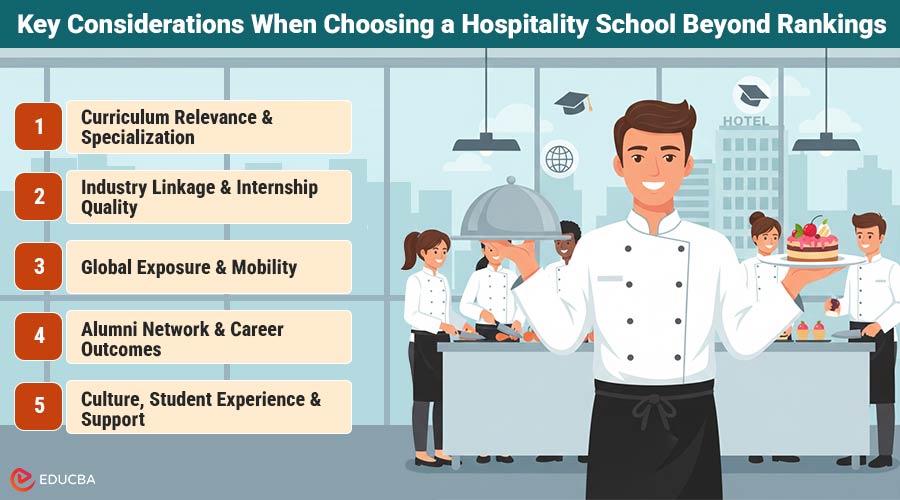
Key Considerations When Choosing a Hospitality School Beyond Rankings
When choosing a hospitality school, consider factors beyond global rankings:
1. Curriculum Relevance and Specialization
A school may rank highly overall in hospitality, but you have to check what kind of hospitality it offers. Is it luxury hotel management, resort operations, event management, F&B leadership, or tourism entrepreneurship? A generic “Hospitality & Leisure” tag would not unpack that. On the other hand, a school with a narrower focus may serve you better if you already know your niche. For example, in the case of Glion, one feature that differentiates it is the blend of “business strategy, real-world experience, global industry access and strong leadership training”. Ask: Does the programme include strategic leadership, not just service operations? Are advanced modules offered (digital revenue management, luxury brand strategy, sustainable hospitality)? How much of it is hands-on versus lecture-based?
2. Industry Linkage & Internship Quality
Rankings rarely capture the depth of industry partnerships, the actual internship experiences, and whether the “real-world” switch is smooth. A strong internship network means exposure, credible work experience, and often a first foot in the door. Ask: Does the school place you into meaningful internships with major brands or boutique operators? Are these internships paid? How long are they? Where are these located? Does the school assist you in finding a job after graduation?
3. Global Exposure & Mobility
Hospitality is inherently global. A top-ranked programme may be nationally strong but less globally oriented. You will want exposure to different cultures, cross-border mobility, a diverse cohort, and perhaps campuses in multiple locations. For instance, Glion offers campuses in Switzerland and London, providing students with an international context and the adaptability needed to work in multicultural teams. Ask: What are the campuses? What are the study-abroad options, or opportunities to work in different countries? How international is the student body and faculty?
4. Alumni Network & Career Outcomes
Again, rankings may reference ’employer reputation,’ but they seldom break down alumni outcomes by region or career path. A school might be ranked high yet deliver outcomes that differ depending on the student’s origin or focus. Ask: Where do alumni work three or five years after graduating? Are they in operations, leadership, or simply entry-level jobs? How active is the alumni network regionally and globally? Can you connect with alumni from your home country or target market?
5. Culture, Student Experience & Support
The facade of a ranking can not show how you will feel walking through campus at 8 a.m., navigating group projects late at night, balancing study and practical placements, or juggling cultural adaptation as an international student. Ask: What support services exist (career, academic, wellness, accommodation)? How many international students are on campus, and how well are they supported? What is the class size and student-to-faculty ratio? Does the school’s culture suit your personality (competitive, collaborative, luxury-oriented, boutique-focused)?
6. Recognition, Accreditation & Transferability
Some rankings focus on research output and reputation rather than accreditation or the transferability of your qualification. Especially if you are studying abroad, you want to ensure your degree is recognised, your credits transferable, and that you can use the credential globally. For example, institutions list accreditation from various bodies and membership of global quality assurance networks. Ask: Is the programme accredited by recognised bodies? Will your degree be valid in your target country or employer market? Are qualification routes clearly outlined?
7. Cost vs Value
High ranking often correlates with high cost. Yet the value arises from how the school helps you realise your ambitions. A heavily-ranked institution may charge a premium but deliver less practice-oriented learning or weaker industry integration. Ask: What is the real total cost (tuition + living + internships unpaid)? What scholarships exist? What is the typical graduate salary or placement rate? What is the return on investment for your career goals and home market?
Checklist for Choosing a Hospitality School
- Visit the school (or take a virtual tour) and speak with current students and alumni, especially those from your home country or with a similar background.
- Review the curriculum modules and map them to what you want to do in 5–10 years.
- Check internship partners, placement statistics, and alumni outcomes (not just globally, but regionally relevant).
- Explore international mobility options, campus locations, and the diversity of classmates and faculty.
- Understand accreditation and whether your degree will be recognized or transferable where you want to work.
- Consider costs, living expenses, fees, hidden costs, and potential scholarships.
- Reflect on whether the school culture feels like a fit bespoke hospitality programmes thrive when students feel they belong and are motivated to lead.
How to Evaluate a Hospitality School?
Prestigious names and rankings may attract attention, but the real value of a hospitality education lies in the learning and growth that happen beyond the accolades. From industry access to cultural fit, internships to alumni networks, choosing the right school means looking deeper. The best institutions show that a strong balance of academic excellence, real-world experience, and international outlook matters far more than a place on a list.
Final Thoughts
Choosing a hospitality school is less about chasing “top-ranked” and more about choosing the right fit. Rankings can guide you to shortlist institutions, but they should never be the only filter. By asking deeper questions about curriculum, internships, global exposure, alumni outcomes, culture, cost, and alignment with your goals, you make a smarter choice. After all, a hospitality education is more than a certificate it shapes your career, your network, and your international future. And when you begin with the right questions rather than the headline score, you’re far more likely to choose a school that truly fits your goals.
Recommended Articles
We hope this guide on choosing a hospitality school helps you make informed decisions. Check out these recommended articles for more tips and insights.


