


Updated November 25, 2025
Introduction
Managing inventory has consistently been one of the most challenging aspects of operating a business. Money sits on boxes when you stock too much. They lose customers to competitors if they do not have sufficient inventory. At some point, every business owner has had to strike this delicate balance. However, contemporary companies are no longer compelled to rely on guesswork or outdated spreadsheets to determine their inventory requirements. With AI inventory forecasting, businesses now have quicker, more advanced, and more dependable ways to manage stock.
Artificial intelligence (AI) revenue forecasting provides a comprehensive view that goes beyond intuition or past sales data. It examines trends, shifts in customer behavior, market changes, and external factors often overlooked. This enables businesses to stay prepared, reduce waste, and swiftly adjust to evolving demand, improving overall efficiency and decision-making.
Why Traditional Inventory Planning Falls Short?
For years, businesses have used historical sales data and basic formulas to estimate the amount of stock they would need. These methods are effective to an extent, but they overlook many important details. Customer preferences shift rapidly, trends can emerge and disappear within weeks, and supply chains often face sudden disruptions.
When planning is based solely on last year’s data, it often fails to capture what is happening right now. This leads to
- Extra stock that needs to be stored.
- Stock-outs during busy times.
- Misjudged the best time to buy.
- Cash becomes trapped in slow-moving things.
When markets change quickly, manual planning is not enough, which is why adopting reliable inventory management software online helps businesses become faster, more proactive, and far less dependent on human assumptions, because it is slow, reactive, and overly reliant on human opinion.
How AI Inventory Forecasting Works?
AI inventory forecasting utilizes machine learning, a method in which computers learn patterns from large datasets. It gets better at guessing what will happen in the future as you give it more information. Here is what AI typically looks at
- Past sales
- Seasonal demand
- Product popularity
- Regional buying patterns
- Marketing campaigns
- Pricing changes
- Supplier lead times
- Online browsing behavior
- Economic and local trends
AI brings all these pieces together to give a clear picture of what demand might look like in the coming days, weeks, or months. And unlike traditional methods, AI updates its demand forecasting whenever new information becomes available. It learns continuously.
Benefits of AI Inventory Forecasting
AI inventory forecasting empowers businesses to operate with precision, reducing guesswork and strengthening every stage of the inventory lifecycle.
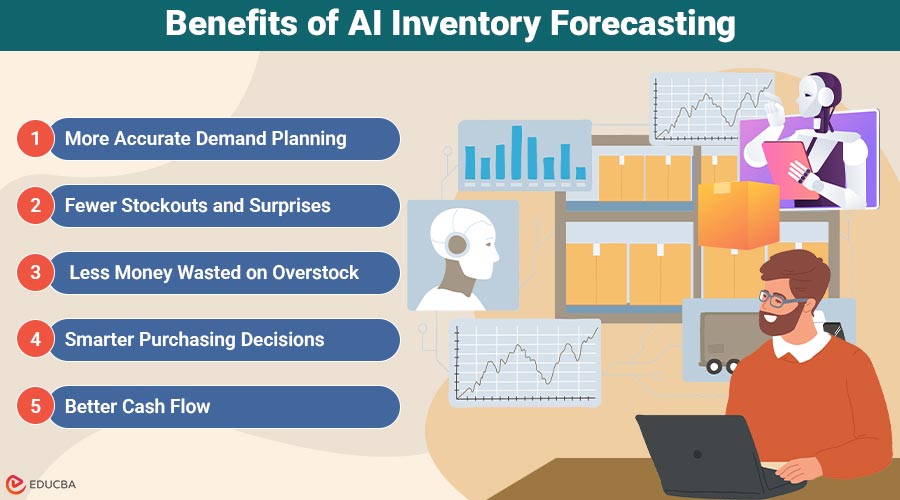
1. More Accurate Demand Planning
Instead of guessing or hoping that stock levels match customer demand, AI can accurately predict what will happen. It can immediately detect when demand is increasing or decreasing and when a product becomes less popular. This keeps companies one step ahead, so they do not have to move quickly.
2. Fewer Stockouts and Surprises
Running out of important items harms sales and damages customer trust. With AI forecasting, businesses can track items that are selling faster than expected and reorder before they run out. It reduces last-minute panic decisions.
3. Less Money Wasted on Overstock
Overstock is costly not only because it locks up cash, but also because products can expire, go out of trend, or lose value over time. AI inventory forecasting helps maintain lean, efficient inventory levels so businesses avoid storing items customers no longer want.
4. Smarter Purchasing Decisions
AI can also recommend the right time to reorder. It examines supplier lead times, delivery delays, price fluctuations, and historical order patterns. This means purchase decisions are based on real data, not instinct.
5. Better Cash Flow
When inventory matches demand, businesses do not overspend on stock they do not need. This frees up cash that can be used for marketing, expansion, or product development.
6. Improved Customer Satisfaction
When customers consistently find what they want in stock, they are more likely to return. Reliable availability builds trust, something every business wants to strengthen. Leading VoIP providers help ensure real-time communication between sales channels and inventory systems, making it easier to keep accurate stock records and support a better customer experience.
7. Less Waste, Especially for Perishable Goods
Industries such as food, beauty, and healthcare manage products with limited shelf lives. AI forecasting helps them prevent over-ordering and significantly reduces waste.
How Different Businesses Are Using AI Forecasting?
AI Forecasting is transforming operations across industries by improving accuracy, reducing waste, and enabling smarter decision-making.
1. Retail & E-commerce
In Retail & E-commerce, AI helps online stores track browsing behavior, understand what customers search for, and identify when sales rise or fall. They can then plan their stock based on the goods they think will be successful.
2. Manufacturing
AI helps manufacturers determine the optimal amount of raw material needed. This keeps things running smoothly and prevents production from being held up.
3. Food and Groceries
AI helps grocery stores and restaurants prevent over-purchasing items that spoil quickly, which is crucial when profit margins are tight.
4. Fashion
Fashion brands utilize AI to stay ahead of rapidly changing customer tastes and trends, thereby avoiding excessive seasonal stockpiling.
These use cases highlight how AI planning supports businesses across various industries and scales.
Getting Started with AI Inventory Forecasting
To use AI forecasts, you do not need to know a lot about technology. The first step is to organize your data. Shadcn AI works best when your sales records, product details, and supplier information are clean and up-to-date. Focus on your most important or best-selling items at first to get a feel for how the system works. Then, add all of your items to it. Additionally, it is best to select AI software that integrates seamlessly with your current point-of-sale (POS) or tracking system.
These days, many tools are designed to be easy to use and require minimal technical setup. Make sure your team understands how the AI generates predictions and how to apply them to purchasing and planning decisions. When people understand the “why” behind the tool, results naturally get better. Finally, make it a habit to review forecasts regularly. While AI becomes more accurate over time, human oversight remains crucial for comparing predictions with actual sales and making necessary adjustments.
Final Thoughts
Inventory management no longer requires forecasting. AI inventory forecasting clarifies what clients will purchase, when demand is expected to grow, and how much stock you need. It reduces waste, shortages, and streamlines processes, thereby improving cash flow.
Using AI to keep track of goods is not just smart; it is becoming necessary in a world where markets change quickly, and customer standards keep rising. AI forecasting is an excellent tool for businesses that wish to operate confidently and meet demand.
Recommended Articles
We hope this guide on AI Inventory Forecasting helped you optimize inventory planning. For more insights, explore these related articles below:


