


What Is the Long Tail?
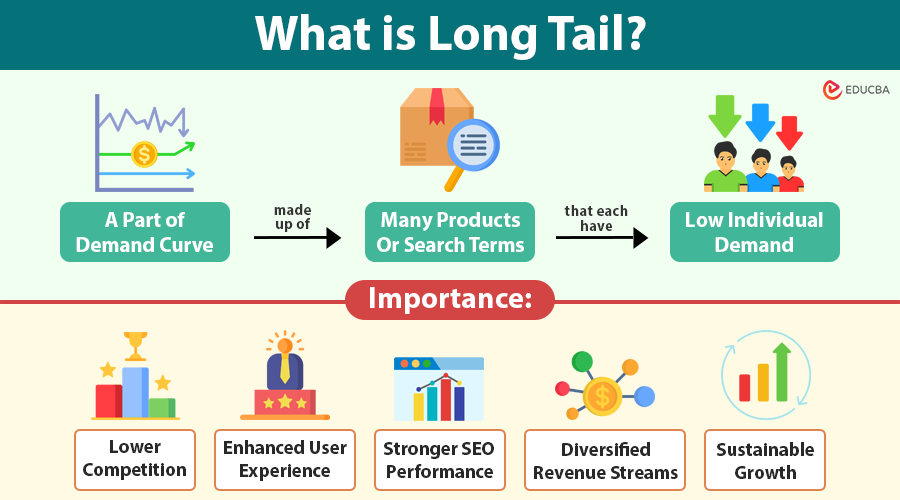
The long tail refers to the extended section of a demand curve where numerous products or search terms each have low individual demand. However, their combined volume equals or surpasses the demand for mainstream products. This concept applies to product catalogs, streaming libraries, search queries, and content topics.
Key characteristics of the long tail:
- High variety but low volume per item
- Massive cumulative demand
- Availability enabled by digital platforms
- Niche segmentation and personalization.
Physical stores can offer only what fits on shelves, but digital businesses can list millions of items, making the long tail a practical and profitable strategy.
Table of Contents
- Meaning
- Importance
- How Does it Work?
- Long Tail in SEO
- Long Tail in eCommerce
- Long Tail in Content Strategy
- Examples
- How to Build a Strategy?
- Advantages
- Challenges
Why Is the Long Tail Important?
It is important because it democratizes markets. It shifts focus from competing only in broad, saturated categories to tapping into smaller, overlooked segments where customer needs are highly specific.
- Lower competition: Niche markets have fewer competitors, making it easier to rank in search engines, gain visibility, and sell products.
- Enhanced user experience: Customers discover more personalized products, content, and recommendations tailored to their individual interests.
- Stronger SEO performance: Long tail keywords attract high-intent users who are more likely to convert.
- Diversified revenue streams: Businesses generate income from hundreds or thousands of small niches, reducing dependence on top sellers.
- Sustainable growth: Long tail strategies create a stable demand curve, minimizing risks associated with trends or market fluctuations.
How the Long Tail Works?
The long tail works by removing the traditional limitations of inventory, shelf space, and distribution. Digital platforms can host an unlimited number of products, enabling niche items to reach the right customers, even if demand is small.
For example, A physical music store may be limited to carrying only 500 popular albums due to space constraints.
A digital platform like Spotify can host millions of tracks from global hits to those of independent artists with small fan bases. Over time, these niche tracks collectively generate massive listening hours and steady revenue.
Key enablers of the model:
- Digital storage
- Algorithmic recommendations
- Global reach
- Data-driven targeting
- Low distribution costs.
This digital infrastructure enables businesses to capitalize on localized demand worldwide.
Long Tail in SEO
In digital marketing, long tail keywords form the backbone of modern SEO strategies. These are longer, specific search phrases with lower competition but higher intent.
- Higher ranking potential: It makes it easier to appear on the first page of search results.
- Voice search alignment: Users increasingly speak in full sentences, exactly how long tail queries are structured.
- Higher conversion rates: Users searching for specific queries are more likely to know exactly what they want and are therefore more likely to make a purchase.
- Cost-effective advertising: Long tail keywords reduce PPC costs because they face less bidding competition.
- Topical authority building: Publishing content around long tail keywords helps establish niche dominance.
Long Tail in eCommerce
The long tail is a powerful revenue driver in eCommerce. While bestsellers drive initial traffic, niche products drive long-term profitability.
- Stocking variety: Online marketplaces can list tens of thousands of products, catering to micro-niches such as organic pet food, customized stationery, or vegan skincare.
- Search-based discovery: Customers often search for very specific items, such as long tail keywords like “eco-friendly bamboo toothbrush for kids.”
- Recommendation engines: Platforms use AI to suggest niche products users never knew they wanted.
- Personalized ads: Retailers target niche product ads to small but highly engaged audiences.
- Niche store creation: Entrepreneurs build stores around specific themes, such as vintage decor, anime merchandise, or gluten-free baking supplies.
By serving thousands of micro-communities instead of one broad audience, eCommerce companies experience scalable growth.
Long Tail in Content Strategy
Content creators, bloggers, YouTubers, and educators thrive when they apply this strategy.
Instead of creating generic content that competes with millions of other creators, they produce niche content that answers specific questions.
- Tutorials: “How to repair a leaking Samsung washing machine drum”
- Guides: “Beginner-friendly photography tips for rainy-day portraits”
- Reviews: “Best laptops under 40,000 INR for content creators in 2025”
- Education: “How to understand behavioral economics as a beginner”
Why long tail content succeeds:
- It consistently brings in organic traffic for years.
- It satisfies a highly specific user intent.
- It positions the creator as an expert in niche topics.
- It encourages loyal community building.
- It avoids competing with viral or trendy content.
With a long-tail content strategy, even small creators can achieve a massive cumulative reach.
Examples of Long Tail Businesses
Many globally successful companies built their empires on the long tail model.
- Netflix: Uses data to recommend niche movies, documentaries, and international shows, generating continuous engagement.
- Amazon: Generates substantial revenue from millions of low-demand products offered by sellers across the world.
- Spotify: Supports indie musicians by making niche music discoverable through playlists and algorithms.
- YouTube: Enables creators to succeed in micro-niches such as woodworking, gaming hacks, fitness routines, or language learning.
- Udemy & Coursera: Offer courses in everything from AI to knitting—topics traditional institutions would never cover.
How to Build a Long Tail Strategy?
Businesses must combine analytics, creativity, segmentation, and personalization to achieve optimal results.
- Analyze niche demand: Use keyword tools, market research, and customer feedback to identify underserved niches.
- Expand offerings: Add niche products, categories, or content tailored to micro-audiences.
- Organize your catalog: Use filters, categories, and tags to make niche items discoverable.
- Publish long tail content consistently: Cover specific questions, pain points, and user searches.
- Use personalization tools: Recommend niche content based on individual preferences.
- Leverage long tail keywords in SEO: Optimize pages with variations, synonyms, and related search queries.
- Track performance: Identify which long tail niches drive most conversions and scale them.
Advantages of the Long Tail
It provides significant advantages for businesses, especially those operating in digital markets.
- Access to global audiences: Niche interests from around the world contribute to cumulative demand.
- Steady passive revenue: Long tail products often sell consistently without heavy marketing.
- Better personalization: Long tail strategies allow brands to match products to individual tastes.
- Competitive edge: By dominating smaller niches, businesses avoid direct competition with industry giants.
- Evergreen visibility: Niche keywords consistently maintain stable search demand throughout the year.
- Future-proofing: As user preferences diversify, the long tail becomes increasingly valuable.
Challenges of the Long Tail
While powerful, it comes with challenges that need careful management.
- Catalog complexity: Managing thousands of niche items requires strong systems and automation.
- Content overload: Too much niche content without proper structure can confuse users.
- Algorithm dependency: Platforms rely heavily on discovery algorithms to surface niche options.
- Quality control: Low-demand items may lack sufficient reviews or quality checks.
- Marketing difficulty: Identifying niche audiences can be challenging without precise targeting tools.
Final Thoughts
The long tail is transforming how businesses operate, enabling them to reach millions of niche markets that traditional models often overlook. From SEO to eCommerce, content creation to streaming services, long tail strategies drive consistent growth, improved user satisfaction, and diversified revenue.
By focusing on niche products, long tail keywords, and specific audience needs, businesses can achieve stronger visibility, higher conversions, and long-term success. The future of digital commerce and content creation lies in mastering the long tail.
Frequently Asked Questions (FAQs)
Q1. How is the long tail different from the Pareto Principle (80/20 rule)?
Answer: The Pareto Principle suggests that 20% of products generate 80% of revenue.
The long tail challenges this idea by showing that the remaining 80% the niche items can collectively generate revenue equal to or greater than the popular top sellers, especially in digital marketplaces.
Q2. Does every business need a long tail strategy?
Answer: Not necessarily. Businesses with limited digital capabilities, highly specialized offerings, or physical-only operations may find long tail strategies challenging. However, almost all online businesses can benefit from incorporating some long-tail elements, whether through content, products, or SEO.
Q3. How do long tail keywords improve conversion rates?
Answer: Long tail keywords capture users who have a clear, specific intent. These users are usually closer to making a decision, so they are more likely to buy than people searching with broad, general keywords.
Q4. How does the long tail impact pricing strategies?
Answer: Businesses often price long tail products higher because they serve specialized needs with lower competition. Conversely, some platforms offer niche products at lower prices when scale offsets the lower demand.
Q5. Is the long tail relevant in 2025 and beyond?
Answer: Yes, its relevance continues to grow. As digital consumption rises and AI improves discoverability, the long tail becomes even more valuable for businesses aiming for personalization, global reach, and diversified revenue.
Recommended Articles
We hope this article helps you understand how niche markets, long tail keywords, and micro-segmentation can unlock powerful growth opportunities. Explore our related articles to learn more about SEO strategies, eCommerce trends, and building data-driven content models for long-term success.

