


Introduction to Hedging Against Inflation
In the global economic environment, many investors are increasingly concerned with the risk of rising prices eroding the purchasing power of their wealth. This is where the concept of hedging against inflation comes into play. To hedge against inflation means taking investment steps designed to protect real returns when the general price level of goods and services increases.
Inflation can undermine both savings and investment returns. What you earn in nominal terms may look good, but if inflation is high, your real return (after adjusting for price rises) might be negative. Consequently, modern investors must think beyond traditional stocks and bonds and adopt strategic approaches to preserve the real value of their capital.
This article explores why hedging against inflation is important, offers a set of practical strategies, examines the role of precious metals (especially gold) as one tool, and outlines how to build a resilient, inflation-aware portfolio.
Why Hedging Against Inflation Matters?
Understanding why inflation can erode your wealth is the first step in developing effective strategies to protect your investments.
The Inflation Risk
Inflation diminishes the real value of money: if the annual inflation rate is 5 %, then, in effect, your purchasing power falls by about 5 % if your investments do not keep up.
Furthermore, inflation is often unpredictable; what one might expect (say 2 %) might turn out to be 6 % or higher, imposing greater real losses.
Impact on Different Asset Classes
Investors have often used stocks as a hedge against inflation because companies can pass on higher costs to their customers, thereby mitigating the impact of inflation on their investments. However, research indicates that during periods of high inflation, equities have typically delivered negative real returns.
Fixed income (bonds) is vulnerable: rising inflation leads to higher nominal interest rates and lower fixed‑income bond prices (in real terms). The real return becomes negative if inflation outpaces the coupon rate.
Macro Environment Shift
With global central banks having pumped liquidity into economies and supply-chain disruptions persisting, concerns about inflation have risen. According to a widely‑cited report, gold is a “proven long‑term hedge against inflation,” though not always in the short term.
Hence, for modern investors, having dedicated strategies for hedging against inflation is no longer optional; it may be essential.
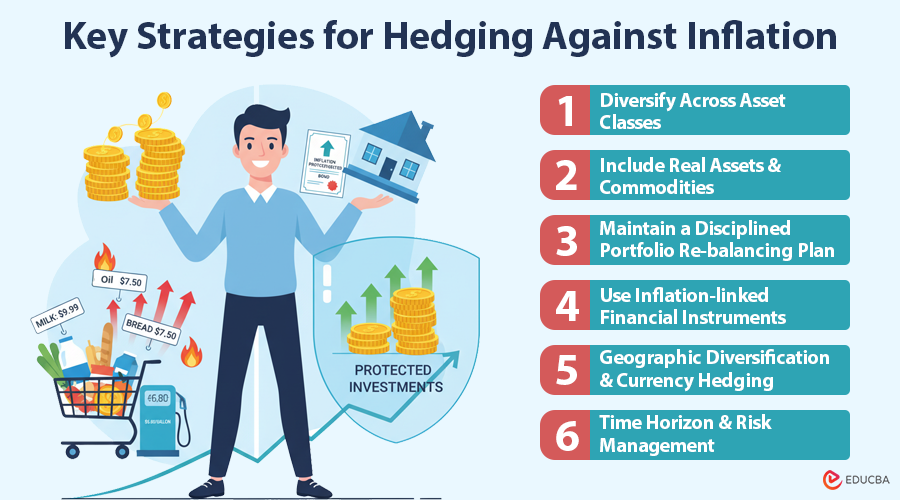
Key Strategies for Hedging Against Inflation
Here are several practical strategies that modern investors can adopt. These are not mutually exclusive; a diversified approach often works best:
1. Diversify Across Asset Classes
One core strategy is to hold assets whose cash flows or values rise with inflation. For example:
- Inflation‑linked bonds (e.g., government bonds whose coupon or principal adjusts with CPI)
- Real assets: real estate, infrastructure, commodities
- Equities of companies with strong pricing power
- By diversifying across these, you reduce dependence on any single inflation‑sensitive asset. Empirical work suggests no single asset offers a perfect hedge in all inflation regimes.
2. Include Real Assets and Commodities
Real assets, such as property, infrastructure, farmland, or commodities, typically appreciate when input or consumer prices rise. They offer a more direct hedge because they either generate cash flows or their underlying assets appreciate in value.
For example, a 2024 study found that gold exhibits a stronger inflation-hedging ability when annual inflation exceeds roughly 6%, although in other regimes, the effect is weaker.
Thus, including real‑asset exposure is a wise tactic for hedging against inflation.
3. Maintain a Disciplined Portfolio Re‑balancing Plan
When inflation is rising, investors may need to reassess their allocations, reduce exposure to assets vulnerable to inflation (e.g., long-duration bonds), and increase exposure to inflation hedges. Regular monitoring and rebalancing ensure that the inflation hedge portion remains sufficient.
Additionally, you can tailor the hedge ratio to your risk tolerance and horizon: for example, younger investors may accept more volatility and hedge less, while retirees may hedge more aggressively.
4. Use Inflation‑linked Financial Instruments
There are instruments specifically designed for inflation hedging, such as inflation swaps and inflation-linked bonds, notably Treasury Inflation-Protected Securities (TIPS) in the U.S. These instruments provide direct exposure to inflation risk.
While these may offer more “pure” inflation hedge, they also come with complexity, liquidity constraints, and potentially higher costs, so they require careful consideration.
5. Geographic Diversification & Currency Hedging
Inflation is often country‑specific. By holding assets in multiple currencies and regions, you reduce the inflation risk concentrated in a single economy. Moreover, currency depreciation often accompanies inflation, so hedging currency risk goes hand‑in‑hand with inflation hedging.
6. Time Horizon & Risk Management
Your time horizon matters. The effectiveness of hedges can vary depending on how long you plan to hold them and the inflation regime. Research indicates that assets such as equities or gold may exhibit different behavior in short-term versus long-term periods of inflation.
Hence, define your horizon clearly and calibrate the hedge accordingly.
The Role of Precious Metals and the Link to Asset Protection
Among the asset classes used to hedge against inflation, precious metals (especially gold) have a unique place.
Why is Gold Often Used?
Gold has several features that make it attractive as an inflation hedge:
- It is a real asset with intrinsic value and scarcity.
- It is independent of any single currency’s purchasing power.
- Gold has historically maintained its value during periods of high inflation. The World Gold Council states that gold is a reliable long-term hedge, although its short-term performance can fluctuate.
- When discussing inflation hedging strategies, it is natural to link them to gold prices as a real-time reference for how this hedge is performing in the market.
Limitations and Caveats
However, gold is not a flawless inflation hedge. Some scholarly research shows that under certain inflation regimes or structural breaks, gold’s effectiveness may decline. A study covering the period from 1953 to 2023 found that gold failed to hedge effectively in one regime until researchers accounted for structural breaks in the data.
Therefore, while gold can be a powerful component of your inflation hedge strategy, it should not be relied upon exclusively.
Practical Implementation of a Gold‑based Hedge
- Decide whether you will hold physical gold, gold mining stocks, gold ETFs, or gold futures (depending on cost, liquidity, and tax considerations).
- Calibrate the exposure: Many asset managers suggest a modest allocation to gold (for example, 5–10% of the portfolio) to serve as an inflation hedge and a haven.
- Monitor correlation: check how gold behaves in relation to inflation, currency movements, and other assets in your portfolio.
- Rebalance: If gold has risen significantly and your allocation is above target, rebalance to reduce overexposure.
How to Build an Inflation‑Aware Portfolio: A Step‑by‑Step Guide
Here is a practical framework you can follow to implement an inflation‑hedging strategy:
Step 1: Define your Inflation Risk and Horizon
- Estimate the inflation risk you face: What inflation rate would start to harm your purchasing power significantly?
- Define your investment horizon: Are you investing for retirement in 20 years, or is your horizon 5 years? Shorter horizons often require stronger hedges.
Step 2: Review Current Asset Allocation
- List your holdings by asset class: equities, bonds, real estate, commodities, and cash.
- Analyse sensitivity to inflation: e.g., long‑duration bonds are highly sensitive; equities of companies with weak pricing power are vulnerable.
Step 3: Decide on Hedge Targets
- Set a target for the hedge portion of your portfolio (e.g., 10 % real‑assets + 5 % precious metals).
- Choose instruments: inflation‑linked bonds, real estate/REITs, commodities, gold.
- Select the mix based on your risk tolerance, liquidity requirements, and tax situation.
Step 4: Implement and Allocate
- Fund the hedge with instruments appropriate to your region (in India, for example, you may consider gold ETFs, real estate, commodity exposure via mutual funds).
- Ensure you maintain diversification: do not cluster all hedging into a single asset, such as gold alone.
- Keep costs and tax treatment in mind (e.g., storage costs for physical gold, tax on REIT income, etc).
Step 5: Monitor & Rebalance
- Track inflation indicators (e.g., CPI, producer price inflation, commodity price indices).
- Monitor how your hedge assets are performing relative to inflation and other holdings.
- Rebalance at least annually (or when allocations deviate materially) to maintain your hedge exposure.
- Update the strategy if the inflation regime changes (for example, transitioning from moderate to high inflation).
- One empirical insight: gold has stronger hedging effectiveness when inflation is above a threshold (around 6 % annually) but less so below that.
Real‑World Data & Evidence
- The World Gold Council found that gold protects purchasing power over the long run, against inflation and currency debasement.
- A 2022 study observed that when monthly U.S. inflation exceeds ~0.55 %, gold exhibits significant responses to inflation changes.
- A comparative analysis (1992‑2023) concluded that gold was a “significant inflation hedge, particularly over the long run,” albeit with nonlinear dynamics.
- However, a 2024 study found that gold failed to hedge effectively in certain regimes unless researchers accounted for structural breaks in the data.
- These mixed findings underscore that hedging against inflation is not a “set‑and‑forget” exercise; it requires awareness of regime changes and asset behavior.
Practical Tips & Pitfalls to Avoid
- Do not over-allocate to one hedge asset: For example, putting 50% of your portfolio into gold because you believe inflation is coming is risky; you might miss out on growth from other asset classes, and the hedge may underperform.
- Beware of inflation surprises: Unexpected inflation or deflation may render some hedges ineffective or even detrimental.
- Watch costs & liquidity: Some inflation hedges (e.g., commodities, physical assets) may have higher transaction or storage costs, or may be harder to liquidate in stress.
- Be mindful of the tax & regulatory environment: For example, in India, gold holdings, real estate, or certain commodities may be subject to specific tax rules or capital gains treatment.
- Regular review is essential: The inflation environment changes, for example, transitioning from low inflation (2‑3%) to high inflation (6% +) changes the effectiveness of different hedges.
- Macroeconomic context matters: Some hedges may underperform if inflation occurs alongside deflationary pressures elsewhere or a strong currency appreciates.
- Liquidity needs vs hedge duration: If you need near‑term liquidity, avoid tying too much into illiquid real assets.
Final Thoughts
Hedging against inflation is a crucial part of modern investment strategy. Inflation erodes purchasing power, and without appropriate hedges, even seemingly solid investment returns may result in real losses. The key strategies include diversifying across asset classes, incorporating real assets and commodities, utilizing inflation-linked instruments, implementing geographic/currency diversification, and maintaining disciplined rebalancing.
Precious metals, particularly gold, have a proven role in inflation hedging; however, their effectiveness is not perfect, as it depends on inflation regimes, structural breaks, and investor horizons. By linking to gold prices, investors can monitor one of the key inflation hedges in real time.
In building an inflation‑aware portfolio, the following are the places to begin:
- Define your inflation risk and horizon
- Review current allocations and inflation sensitivity
- Set hedge targets and choose instruments
- Implement and monitor, rebalance regularly
- Stay alert to changing macro regimes and adjust accordingly.
When done thoughtfully, hedging against inflation helps protect wealth, preserve purchasing power, and prepare a resilient portfolio that can weather the inflation storms of tomorrow.
Recommended Articles
We hope this article on ‘Hedging Against Inflation’ helps you understand strategies to protect your wealth from rising prices. Check out our related articles to explore more about investment diversification, precious metals, and long-term portfolio management techniques.


