


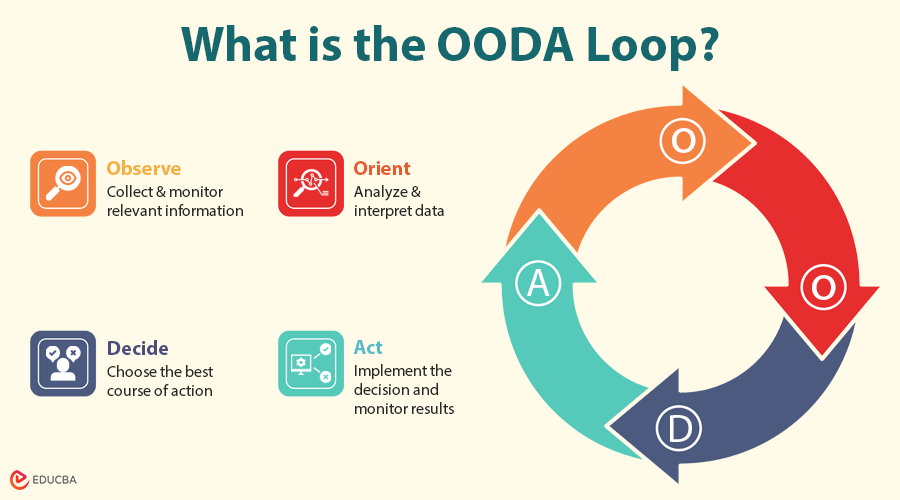
What is the OODA Loop?
The OODA Loop is a strategic decision-making and action framework developed by United States Air Force Colonel John Boyd in the mid-20th century. Initially designed for air combat, the model has since found relevance in business, sports, technology, and personal development.
The term OODA stands for:
- Observe: Collect and monitor relevant information.
- Orient: Analyze and interpret data to gain a deeper understanding of the situation.
- Decide: Choose the best course of action to take.
- Act: Implement the decision and monitor results.
The OODA Loop emphasizes speed, adaptability, and situational awareness, helping decision-makers respond effectively in uncertain and competitive environments. Organizations and individuals who cycle through the OODA Loop more quickly than their competitors often gain a significant strategic advantage, as they can anticipate changes and adjust their actions proactively.
Table of Contents
History of the OODA Loop
Colonel John Boyd, a renowned fighter pilot and innovator in aerial combat, developed the OODA Loop. Boyd observed that pilots who could process information and adapt more quickly had a higher chance of winning dogfights, even against technically superior opponents.
He formalized his observations into a cyclical decision-making process that focused on speed, adaptability, and continuous feedback. Initially applied in military operations, Boyd’s OODA Loop became influential in military strategy, tactical planning, and operational efficiency.
Over time, businesses and organizations recognized that Boyd’s principles could be applied beyond combat, anywhere fast, informed, and adaptive decision-making is critical. Companies like Amazon, Toyota, and Netflix have successfully incorporated OODA-inspired strategies to innovate and respond more quickly than their competitors.
Components of the OODA Loop
The OODA Loop consists of four interrelated stages, each critical for effective decision-making:
1. Observe
Observation forms the base of the OODA Loop. It involves systematically collecting information about the environment, competitors, customer behavior, or operational processes.
Key activities include:
- Monitoring market trends and competitor activity
- Tracking internal performance metrics
- Collecting feedback from employees, customers, or sensors in real-time.
Effective observation requires avoiding information overload. Focus on actionable insights rather than every possible data point.
2. Orient
Orientation is the analytical and interpretive phase of the process. It is where you make sense of the data gathered during observation. Culture, experience, knowledge, and analytical tools influence this stage.
Key aspects include:
- Understanding patterns and trends from collected data
- Contextualizing information based on internal capabilities and external factors
- Assessing risks and opportunities.
Orientation shapes your perspective and helps prevent biased or reactive decisions, enabling more accurate insights.
3. Decide
Decision-making involves selecting the most effective action based on insights gained from the orientation phase. This is where strategy turns into actionable plans.
Best practices include:
- Generating multiple alternatives before committing
- Prioritizing options with the highest potential impact
- Considering both short-term gains and long-term consequences.
A strong decision-making process reduces the risk of wasted resources and ensures alignment with overall goals.
4. Act
The action stage involves executing the chosen strategy and monitoring its impact. Implementation must be deliberate yet adaptable.
Critical steps include:
- Executing tasks efficiently while adhering to strategy
- Monitoring results in real-time and collecting feedback
- Looping back to the observation to evaluate effectiveness.
Effective action ensures the loop becomes a continuous cycle of learning, improvement, and adaptation.
Importance of the OODA Loop
The OODA Loop is crucial for achieving strategic agility and a competitive advantage in both military and business contexts. Its importance lies in:
- Faster decision-making: Enables rapid responses in dynamic environments
- Adaptability: Encourages flexible thinking and quick course correction
- Situational awareness: Enhances understanding of opportunities, risks, and threats
- Competitive advantage: Organizations and individuals who complete the loop more quickly often outmaneuver their slower competitors.
Applications of the OODA Loop
1. Military Strategy
In the military, the OODA Loop helps forces:
- Outmaneuver opponents through superior situational awareness
- Anticipate threats before they materialize
- React to battlefield changes faster than adversaries.
2. Business & Management
Organizations use the OODA Loop to:
- Adapt to market disruptions
- Respond to customer demands quickly
- Innovate products and services proactively.
3. Sports & Competitive Games
Athletes, coaches, and esports players use OODA principles to:
- Analyze opponents’ strategies
- Make rapid tactical adjustments
- Gain the upper hand in fast-paced competitions.
4. Personal Development
Individuals can leverage the OODA Loop for:
- Time management and prioritization
- Continuous skill development and learning
- Problem-solving under uncertainty.
Tips for Applying the OODA Loop Effectively
- Focus on high-impact data: Avoid overwhelming yourself with irrelevant information.
- Build situational awareness: Continuously monitor trends, competitors, and internal performance to stay informed.
- Embrace agility: Be willing to adapt strategies quickly as conditions change.
- Iterate rapidly: Use each cycle to improve decisions and outcomes.
- Leverage technology: Analytics, AI, and automation can accelerate observation and decision-making.
- Encourage collaboration: Diverse perspectives in orientation improve decision quality.
Common Misconceptions
- OODA loop is linear: The loop is cyclical, not sequential. Observation, orientation, decision, and action continually inform one another.
- Speed over accuracy: While speed is crucial, accurate and contextual decisions are equally important.
- Only for military use: The loop is applicable in business, sports, technology, and personal growth.
Final Thoughts
The OODA Loop is a powerful decision-making framework that emphasizes speed, adaptability, and continuous learning. By observing, orienting, deciding, and acting efficiently, individuals and organizations can gain a strategic advantage, respond proactively to challenges, and continually improve their performance.
Implementing the OODA Loop cultivates agility, strategic thinking, and competitive advantage, making it a timeless tool for leaders, managers, and decision-makers across industries.
Recommended Articles
We hope this guide on the OODA Loop helped you understand its significance in strategy and decision-making. Explore our related articles on:

