


Updated September 26, 2025
Make Your Online Store Easier to Shop with AI Smart Search
Have you ever noticed a potential customer leave your online store because they could not find the product they were looking for? Often, it is not that the product is unavailable—it is that the search function cannot understand the customer’s query. This is where AI smart search comes in. With AI-powered search, shoppers can quickly find the right products, even if they use natural language, misspell words, or provide vague descriptions.
According to recent market studies, including McKinsey reports, personalization and AI-powered search can significantly boost conversion rates and sales. Online stores that enhance search results and integrate them with personalized content often experience double-digit growth. Enhancing your website’s search functionality is one of the quickest ways to improve the overall customer experience, as it helps users find what they need more quickly and accurately.
What is AI Smart Search?
Artificial intelligence (AI)- powered search utilizes current AI methods, including machine learning, natural language processing (NLP), and semantic and vector search, to determine what shoppers mean, not just what they type. It does not just look for exact matches for keywords; it also reads meaning, finds synonyms, fixes misspellings, sorts results by relevance, and makes results more relevant based on your behavior. People can now put in “comfortable running shoes for flat feet” and get useful, relevant results instead of nothing or items that are only tangentially related.
Why Does it Matter?
Fewer pages do not contain any results. Because smart search knows semantics and synonyms, it generates a lot fewer blank results that buyers find annoying. Research and case studies demonstrate that implementing semantic search can significantly reduce instances of “no results” while enhancing conversion rates, resulting in a more effective and satisfying user experience. Beyond search, these AI capabilities are transforming AI for customer service across all touchpoints, making support interactions more intuitive and effective.
AI-powered personalized search and suggestions boost both conversion rates and average order value (AOV). A better UX on all devices. Customers on mobile devices love natural-language search. Since typing is slower on phones, smarter question handling lowers frustration and abandonment of orders. Finding long-tail goods faster. People who would never find niche SKUs and unique versions otherwise are more likely to see them.
How AI Smart Search Works?
AI search leverages multiple advanced technologies to understand what shoppers truly want. Here is how it works step by step:
- Natural Language Processing (NLP) and Intent Parsing: AI breaks down customer queries into specific, understandable attributes. For example, “red cotton dress under $100” is broken down into “color = red,” “material = cotton,” and “price < $100.”
- Semantic and Vector Search: Goes beyond simple keyword matching by understanding the meaning behind words. Helps the system recognize that “warm sweatshirt” and “hoodie for winter” refer to the same type of product, ensuring more accurate search results.
- Integration with AI-powered Revenue Intelligence: Businesses combine AI search with AI-powered revenue intelligence to enhance search outcomes. This integration not only improves immediate results but also anticipates customer intent throughout their entire shopping journey.
- Relevance Scoring and Business Rules: AI ranks products based on relevance while considering business rules. This allows retailers to promote new items or high-margin products without compromising search accuracy.
- Personalization Loop: AI analyzes each user’s browsing history, past purchases, and overall shopping behavior. The search experience becomes personalized, showing more relevant results tailored to individual preferences.
- Continuous Learning: The system continually learns from every click, purchase, or return. Feedback loops constantly refine the model over time, yielding progressively more accurate and refined search results.
This stepwise approach ensures that AI search is not just about matching keywords but about understanding shopper intent and driving meaningful results.
Avoid These Common Mistakes
If you want to make money from your site, you should be cautious with AI clips, as they can answer questions without requiring a click. Use clear calls to action (CTAs) to product pages along with helpful overviews.
- Product characteristics that are wrong or missing inhibit semantic matching. The info needs to be clean and standardized.
- Shoppers do not care about delay; they want results right away. Low latency should be your top priority in any design choice.
- Be cautious about how you use personalization; be transparent about how you utilize data, and provide people with the option to opt out of its use.
Practical Examples
Retailers implementing AI-augmented search have reported:
- Significant reduction in zero-result searches
- Increased click-through rates on search results
- Double-digit improvements in search-driven conversion rates
In terms of ROI, optimizing search often outperforms broad advertising because it targets customers who are already engaged on the site, increasing the likelihood of a purchase.
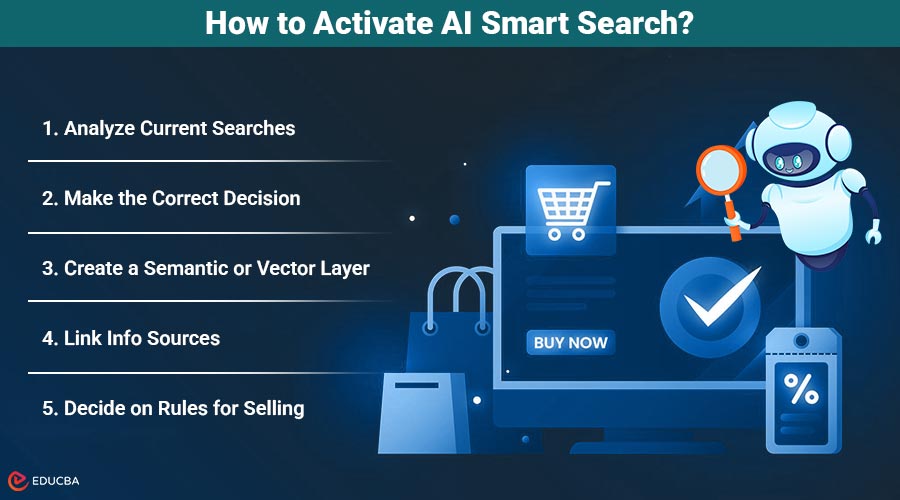
How to Activate AI Smart Search?
Here are the key steps and best practices to successfully implement AI Smart Search in your online store:
- Analyze Current Searches: Review the most popular searches, terms that yield “no results,” conversions by search, and locations where users typically stop using the site.
- Make the correct decision: Use a plug-in SaaS or develop it internally. Building gives you more power than SaaS.
- Create a semantic or vector layer: Use a mixed model (keyword + semantic) to find the best balance between accuracy and retention.
- Link info sources: Add the catalog of products, their characteristics, reviews, and behavioral logs to the search layer.
- Decide on rules for selling: Let commercial teams promote or hide items without needing to write code.
- A/B test and measure: Track time-to-first-click, click-through rate, and the “zero results” rate. If you are prioritizing what to test on the page itself (headlines, CTAs, forms), this conversion refresher from ZenBusiness helps keep efforts focused. Change the business rules and limits.
- Repeat: Improve mappings, synonyms, and model parameters by using analytics to identify questions that are not performing as expected.
Adding intelligent search to popular platforms like Shopify, Magento, or WooCommerce is much easier with plug-and-play apps that require minimal code.
Helpful Checklist to Have Before You Start
Use the following points to ensure your AI search implementation is smooth, effective, and ready for optimal performance:
- Check the top 100 queries and terms that say “no results.”
- Normalize the color, size, and material of an object.
- To get started, select a method that uses both keywords and semantics.
- Make sure that every search event has a data hook.
- Before going live on the entire site, conduct a 4- to 8-week pilot in a key area.
- Maintain marketing control over merchandising for promotional purposes.
- Make sure you have solid on-page SEO.
Final Thoughts
One of the most important improvements for online shops is AI smart search. People can find what they want even if they do not know the right words. It lowers friction and boosts sales. Focus on a pilot, track the correct data (such as search conversion, no results, and average order value), and make changes as needed. Over time, a better search will become the best salesperson in your store because it is quick, helpful, and always learning.
Recommended Articles
We hope this guide to AI smart search helps improve your online store’s search experience. Explore these recommended articles for additional tips on enhancing e-commerce performance.


