


What Does “Boil the Ocean” Mean?
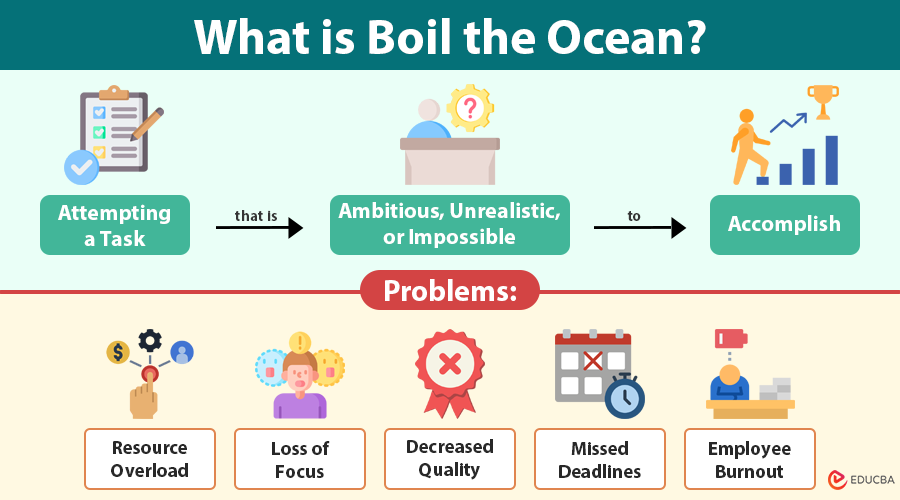
Boil the Ocean” is a common idiom used in business and project management. It refers to attempting a task that is overly ambitious, unrealistic, or impossible to accomplish.
In practical terms, it describes scenarios where organizations or individuals attempt to address every aspect of a problem simultaneously, rather than focusing on critical priorities. Attempting to “boil the ocean” often leads to inefficiency, resource wastage, and missed deadlines.
In business, it serves as a warning against spreading efforts too thin, encouraging teams to focus on high-impact areas rather than tackling everything at once.
Table of Contents
- Meaning
- Origin
- Why is it a Problem?
- Boil the Ocean in Business and Project Management
- Examples
- How to Avoid?
- Related Idioms and Terms
Origin of the Term
The expression derives from a metaphor: imagine trying to boil the entire ocean, which is obviously an impossible task. Management consulting and corporate strategy popularized the phrase, using it to caution clients and teams against overextending their resources.
While its exact historical origin is unclear, it gained traction in the late 20th-century corporate lexicon, particularly in strategic planning discussions. Consultants often use it to highlight the risks of overambitious or poorly scoped projects.
The metaphor resonates because it vividly illustrates the futility of trying to do too much at once, reinforcing the importance of pragmatism and prioritization in business.
Why “Boil the Ocean” Is a Problem?
Attempting to boil the ocean in any professional or personal project can create serious challenges:
- Resource overload: Large, overly ambitious projects consume excessive time, money, and manpower, which can strain other areas of the organization.
- Loss of focus: Teams may lose sight of critical objectives when they simultaneously juggle too many initiatives. This dilutes efficiency and productivity.
- Decreased quality: Overextension often results in subpar work, errors, or incomplete outputs.
- Missed deadlines: Unrealistic scope and expectations often lead to project delays or outright failures.
- Employee burnout: Trying to achieve the impossible can demotivate and overwhelm teams, impacting morale and retention.
Recognizing and avoiding “boil the ocean” projects ensures a better allocation of resources, higher-quality outputs, and improved overall efficiency.
Boil the Ocean in Business and Project Management
The idiom is particularly relevant in business strategy, consulting, and project management. It often appears in scenarios such as:
- Large-scale product launches: Companies may attempt to implement all features requested by every customer, resulting in delayed releases and poor performance.
- Comprehensive market research: Attempting to analyze every customer segment globally, rather than focusing on the most valuable segments, results in wasted effort and resources.
- Full-scale process improvement: Trying to optimize every internal process simultaneously can overwhelm teams and reduce effectiveness.
Business leaders often advise adopting a phased, prioritized approach:
- Identify high-impact areas first.
- Focus on specific objectives that yield measurable results.
- Implement changes incrementally to reduce risk and improve adaptability.
Examples of Boil the Ocean
1. Market Research
A company launches a global survey to understand all customer preferences simultaneously. The effort becomes costly, time-consuming, and produces an overwhelming amount of data that is hard to analyze effectively.
2. Product Development
A software firm attempts to incorporate every requested feature from clients into a single release. This leads to delayed timelines, buggy products, and frustrated clients.
3. Strategy Planning
An organization attempts to improve every internal workflow at once rather than prioritizing critical areas. Teams become overwhelmed, miss deadlines, and deliver inconsistent results.
4. Marketing Campaign
Launching a marketing campaign that targets all possible demographics and platforms simultaneously often results in diluted messaging, high costs, and low engagement.
How to Avoid Boil the Ocean Projects?
Avoiding overambitious projects requires strategic planning, prioritization, and realistic goal-setting:
- Prioritize critical tasks: Focus on high-impact initiatives that drive measurable results.
- Break down objectives: Divide large projects into smaller, achievable phases for better management.
- Set realistic goals: Use the SMART framework Specific, Measurable, Achievable, Relevant, and Time-bound goals.
- Implement incrementally: Roll out initiatives step by step to manage risks and adjust strategies as needed.
- Monitor progress regularly: Track KPIs and progress, making data-driven adjustments to prevent scope creep.
- Empower teams: Delegate responsibilities and ensure teams have clear roles, responsibilities, and resources.
By following these steps, organizations can avoid overambitious projects while achieving effective and measurable results.
Related Idioms and Terms
- “Don’t bite off more than you can chew”: Highlights the importance of manageable tasks.
- “Scope creep”: It means the project scope keeps expanding beyond the original goals.
- “Analysis paralysis”: Overanalyzing leads to indecision and inaction.
- “Hit the low-hanging fruit first”: Focus on tasks that yield immediate, impactful results.
These terms and idioms complement the concept of avoiding overambition and prioritizing key objectives.
Final Thoughts
The idiom “Boil the Ocean” serves as a crucial lesson in business and project management: trying to do everything at once often results in inefficiency, wasted resources, and failure.
Organizations and individuals can achieve success by:
- Prioritizing critical tasks
- Setting realistic goals
- Breaking down large projects into manageable steps
- Implementing incremental improvements.
Avoiding the “boil the ocean” trap ensures projects are manageable, efficient, and impactful, ultimately saving time, resources, and effort.
Frequently Asked Questions (FAQs)
Q1. Is “Boil the Ocean” always a negative phrase in business?
Answer: No, while the idiom usually highlights impractical efforts, some leaders use it positively to describe ambitious thinking or visionary goals. However, in practice, it mostly warns against unrealistic undertakings.
Q2. How do I identify if my project is a “Boil the Ocean” situation?
Answer: If your project has too broad a scope, lacks clear priorities, requires excessive resources, or feels overwhelming to manage, it likely falls into the “boil the ocean” category.
Q3. Can startups fall into the trap of trying to boil the ocean?
Answer: Yes, startups often try to serve all customer needs, enter multiple markets, or launch too many features at once, which spreads them thin. Focusing on a minimum viable product (MVP) helps avoid this.
Q4. What is the opposite of “Boil the Ocean”?
Answer: The opposite approach is to “focus on low-hanging fruit,” selecting easy, high-impact tasks that yield quick results, rather than attempting to tackle everything simultaneously.
Q5. How does boiling the ocean affect employee morale?
Answer: It often demotivates employees, creates stress, and leads to burnout because teams feel like they are working toward an unreachable target.
Recommended Articles
We hope this guide on Boil the Ocean helped you understand the dangers of overambitious projects. Explore our related articles on:

