


Introduction to Joget’s Low-Code App Development
In 2025, low-code platforms will have shifted from being experimental tools to becoming core drivers of digital transformation. Enterprises and mid-sized businesses face constant pressure to deliver applications faster while maintaining control over costs and risks. That is where Joget’s low-code app development steps in.
Known for its balance of speed, flexibility, and enterprise readiness, Joget helps organizations build powerful business apps without getting bogged down in code. If you are exploring modern platforms to accelerate innovation, here are the top reasons to choose oget’s low-code app development and why it stands out from a hoard of other tools.
Why Low-Code Matters More Than Ever in 2025?
The world of app development is under pressure: rising demand, limited developers, and tighter schedules require smarter tools. Here is what the data says about embracing low-code and no-code platforms.
- Global low-code market projected to reach $187 billion by 2030, growing at a ~31% CAGR.
- By 2025, 70% of new applications will rely on low-code/no-code technologies.
This is where platforms like oget’s low-code app development have gained serious traction. By combining visual tools with the option to extend using custom code, Joget development bridges the gap between business users and professional developers.
- Joget already supports 3,000+ installations globally with over 12,000 community members.
- Joget’s core platform is open source and available on GitHub under GPLv3.
- Joget DX lets non-coders and coders build, deliver, and monitor enterprise apps together.
- It offers 70% faster app development, 50% lower development cost, and a whopping 200% efficient resource allocation.
It allows companies to shorten delivery cycles, reduce dependency on scarce developer resources, and still maintain control, making it a strong contender for anyone evaluating the top reasons to choose Joget for low-code app development in 2025.
Top Reasons to Choose Joget’s Low-Code App Development in 2025
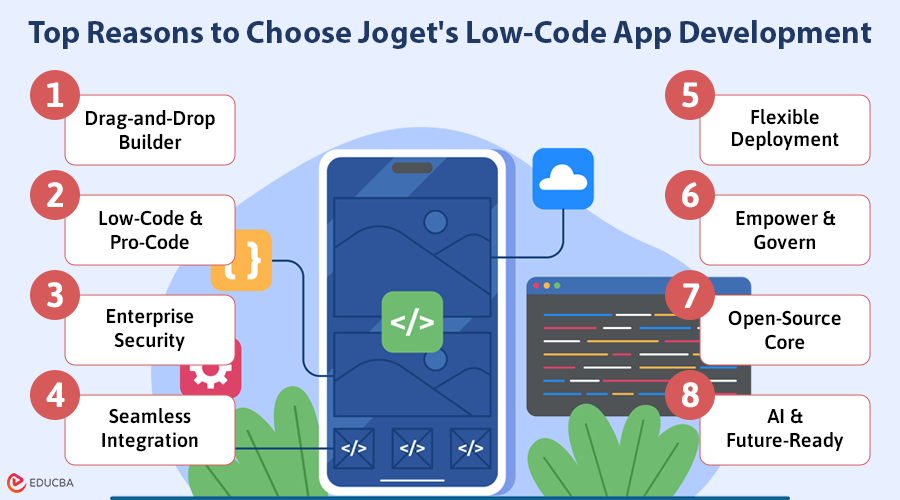
Choosing the right platform can define how fast your business innovates. Here are the top reasons to choose Joget’s low-code app development:
1. Joget Drag-and-Drop Application Builder that Handles Real Work
Build forms and workflows visually, then iterate fast. Joget’s Form Builder and Process Builder enable teams to compose UI and processes with true drag-and-drop functionality. No heavy setup is needed.
Want to expose data or actions as APIs without hand-coding? The API Builder creates custom JSON endpoints through a visual designer, streamlining integrations.
2. Low-Code Speed with Pro-Code Extensibility
When you need depth, you can extend. The API Connector Builder consumes third-party services using OpenAPI (OAS) specs through a guided UI, and the broader Marketplace adds pluggable components for complex use cases.
For complete control, the open-source core invites code-level extensions—enhancing Joget’s low-code app development capabilities.
3. Enterprise Security, Identity, and Governance
Joget supports modern SSO standards, including OpenID Connect, SAML, and Kerberos, as well as directory integrations with Active Directory and LDAP for centralized access control. You can enable multi-factor authentication (MFA) using TOTP or email-based methods and apply security best practices across all your apps.
For additional hardening, Security Enhanced Directory Manager upgrades password storage to SHA-256 and related controls, and Joget publishes security advisories and compliance guidance.
4. Integration Without Lock-In
Teams connect Joget apps to existing systems through RESTful APIs, directory services, and Marketplace plugins, avoiding proprietary traps. Visual API tooling reduces glue code while maintaining transparency for Joget’s low-code app development capabilities projects.
5. Deployment Flexibility and Scale
Joget can run on-premises or in the cloud, with support for containerized deployments on Kubernetes platforms like AKS and GKE. Clustering options make it easier to scale Joget development environments securely across enterprise infrastructures.
6. Empower Business Users, Keep IT in Control
Joget’s visual builders let business teams ship workflows and apps quickly while IT governs authentication, permissions, encryption, and audit trails, reducing backlog without sacrificing control.
7. Open-Source Foundation and Transparent Roadmap
Joget’s core is GPLv3 open source on GitHub, which helps architects evaluate the stack and extend it when needed. Release notes and change logs keep roadmaps clear.
This transparency gives enterprises full visibility into the stack and confidence in long-term sustainability.
8. Readiness for What is Next (AI and DX 9)
The DX 9 track highlights UX improvements and an AI Bundle to accelerate intelligent features in apps, positioning Joget as a Low-Code, No-Code development platform for AI-assisted building. DX 9 is currently in beta; follow the official change log for updates.
Industry Use Cases for Joget’s Low-Code App Development
Here are how different sectors are using Joget development to solve real problems, improve efficiency, and scale.
Finance: Accelerating Digital Services in Asia
A leading Asian financial institution used Joget development to digitize customer management and back-office processes.
Within months, it launched multiple apps for loan approvals and compliance tracking, reducing manual processing times by over 40%.
Insurance: Streamlining Claims and Compliance
An insurance provider built claims processing and underwriting applications on Joget, replacing fragmented legacy tools.
The Joget drag-and-drop application builder enabled the faster rollout of apps while ensuring regulatory compliance, significantly improving claims turnaround time.
Healthcare: Digitizing Hospital Operations
A hospital network deployed over 20 apps on Joget DX to handle patient intake, pharmacy workflows, and diagnostic centre operations.
This Joget Low-Code No-Code development initiative cut paper-based tasks, enhanced patient experience, and improved operational transparency.
Manufacturing: Scaling Enterprise Applications
A manufacturing company rolled out more than 100 Joget apps covering procurement, HR, and production workflows. By unifying processes on one platform, the company reduced costs and improved collaboration between global teams.
Government: Empowering Citizen Services
Several government agencies worldwide have adopted Joget to create e-governance platforms for citizen request management, licensing, and service delivery.
These solutions provided transparency and reduced processing delays while maintaining the security of sensitive data.
Joget vs Other Low-Code Platforms in 2025
Joget’s low-code app development stands out with open-source flexibility, full-stack extensibility, and enterprise security, while keeping ownership costs lower compared to proprietary competitors.
| Parameter | Joget | Mendix | OutSystems | Microsoft Power Platform |
| Licensing Model | Open-source core (GPLv3), enterprise edition available | Proprietary (subscription-based) | Proprietary (enterprise subscription) | Proprietary (Microsoft ecosystem licensing) |
| Customization & Extensibility | Full source access + plugin architecture (Java) | Limited source access, relies on APIs | Extensible via proprietary modules | Customization limited, mostly low-code/no-code |
| Drag-and-Drop Builder | Yes — forms, workflows, UIs, APIs visual builder | Yes — strong UI modeling | Yes — full-stack visual modeling | Yes — primarily for simple apps and automation |
| Pro-Code Support | Java-based plugins, scriptable APIs | Limited Java customization | High — but requires specialized skills | Limited — primarily Power Fx scripting |
| Enterprise Security | MFA, SAML, OpenID Connect, Kerberos, LDAP/AD | SAML, OAuth (premium tiers) | SAML, OAuth (premium tiers) | Azure AD integration, limited SAML |
| Integration Capabilities | REST API builder, connectors, Marketplace plugins | Good API support | Strong API support, proprietary middleware | Built-in connectors, but tied to Microsoft ecosystem |
| Deployment Flexibility | On-prem, cloud, containers, Kubernetes (AKS/GKE) | Primarily cloud; limited on-prem | Primarily cloud; complex hybrid setup | Cloud-first; on-premises via complex connectors |
| Scalability | Horizontal scaling, clustering supported | High (enterprise features) | High (enterprise features) | Moderate; depends on Azure tenancy |
| Total Cost of Ownership | Low (no per-user fees on open-core model) | High (per-user + environment licensing) | High (enterprise licensing) | Moderate (depends on Microsoft licensing stack) |
| Community & Ecosystem | Active open community + enterprise support | Vendor-driven community | Vendor-driven community | Large user base, vendor-driven |
Key Takeaway: Joget uniquely offers open-source flexibility, full-stack extensibility, and enterprise security while keeping ownership costs lower. This makes it stand out as a strategic choice when weighing the top reasons to choose Joget for low-code app development.
The Future of Joget Low-Code App Development
As organizations deepen their digital transformation, low-code platforms are assuming a broader role, encompassing not only workflow automation and rapid prototyping but also more advanced applications.
The next frontier is intelligence, composability, and scalability. Joget is already preparing for this future with its upcoming releases and roadmap.
- AI-Driven Application Building: Joget DX 9 introduces an AI Bundle designed to assist users in generating application components faster. This helps both business users and developers build smarter apps with fewer manual steps.
- Enhanced User Experience: The new version emphasizes a refined UI and UX, making applications built on Joget more intuitive for end-users while reducing complexity for builders.
- Enterprise Readiness at Scale: With improved support for Kubernetes deployments, container orchestration, and clustering, Joget is aligning with the way enterprises scale digital services in hybrid and multi-cloud environments.
- Open-Source Community Momentum: The platform’s open-source foundation continues to attract developers, ensuring ongoing contributions of plugins, connectors, and accelerators. This community-driven innovation is a key differentiator from proprietary low-code ecosystems.
- Composable and Extensible Apps: Future releases aim to give enterprises the ability to break down monolithic applications into reusable components, aligning Joget with the composable enterprise trend.
In short, Joget’s low-code app development capabilities are moving beyond drag-and-drop simplicity into a new era of AI assistance, enterprise-scale deployment, and community-driven innovation. For organizations making long-term bets on digital platforms, Joget’s roadmap shows a clear commitment to staying relevant in 2025 and beyond.
Final Thoughts
For enterprises and mid-sized businesses searching for Joget’s low-code app development capabilities, the platform is future-ready, flexible, and secure. From drag-and-drop builders to pro-code extensibility and AI-assisted development, Joget empowers teams to innovate rapidly while maintaining governance.
That is where Relinns Technologies comes in, offering end-to-end Joget development, implementation, integration, consulting, and support services. Whether you are launching your first Joget app or scaling enterprise-wide adoption, our specialists help you deliver secure, efficient, and future-ready solutions.
Recommended Articles
Discover more insights into Joget’s low-code app development and learn how modern enterprises are accelerating innovation and digital transformation. Explore related articles on low-code platforms, AI-assisted app building, and workflow automation to stay ahead in 2025.

