


Introduction to Conversion Rate Optimization
You are not the only one who spends time and money getting people to visit their website, but does not see enough sales. Many businesses focus on getting clicks but overlook the most important part: converting those visitors into customers. One way to achieve this is through conversion rate optimization (CRO) strategies.
Making changes to your site or campaign based on data and improving how people interact with it will ultimately increase the number of visitors who take a useful action, such as purchasing a product, booking a demo, or filling out a form. Nowadays, modern brands use effective CRO strategies to turn their online campaigns into tools that convert more visitors into customers.
Effective Conversion Rate Optimization Strategies to Follow
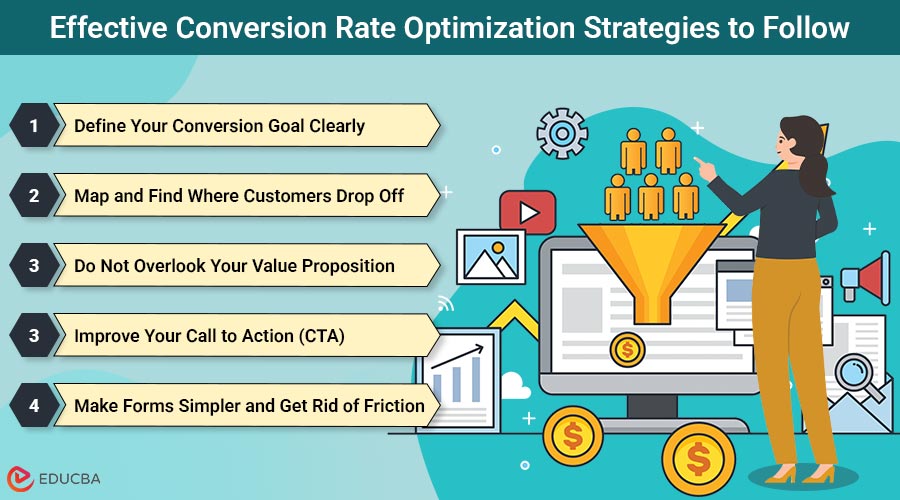
To boost your online campaign results, here are some key conversion rate optimization strategies you should follow:
1. Define Your Conversion Goal Clearly
Conversions have different meanings for each business. For an e-commerce site, it could mean making a sale. For a SaaS company, offering a free membership could be a viable option.
A service-based business may also get leads from lead forms. That is why setting a clear goal is the first step in any CRO plan. If you cannot measure it, you cannot improve it. Your improvement efforts will be pointless if you do not set clear goals, like increasing the number of completed checkouts by 20% or the number of email sign-ups by 15%.
2. Map and Find Where Customers Drop Off
Not all visitors to your site are ready to make a purchase. They might glance at a few pages, lose interest, or give up because the message is unclear or the experience is unpleasant. Examining your funnel can help you identify where these drop-offs occur.
You can find out which pages people leave the most quickly, where they get stuck, and how far they scroll with tools like Google Analytics, Hotjar, and Clarity. Often, it is not the traffic that bothers people, but how they feel when they get there. You may need to make your plans easier to understand or add trust-building elements, such as testimonials and money-back guarantees, if people leave your price page quickly.
3. Do Not Overlook Your Value Proposition
As soon as someone clicks on your ad or website, they are thinking, “What is in it for me?” We need a clear and quick answer to that question from your value proposition, which includes the title, subheadline, and supporting message. Do not use words. Describe it. Tell people what you can do for them and why they should pick you over other people.
It is challenging to stand out with a title like “We Help Businesses Grow.” But “Get 3X More Qualified Leads in 30 Days – Guaranteed” is benefit-driven, bold, and likely to lead to a sale.
4. Improve Your Call to Action (CTA)
People often overlook CTAs, but they are one of the most crucial elements of your page. It matters what you say, the color of the button, and even where you place it. Instead of simply writing “Submit” or “Click Here,” create CTAs that prompt people to take an action related to the value they will receive.
As an example:
- “Start Your Free Trial”
- “Get My Instant Quote”
- “Download the Checklist”
Also, make sure your call to action is above the fold. People should not have to scroll down to see the next step. If you want to catch users who need more push, repeating the CTA lower on the page can help.
5. Make Forms Simpler and Get Rid of Friction
Every extra field in a form makes it harder to use. Only ask for the things you need. You likely do not need the user’s phone number, job title, or company size if you are simply offering a free guide. Do not add too much.
Short forms usually work better than longer ones. One case study found that reducing a form from seven fields to three led to a 40% increase in entries. Another tip is to use inline validation, which displays errors as people type and reassures users with small text, such as “We won’t spam you.”
6. Make Your Website Fast
Slow websites lose visitors. Sales might drop by as much as 7% for every second that a page takes to load. That number is even worse in the mobile-first world. People expect your site to load in less than two seconds.
Remove unnecessary scripts and images, and utilize speed optimization tools like Google PageSpeed Insights or GTmetrix to identify performance issues. Optimize your server for speed (or decide if it is time to graduate from shared hosting). If your website takes a long time to load, you should address this issue before making changes to the style or creating new ads.
7. Build Trust at Key Touchpoints
People would not take you up on your offer if they do not trust you. Customer reviews, media mentions, security badges, guarantees, and a professional appearance all signal that a business is trustworthy. It may seem simple, but a clean layout, no broken links, and correct spelling reassure guests that they are in the right place.
If you want to obtain private information, such as a credit card number or contact details, displaying SSL certificates and privacy policy links can help people feel more secure. Showing real images and videos of satisfied customers also gives your business more credibility and a personal touch.
8. Do Not Ignore Mobile Optimization
Over half of all web traffic comes from mobile devices, yet many websites remain unoptimized for smaller screens. Buttons should be thumb-friendly, forms should be auto-filled where possible, and text should be legible without zooming.
A page that looks good on desktop but does not work well on mobile can quietly hurt your conversion rate. Check your site using tools like Google’s Mobile-Friendly Test, and browse it yourself on different devices to spot issues firsthand.
Final Thoughts
Conversion rate optimization strategies are something that the best marketers understand must be applied consistently. It is always a process of learning, trying, making adjustments, and improving. Address slow-loading pages, unclear call-to-actions, and long forms first, as these are among the most common issues affecting user experience. Then, take a closer look at what your users are doing on your site. Marketing experts recommend getting a CRO Audit of your website to evaluate its performance and stay updated on best practices across these critical areas.
Do not forget that CRO is not about getting people to click on your links; it is about getting them to take the desired action. It is about making your deal stronger, your message clearer, and your experience better. What was the result? When you spend money on marketing, you should expect to generate better leads, drive more sales, and achieve a significantly better return on investment.
Recommended Articles
We hope this guide on conversion rate optimization helps you turn more website visitors into loyal customers. Explore these recommended articles for proven strategies, tools, and insights to enhance your conversions and drive business growth.

