


Introduction
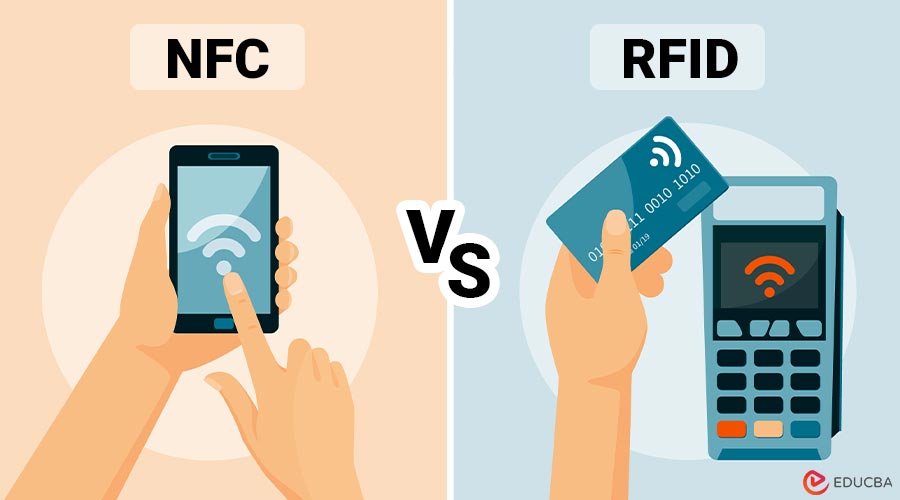
In today’s digital world, seamless wireless communication has become essential for enhancing productivity, improving the customer experience, and ensuring data security. Two leading technologies that enable this wireless exchange are NFC (Near Field Communication) and RFID (Radio Frequency Identification). Although both technologies use similar principles of radio wave transmission, they exhibit significant differences in application, range, speed, and capabilities. In this article, we examine NFC vs RFID by defining both technologies, comparing their core differences, exploring practical use cases, and evaluating their pros and cons.
Table of Contents:
- Introduction
- What is NFC?
- What is RFID?
- Key Differences
- Use Cases and Applications
- Advantages and Disadvantages
- Examples
- Which One Should You Use?
- Future Trends
What is NFC?
NFC is a subset of RFID technology that operates at high frequency (13.56 MHz) and enables two-way communication between compatible devices over very short distances (typically less than 4 cm).
What is RFID?
RFID is a wireless technology that relies on electromagnetic fields to find and track tags attached to items. These tags can be passive (powered by the reader) or active (battery-powered), and they communicate with RFID readers using radio frequency identification (RFID) technology, which utilizes radio waves to transmit data.
NFC vs RFID: Key Differences
Below is a comparative table to highlight the major distinctions:
| Feature | NFC | RFID |
| Full Form | Near Field Communication | Radio Frequency Identification |
| Range | ~4 cm | Up to 100 meters (active RFID) |
| Communication Type | Two-way (peer-to-peer) | One-way (reader to tag) |
| Frequency Bands | High (13.56 MHz only) | Low (125-134 KHz), High (13.56 MHz), UHF (860–960 MHz) |
| Data Transfer Speed | ~424 kbps | Varies (up to 640 kbps for UHF) |
| Power Source | Usually passive and powered by the reader | Tags can be active (battery), passive, or semi-passive |
| Security | High security protocols (e.g., ISO/IEC 14443) | Less secure without encryption |
| Cost | Slightly more expensive due to added encryption | Varies (tags are cheaper in bulk) |
Use Cases and Applications
Here are the practical implementations of RFID and NFC technologies across various industries:
NFC Use Cases:
- Contactless Payments – Enables tap-to-pay using smartphones or NFC cards.
- Public Transport – Used in metro and bus passes (e.g., Oyster Card, Octopus).
- Digital Business Cards – Tap phones to share contact details instantly.
- Smart Posters – Scanning posters with NFC tags to get more information.
- Device Pairing – Instantly pair Bluetooth speakers or headsets.
RFID Use Cases:
- Inventory Management – Retailers use RFID to track stock levels in real-time.
- Supply Chain & Logistics – Improves visibility and reduces shrinkage.
- Access Control – Used in ID badges and security cards.
- Library Systems – Speeds up check-in/check-out processes.
- Toll Collection – Enables contactless payments at highway toll booths.
Advantages and Disadvantages
Here are the advantages and disadvantages of both NFC and RFID technologies:
Advantages of NFC:
- Highly secure for financial transactions
- Low energy consumption
- Easy to integrate with smartphones
- Ideal for peer-to-peer communication
Disadvantages of NFC:
- Very short range (maximum of 4 cm)
- Slower data transfer speeds than some RFID types
- More expensive to implement in certain applications
- Requires close alignment between devices for successful communication
Advantages of RFID:
- Long read range (up to 100 meters for active tags)
- Can scan multiple tags simultaneously
- Durable and weather-resistant
- Versatile frequency options
Disadvantages of RFID:
- Higher costs for active RFID system
- Limited security in some low-cost systems
- Interference issues with metal or water
- Privacy concerns due to remote scanning capabilities
Real-world Examples
Here are the practical, real-world examples of both NFC and RFID technologies:
NFC in Action:
- Apple Pay & Google Pay: Use NFC chips for secure, tap-to-pay functionality.
- Hotel Key Cards: Many hotels use NFC-enabled cards for room access.
- Contactless ATMs: Allow cardless cash withdrawals using smartphones.
RFID in Action:
- Amazon Go Stores: Use RFID for seamless checkout-free shopping.
- Airlines: Use RFID baggage tags to reduce lost luggage.
- Walmart: Employs RFID to track clothing and high-value items in real-time.
Which One Should You Use?
The decision between NFC vs RFID depends on your specific needs:
Choose NFC if you need:
- Secure, short-range transactions
- User authentication or access control
- Simple smartphone integrations
- Enhanced interactivity (like pairing or payment)
Choose RFID if you need:
- Longer read ranges
- Large-scale inventory tracking
- Simultaneous reading of multiple items
- Industrial or logistics solutions
Future Trends
The future of NFC and RFID is closely tied to the growth of emerging technologies, including the Internet of Things, 5G, Artificial Intelligence, and Smart Infrastructure. Here’s how both are expected to evolve:
NFC Trends:
- Wider Smartphone Adoption: As nearly all smartphones now support NFC, the technology is expanding into digital identity, mobile ticketing, and virtual loyalty cards across global markets.
- Healthcare Applications: NFC is gaining ground in patient identification, medication tracking, and secure health data exchange.
- Expansion in Wearable Tech: NFC is increasingly built into smartwatches, rings, and fitness trackers for convenient payments, transit access, and authentication.
RFID Trends:
- Integration with IoT Platforms: RFID is being embedded into IoT ecosystems to enable real-time tracking, predictive analytics, and automated decision-making in industries such as manufacturing, healthcare, and agriculture.
- Sustainable Tag Development: There is an increasing focus on developing eco-friendly RFID tags using biodegradable materials, which can support green supply chain initiatives.
- Blockchain for RFID Data Integrity: To enhance security and data authenticity, blockchain technology is being integrated with RFID systems for tamper-proof inventory and asset records.
Final Thoughts
In the comparison of NFC vs RFID, both technologies serve unique and important roles. RFID is ideal for long-range, high-volume tracking in logistics and supply chains, while NFC offers secure, user-friendly applications like mobile payments and access control. Understanding their strengths enables businesses and users to choose the right technology for their needs in an increasingly connected digital world.
Frequently Asked Questions (FAQs)
Q1. Can all RFID tags be read using an NFC-enabled device?
Answer: No. NFC operates specifically on the high-frequency (13.56 MHz) RFID band, so it can only interact with RFID tags that use the same frequency. It is not compatible with low-frequency (LF) or ultra-high frequency (UHF) RFID tags.
Q2. Do NFC tags need batteries?
Answer: No. NFC tags are typically passive and receive power from electromagnetic field generated by the NFC reader.
Q3. Why does RFID have a longer range than NFC?
Answer: RFID tags—especially active ones—have their power source and use frequencies that support longer transmission distances. NFC, in contrast, is limited to short-range for security and energy efficiency.
Q4. How is NFC different from general RFID technology?
Answer: NFC is a type of RFID that supports two-way communication over short distances (up to 4 cm) at 13.56 MHz, while general RFID often supports one-way communication over longer ranges and various frequencies.
Recommended Articles
We hope that this EDUCBA information on “NFC vs RFID” was beneficial to you. You can view EDUCBA’s recommended articles for more information.

