


Updated May 30, 2023
What is Grinding Machines?
In manufacturing operations, workers use grinding machines to grind work parts, with abrasive wheels serving as the cutting tool. People commonly refer to this machine as a grinder.
Typically, operators use grinders to precisely shape and finish materials, achieving low surface roughness and high surface quality. Manufacturers primarily employ this technique for finishing purposes, aiming to produce highly accurate surface finishes by removing small amounts of metal.
Grinding, which achieves a dimension precision of 0.00002 mm, is a finishing operation that removes a small depth of metal, ranging from 0.20 to 0.50 mm. However, certain grinding applications require rapidly removing large amounts of metal.
Overview
It consists of a bed with a fixed guide that holds the workpiece in place, and a power-driven wheel spins at a predetermined speed. The grinder’s head is across a fixed workpiece, or the workpiece could be while the grinder’s head remains stationary. The grinding head or table’s location can also be by a manual wheel or a computerized numerical controller (CNC).
Coolants are necessary to keep the workpiece cool, prevent overheating and accidents, and maintain tolerance because this machining operation generates significant heat.
A grinding wheel, composed of silicon carbide or aluminum oxide, is used in grinding machines. Manufacturers produce the wheel by baking and heating abrasive granules of various sizes with a bonding agent, such as clay, rubber, shellac, or soda silicate.
How Does Grinding Machine Work?
A grinding machine’s operation is much easier to grasp.
It generates rubbing action or friction between the workpiece and the abrasive wheel. As a result, the workpiece is fed against the rotating abrasive wheel, removing material from tiny chips.
A grinding machine’s electric motor provides rotational motion power to the grinding wheel via a belt and pulley system. So, when we turn on the electric motor, it rotates at a specific angular velocity (100-15000 RPM, depending on the grinding machine), and the grinding wheel begins to turn as well, and we carry out the operation.
Types of Grinding Machines
- Belt Grinders: A belt grinder is a machining technology that treats metals and other materials with coated abrasives. It is similar to a belt sander (used for wood but sometimes metal). Belt grinding is a versatile technique for finishing and stock removal.
- Cylindrical Grinders: Cylindrical grinders shape the outside of a workpiece. We welcome workpieces of any shape as long as they rotate around a central axis. A cylindrical grinder simultaneously rotates the workpiece and the grinding wheel. Outside and inside diameter grinders, as well as centerless grinders, are examples of cylindrical grinders.
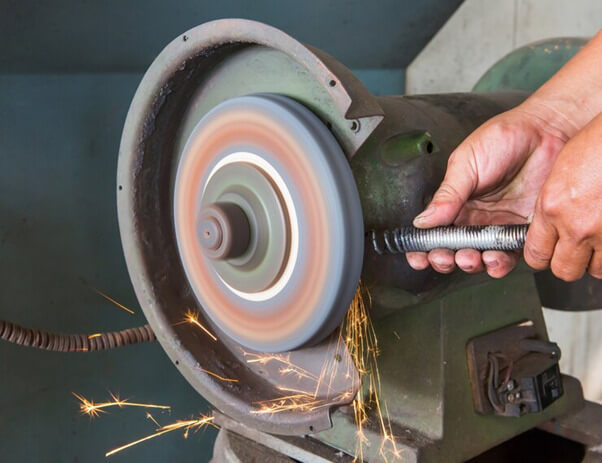
- Bench Grinders: Bench grinders mount to a workbench or floor stand and feature two wheels with different grain sizes for roughing and finishing tasks. They are used to shape tool bits and repair or create various tools. Users operate bench grinders manually.
- Surface Grinders: surface grinder consists of an abrasive wheel, a chuck (a device for holding work material), and a rotary table. The chuck contains the material while the wheel and workpiece rotate to achieve a smooth finish.
- Gear Grinders: Typically, manufacturers use a gear grinder as the final machining procedure for producing high-precision gears. The primary function of these machines is to remove the last few thousandths of an inch of material left over from previous manufacturing procedures (such as gashing or hobbling).
- Die Grinders: The manufacturers have developed grinder models that operate on compressed air but can also be powered directly by a small electric motor or a flexible shaft. Engineers generally use die grinders in large-scale engineering projects.
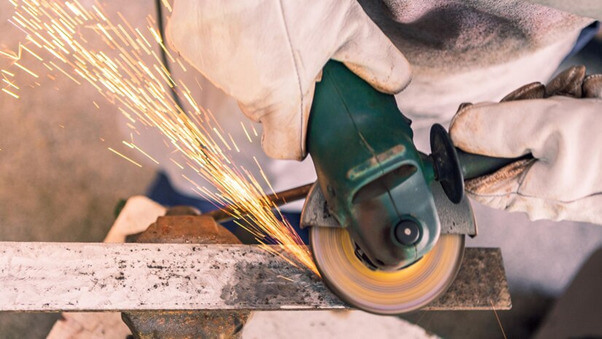
- Angle Grinders: An angle grinder is a portable power tool that is capable of grinding, smoothing surfaces, cutting, and polishing a variety of materials, including wood, metal, marble, and stone.
Uses of Grinding Machines
The grinder machine is helpful in various industries, including pharmacy, chemical, metallurgy, food, and construction. These machines are helpful in pulverizing rigid and difficult-to-pulverize materials such as plastics, copper wires, Chinese herbal remedies, rubber, etc.
It is used primarily in engineering, electrical, automobile, aerospace, and many other industries.

