
Updated February 5, 2025
What is Data Engineer Roadmap?
Data engineers develop and build pipelines that allow data scientists to acquire data from numerous sources and generate and deliver big data insights. For translating data into a usable form, data engineers are highly regarded. They use established methodologies and statistical tools to analyze and interpret the results. The information they supply is used at all levels.
What does Data Engineer do?
What data engineers do is ensure that others can use their organization’s clean, raw data to make data-driven business choices. Data Engineering is advancing quickly, and there is an increasing demand for it. Because the primary goal of Data Engineering is to make the life of data scientists easier, they’re the ones who put Data together. Without them, the vast volume of data created daily would be useless to the company.
Step-by-Step Guide Path – Data Engineer Roadmap
A Data Engineer designed and implemented the architecture for collecting and storing data. They also pre-process the data and convert it into a format that can be used. To recap, a Data Engineer constructs data pipelines and ensures data flows smoothly.
Responsibilities
Data engineers have identical tasks regardless of their concentration on a specific area of a system. This is mostly a technical role that combines computer science, engineering, and database knowledge and abilities.
1. Architecture design: Data engineering is essentially the process of developing the architecture of a data platform.
2. The creation of data-related instruments and instances. In the first place, a data engineer is a developer who employs programming abilities to create, build, and maintain integration tools, databases, warehouses, and analytical systems.
3. Maintenance and testing of the data pipeline. Data engineers would test the reliability and performance of the system during the development process.
4. Machine learning algorithm deployment: Data scientists create machine learning models. The deployment of these into production environments is the responsibility of data engineers.
5. Provide data-access tools: In other circumstances, such tools aren’t necessary since data scientists can use warehouse types like data lakes to get data directly from storage.
1. Programming
Data engineers must be fluent in at least one programming language. Python, Java, and Scala are examples of data engineering-specific programming languages.
2. Big Data
One should be familiar with these Big Data Tools-
- Hadoop and MapReduce are two terms that are often used interchangeably.
- Spark is an Apache project.
- Apache Hive
- Pig Sqoop is an Apache Pig project.
Apache Spark is the most widely used parallel processing engine.
3. Data Warehouse
ETL operations are one of the primary responsibilities of a Data Engineer. As a result, we must understand how to design, build, and operate a Data Warehouse. Snowflake, Amazon Redshift, and Google Big Query are the top data warehousing tools available. Skills like Panoply, Informatica, and Talend were required.
4. Databases
SQL knowledge is required. SQL is the most challenging data engineering technology. Also, strategies like database normalization or a star schema should be recognized. A data engineer also understands that some databases are better for analysis and others for transactions (OLTP) (OLAP).
5. Distributed System
Any data engineer job description will mention distributed file systems like Hadoop (HDFS). The Data Engineer has a broad range of technical expertise and experience with various products and systems. A data engineer knows how to use technology to address challenges involving large amounts of data.
6. Cloud
Google Cloud Platform, AWS, Azure, and Apprenda are some cloud or on-premises systems accessible. A growing number of application workloads are migrating to various cloud platforms. As a result, the data science/engineering community must understand these clouds.
Data Engineer Roadmap Career and Skills
Skills Required are:
Should be proficient in programming languages such as SQL, Python, and R, be knowledgeable about warehousing solutions and ETL (Extract, Transfer, Load) tools, and have a basic understanding of machine learning and algorithms.
A data engineer’s skill set should include soft skills, such as communication and teamwork. Data science is a highly collaborative industry, and data engineers collaborate with various stakeholders, ranging from data analysts to chief technology officers.
To summarise, the following abilities are required:
- The programming is excellent.
- Practical experience with database concepts.
- Knowledge of operating systems.
- Workflows for Cloud Computing Knowledge Scheduling.
- Data Processing Techniques Mastery.
- Technologies like Cassandra and MongoDB.
- Infrastructure like Docker and Kubernetes.
Amazon Web Services (AWS) is a Cloud Computing Service (AWS)
Most programmers utilize Amazon Web Services (AWS) to become more agile, innovative, and scalable. Teams of data engineers use AWS to create automated data flows.
Kafka
Kafka is a real-time data processing software platform that is open-source. It means you may use it to create real-time streaming apps, which enterprises require. Apps based on Kafka can aid in the discovery and application of trends.
A data engineer’s skill set should include soft skills, such as communication and teamwork. Data science is a highly collaborative industry, and data engineers collaborate with various stakeholders, ranging from data analysts to chief technology officers.
Career
The number of job listings for this position has likewise increased by more than 50%. They’ve nearly doubled in the last year. Because there is more data than ever before, and it is rising at an exponential rate. This function will become more critical as data becomes more sophisticated. Data engineering will become much more important as the demand for data grows. Data engineering focuses on initiatives to handle big data, manage data lakes, and create large data integration pipelines for NoSQL storage. In this instance, a dedicated staff of data engineers with duties assigned by infrastructure components is ideal.
The average income for a Data Engineer ranges from $65,000 to $142,000, depending on your talents, function, and experience. In the United States, a Data Engineer earns an average of $128,001 yearly, with a $5,000 cash incentive.
The Carrer hike starts with data engineer -> Senior DE -> BI Architect -> Data Architect.
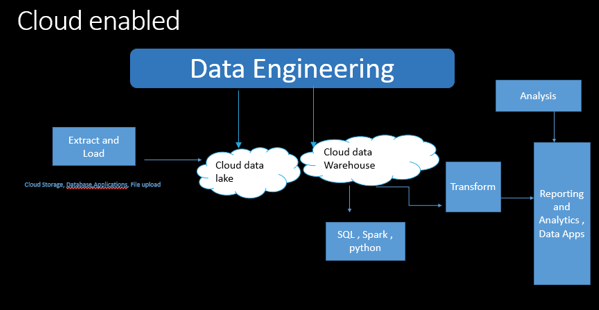
Modern diagram
Conclusion
We’ve reached the finish of our journey. We’ve nearly become data engineers at this point. However, what has been taught must be put into practice. The most challenging aspect of being a data engineer is gaining experience. According to studies, this is one of the industry’s highest-paid talents, and this trend is set to continue, or should we say, adapt and increase shortly.
Recommended Articles
We hope that this EDUCBA information on “Data Engineer Roadmap” was beneficial to you. You can view EDUCBA’s recommended articles for more information.

