


Introduction to Crisis
There are many forms of crises that are indiscriminate and could occur to any company, large or small, irrespective of geography. These can be accidental, legal, or financial. Therefore, a sound managerial or organizational need is required with superb communication skills to tackle internal and external stakeholders.
For a long time, businesses have focused on developing tailored techniques for communicating with external partners in times of crisis. But at the same time, there is a growing need to handle the employee, which so many organizations have not done perfectly; some gaps exist in communicating with them in the event of crises. Therefore, before discussing the utmost requirements to work on internal communication,, we must first understand crises in detail.

Before a crisis strikes, the business must have a robust organizational structure and processes to manage employee communication effectively. And all these calls for building well-planned routines to allocate responsibilities, coach employees, and set up instruments that can effortlessly facilitate vertical (bottom-up and top-down) and horizontal employee communication. Also, a company-wide internal communication program for crises must be established to leverage the benefits of regular planning, execution, and assessment. The exemplary implementation of the communication plan will help protect and even increase the company’s image and competitiveness. Furthermore, internal and external stakeholders should be communicated with to effectively address corporate gossip, misinformation, and unsubstantiated accusations. Those who ignore employee communication will likely suffer economic harm due to a lack of trust, low self-esteem, and the resulting loss of key assets, experts, and committed employees.
Internal communication managers must increase the frequency of employee communications, as employees have a keen need to get updated and must, in turn, respond with honest feedback. These should reach senior management, who should interact with and, when appropriate, praise employees for their support during contingencies. These employees would actively support management objectives and readily represent the company externally. It should not be the case that negative, crisis-linked external news that was not known earlier reaches employees, as this would confuse them and deter a positive crisis response and recovery. Therefore, internal communication must first be communicated to the employees before any external communication.
So, the following questions should be considered when a crisis happens:
What is the intended result of the communication? (i.e., purpose)
What will be corresponded? (i.e., communication)
Who will start the communication? (i.e., correspondent)
Which targeted employees (and management) should be communicated to? (i.e., receiver)
What is the medium of communication, and where will it take place? (i.e., channel and venue)
When would the communication happen? (i.e., moment)
The remaining two questions must be addressed during crises and as part of the post-crisis assessment and crisis vigilance planning.
Was the communication goal met? (i.e., evaluation)
How can we perform well? (i.e., effectiveness)
How to Support Employees during Crisis
You might, of course, face certain unexpected conditions that you cannot be prepared well in advance to combat. As is common when handling an unseen case, your new communication and template should be tailored to address this. Familiarize yourself with the company’s earlier crisis communication strategies. You should also know how employee communications were handled and what questions they asked at that time.
In crises, all the company sites, corporate hierarchies, business levels, and departments are engaged in step-by-step development, performance, and assessment. In addition, there must be proper integration of internal and external communication to address the crisis, and the issue management system must be implemented. All these crisis-management systems require resources, of which a comparatively small yet critical fraction should be allocated to ensure effective employee communication. You cannot be certain there will be no crisis, as it is part of the company’s life cycle. It can occur in any organization, even if it is well prepared. Therefore, any organization’s existence depends on the right amount of crisis preparedness. Given crisis preparedness, the following checklists to tackle any situation should be taken into consideration:
Can your internal communication team access their email and the shared network drives? Can they send messages even when they are away from the workplace?
Are all the important mobile numbers saved in their mobile phones? Are they all aware of how to remotely update the information?
Did you finalize the conference call number for the cross-functional team?
You should always keep a hard copy of all the access codes so that you can easily find the required information when your system is down.
As per your company protocols, use the flash drives.
Communication Messages on How to Support Employees During Crisis
Some communication messages are designed to be attended to, based on the above questionnaire on how to Support Employees during a crisis.
The first step in creating a communication plan is to develop the key messages and steer the rest of the plan. The managers must communicate this plan to their subordinates.
The messages must be clear and simple to understand. These messages must be sent constantly. The main messages would include the additional messages’ pitch, perspective, and permanence.
Messages for external stakeholders, such as the media, consumers, corporate partners, societies, investors, and the government, should be consolidated.
Proper Crisis Management
Proper Crisis Management
When a crisis occurs, all employees should be informed immediately. In addition, several requirements must be met during a crisis. Proper crisis management always yields effective results.
All the right people must be contacted (within an hour the crisis happens), irrespective of the location
Ensure that the people in demand arrive at the crisis site.
No such human error should be mentioned in the communication.
Some next moves should be indicated.
Think about the Future Actions and Guide Employees
William Bridges, in Managing Transitions (2003), notes that some companies fail in times of crisis because they focus too much on essential organizational change management rather than on instilling belief and confidence in employees and preparing them mentally to accept the transition. As a crisis occurs and people are not properly guided through the transition, the chairs are reorganized, he thinks. In times of crisis, companies often focus on keeping employees engaged in doing things in a new way, but in reality, they should prevent the employees from doing things in the old ways. To him, commencing relies on endings. But the issue is that people don’t accept endings.
There are three main stages in times of crisis:
Finishing – Releasing the way they every time used to do things.
Neutral Phase or ‘Time meanwhile’ – This is the phase when the new system is not yet implemented, and the old ways do not exist.
The Start – When people have finally adopted the new ways
Bridges advised some crucial communications to be adopted to face the crisis internally: (How to Support Employees during Crisis)
Understand what people lose and how they react so you can start planning your next move.
Explain to employees why the change is required, and ask them to take ownership. They can speak directly with unhappy customers to take a hands-on approach to resolving the problem. Highlight the level of employee ache caused by the crisis to increase their motivation to stop using the old ways.
Be specific when communicating the issues facing employees and what you need them to begin with. Behavioral skills like ‘consumer-centric’ or ‘attaining cross-functional are insufficient. It would help if you made them believe what they can do differently with their expertise.
The employees must understand the transition process that,, in a way,, help them accept the challenges of the crisis.
If the information is sensitive, you always have the right not to disclose it, but you should explain the reasons to employees rather than leaving them to speculate.
The CEO should present his honest views in Town Hall meetings, put himself in their shoes, provide information, reassure them from their viewpoints, and address their questions.
Post Town Hall Meetings, written messages in the form of a newsletter, company circular, intranet announcements, email from the CEO’s desk, and sometimes, posters with crisp content must reach employees. Sometimes corporate language is ineffective; in such cases, they add a personal touch to announcements and acknowledge emotions. The open forum works best in this regard.
Negative news should be communicated to employees, including layoffs, minimal salary increases, small bonuses, and a constrained budget. The senior management must use appropriate grounds and corporate circumstances for this.
Online global employee surveys conducted soon after formal communication to understand employees’ perspectives on the incident are highly effective. Partnering with reputable employee engagement survey vendors ensures these surveys are well-structured, actionable, and tailored to the unique challenges of crisis communication.
Some more tips are required to accustom the employees to welcome the beginning: (How to Support Employees during Crisis)
Provide a clear image of the goals you are targeting, and state the rationale for setting them. This would help employees understand why they must devote their energy to realizing them.
Provide clarity, in detail and in practical terms, on what the organization’s future would look like. How will employees access the work schedule?
Emphasize the step-by-step structure to signal a new beginning.
Give each person a chance to contribute, so everyone can derive some personal satisfaction from saving their company.
The Target Audience
The senior management should consider the target audience, e.g., front-line employees, line managers, or senior managers. Does it require separate information for each group? For example, if the lead employees are offline, where would they find the information? What kind of channels will you use to convey your message? On the other hand, if you rely on Vanguard employees, are you sending them everything they need? What additional information would they need?
Communication Channels
Employees and other internal stakeholders must easily find the communication. To do that, one needs to consider the right communication channels. Below are some channels that serve as conduits for messages during crises. But first, take a few channels depending on accessibility.
Employee-driven Channels
Visible sections on the intranet home page
Special IVRS to help employees get the appropriate communication relating to a crisis
Hotline arrangement to address all employee questions
Regular posting in the bulletin or company dashboard
Internet site access through a defined password
Daily updates through emails
Guarantee Message Reliability and Real-time Communication.
Well-planned internal and external communication in times of crisis rests on the consistency of the message. The company aims to deliver consistent messages to its employees under the ‘One Shout Policy.’ All competent employees are connected to senior management and other internal partners and are kept up to date on recent developments in crisis events. Based on these, they can well be the company spokespersons. ‘One-Shout-Policy’ is very authentic in that everyone will be on the same page regarding information. There is a common tendency among employees to discuss work-related issues with family, friends, and colleagues, and they may pass judgment on the company’s policy for addressing the crisis. And sometimes, dissatisfied with the scarcity of reliable information and growing concerns about job security, an employee might disclose internal information to the news media. An analytical journalist at the time might engage disgruntled employees and create amusing, marketable news. Therefore, senior management is responsible for ensuring that employee concerns are addressed promptly.
Employee Response by Way of Two-way Communication Process on How to Support Employees during Crisis
Crisis communication is not about broadcasting; it is about ensuring communication lines are open and two-way channels are available. Intelligent management always relies on two-way communication, in which employees are invited, face-to-face or via the intranet, to present their views on the crisis doctrines. Not only should senior management arrange for it, but also take notice of it and use it in important decision-making, thereby giving employees a chance to become emotionally engaged with the company. The following are some ways senior management can ensure employee feedback is considered.
Employee response is a useful way to determine whether the message reached the intended recipients and prompted the desired behavior.
Through employee feedback, one can be certain about their anticipations, sensitivities, and views. At the same time, senior management can easily track the types of information employees may have received from external stakeholders.
Lastly, employee responses could explore a new approach to crisis management.
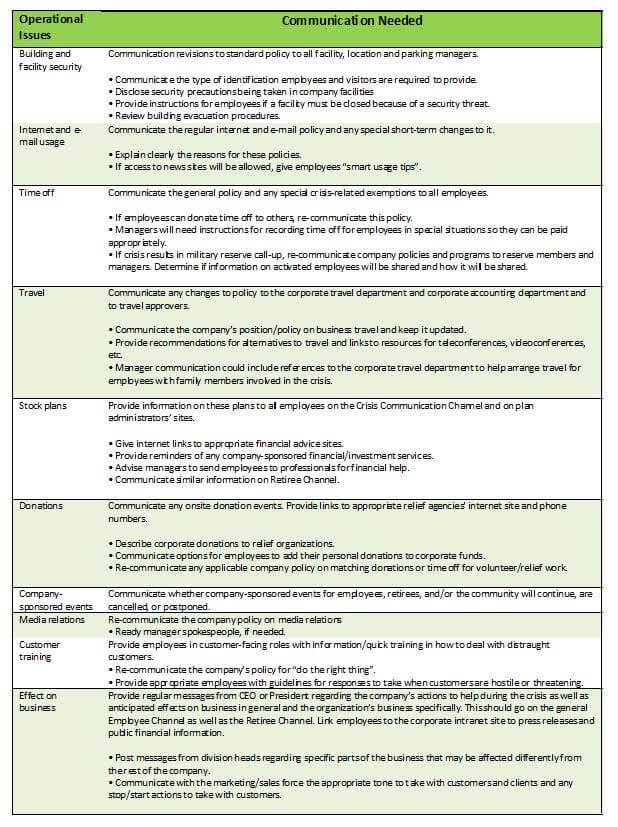
Specific Operational Issues and Proper Employee and Manager Communication
Below is an operational area that is severely affected because of the crisis. For each case, the desired communications are released to employees and their managers.
Keep an Eye on Conversations
This is always a good way to monitor what employees share on internal and external social media platforms. If employees repeatedly ask questions, ensure that something is missing from the communication. Fix this soon.
Transparency
If there is no positive news, send the real news for transparency. There has to be honesty in the workforce. Then, only if all of them work towards a common goal can this be possible. Trust enhances accuracy in business relationships.

Reviewing (How to Support Employees during Crisis)
Post-crisis, management must review how things worked to the company’s advantage, for external stakeholders, and for employees. What could be done better, and how could it be performed next time to avoid possible losses? A folder must be created to document all important messages sent to employees. This case study will be helpful next time unforeseen calamities occur.
Conclusion – How to Support Employees during Crisis
In this article, we have seen how to support employees during a crisis. When management lacks sufficient theoretical and practical experience and crisis-management expertise, it should hire a crisis-management expert with strong expertise to manage the crisis and liaise with employees to ensure timely engagement. His crisis readiness should help the organization recover soon. Since the focus is employee communication and connecting other external stakeholder dots, we must ensure that internal crisis communication is conducted without gaps. No employee should face inadequate information or fear losing their job. Otherwise, this could be news that amuses others but could damage the company’s image.
When senior management prioritizes crisis preparedness and promptly endorses the idea of facing challenges, it can reduce crisis-related damage and turn unprecedented changes into practical benefits. In all of these, effective employee communication is decisive in providing the strength needed to fight back.
Recommended Articles
This guide outlines how to Support Employees during a crisis. Here, we discuss the introduction and learn how to support employees during a crisis. You may also look at the following articles to learn more –


