


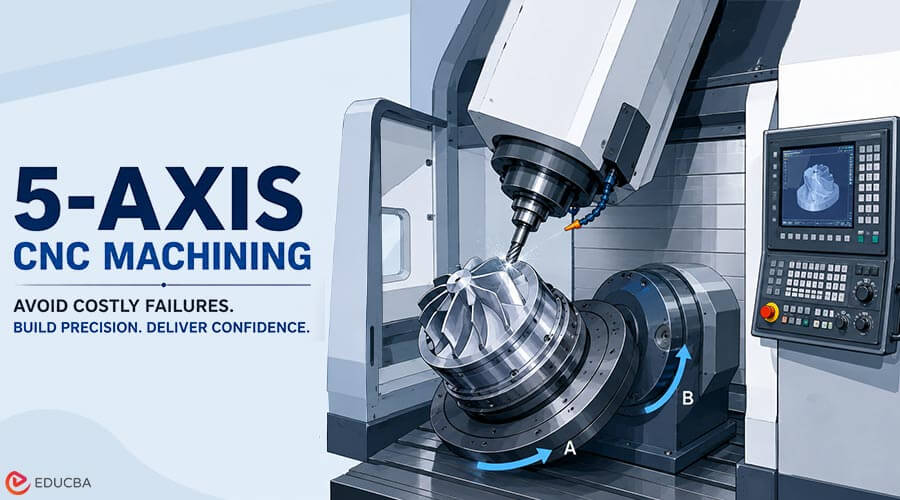
The rapid increase in the complexity of aerospace and medical device components has led many engineering teams to choose multi-axis machining in 2026. However, faulty designs and poor supplier selection are increasing scrap rates, tolerance deviations, and serious delivery delays. The traditional 3-axis mentality does not translate to 5-axis machining, and the lack of DFM review processes and quality controls creates major challenges for manufacturers. In this article, the common failure factors in 5-axis CNC machining services, including tolerance issues, collision problems, and supplier qualification evaluation, have been analyzed to provide a guide for selecting the right service to prevent manufacturing failures in 2026.
Why Do Complex Parts Fail During 5-Axis CNC Machining?
Failure in 5-axis CNC machining can stem from four major causes: excessive tool overhang causing chatter, kinematic collisions during multiaxis motion, datum-shift errors from multiple setups, and thermal deformation. Curved flow channels and cavities increase instability. Engineers should use toolpath simulation early in the design process.
1. The Four Root Causes of Multi-Axis Instability
Overhang-induced tool deflection, kinematic collision between the spindle and the fixture, accumulation of datum errors from multiple setups, and thermal growth during long cuts are the main culprits. In particular, each becomes critical when manufacturing complex parts with cavities and thin walls.
2. Using Toolpath Simulation to Predict Failures
Modern CAM software can detect collisions and analyze vibrations, allowing you to check engagement angles and clearances before actual metal cutting. As per the recommendation of the 2026 5-axis CNC guide, all simulations are to be performed on parts with a depth-to-diameter ratio greater than 3:1.
How Does Design for Manufacturability (DFM) Prevent Multi-Axis Failure?
Effective DFM prevents 80% of geometric clashes before machining. Critical guidelines include a minimum wall thickness of 0.8 mm, chamfer angles that match standard tool geometry, and adequate clearances to avoid tool shanks.
1. Optimizing Geometry Through DFM Rules
By adjusting wall thickness, selecting chamfers that match standard end mills, and adding clearances to avoid shanks, you can prevent interference and vibration. By applying design for manufacturability (DFM) principles early in the design phase, automated pre-screening tools automatically detect risky features.
2. Reducing Scrap Rates with Pre-Cut Analysis
Automated DFM analysis of a 3D model, based on machine kinematics and a tool library, helps detect collisions before any material removal. For custom 5-axis CNC machining jobs, this step is crucial because each part geometry is different and requires specific fixturing.
What Quality Standards Are Critical for Aerospace and Medical CNC Components?
Achieving a high degree of conformity to quality standards is crucial. AS9100D certification is essential for aerospace CNC machining, while medical device CNC machining requires ISO 13485 certification. Leading providers hold multiple certifications to ensure quality at each stage of manufacturing.
1. AS9100D and ISO 13485 Requirements
AS9100D certification ensures material traceability, risk management, and FAI for each batch. ISO 13485 includes process validation and cleanroom requirements for implant-grade parts. It also means CNC machining quality standards, including ISO 9001 and AS9100D, meet strict requirements.
2. Metrology and CMM Verification
A calibration report for the Zeiss CMM, guaranteeing spatial accuracy of 0.0009 mm, ensures the geometry of complex free-form parts conforms to the CAD model. Companies offering precision CNC machining services usually have state-of-the-art metrology systems for ensuring dimensional accuracy.
How to Evaluate a Reliable 5-Axis CNC Machining Service Provider in 2026?
Evaluating a 5-axis CNC service provider requires analysis of RTCP, dynamic machine calibration history, and the ability to design multi-axis fixtures. A 5-axis CNC machining services provider that cannot compensate for RTCP effects will produce positioning errors above ±0.02 mm on tilted planes.
1. Technical Capabilities to Verify
The provider must have RTCP (Rotational Tool Center Point) compensation capability and calibration certificates for each machine. A reputable 5-axis machining supplier should provide this information on demand and have experience in multi-axis fixture development.
2. Benchmarking Against Industry Leaders
To help the engineering team compare the technological capabilities and quality-control processes of overseas suppliers, it is recommended to use industry guidelines, such as the guide to the best 5-axis CNC machining services in China. This will help you choose the top 5-axis CNC manufacturers in China for critical parts.
When Should You Upgrade from 3-Axis to Precision 5-Axis CNC Services?
You reach the ROI threshold when a part’s complexity requires more than four setups on a 3-axis machine. Single-setup precision 5-axis CNC services reduce total fixture cost and clamping errors.
1. Cost-Benefit Analysis of Done-in-One Machining
When part surfaces include freeform features, deep pockets, and undercuts, done-in-one 5-axis machining increases throughput by 300%. In this situation, fixture savings alone will make the move worthwhile once annual production exceeds 500 pieces.
2. Leveraging Digital Platforms for Rapid Prototyping
When CAD models with complex geometry are converted for manufacturing, an automated online CNC machining service enables instant manufacturability checks and rapid prototypes before moving to full-scale production.
Final Thoughts
To avoid costly failures in 5-axis CNC machining, use an integrated strategy that includes strict DFM requirements, tolerance budget analysis, and adherence to international quality standards. As part geometries become more complex in 2026, professional manufacturing support becomes more essential for a smooth transition from CAD models to precise components.
Author Bio:
Gloria, an engineering technology specialist at LS Manufacturing, provided this guide. LS Manufacturing is a precision manufacturing company certified to ISO 9001, ISO 14001, IATF 16949, and AS9100D. They manufacture high-tolerance parts for aerospace, medical, and automotive industries. Engineers looking to eliminate manufacturing hazards can upload their 3D CAD models to receive a free DFM report and quotation.
Frequently Asked Questions (FAQs)
Q1: What is the main difference between 3+2 axis and continuous 5-axis CNC machining?
Answer: In 3+2 axis machining, the tilt and rotary axes remain fixed while movement occurs along three linear axes; continuous 5-axis machining enables simultaneous control over all five axes and can achieve organic curvature, complex impellers, and deep spherical pockets without repositioning errors.
Q2: How does DFM analysis reduce the unit cost of 5-axis CNC machined parts?
Answer: DFM analysis identifies costly features such as excessively deep pockets or internal radii. Modifying these features makes them compatible with standard tools, reducing custom-tool costs, lowering cycle times, and minimizing workpiece deflection.
Q3: Why are ISO 9001 and AS9100D certifications crucial for 5-axis machining suppliers?
Answer: While ISO 9001 sets the foundation for quality management, AS9100D adds aerospace-specific criteria, including material traceability, risk management, and FAI procedures, which are essential for controlling complex multi-axis motions and tight tolerances in every production run.
Q4: What materials yield the best dimensional stability in precision 5-axis machining?
Answer: Dimensionally stable materials include aerospace aluminum alloys (AL 7075-T651), stainless steel (17-4PH), titanium grade 5 (Ti-6Al-4V), and PEEK. Stress-relieving heat treatment and strict temperature control during cutting are vital to maintaining tight tolerances.
Q5: How can engineers prevent tool deflection and chatter during deep-cavity 5-axis milling?
Answer: The continuous tilt of five axes makes it possible to use shorter and stiffer cutting tools with the correct contact angles. Dynamic simulation of trochoidal tool paths, high-feed milling techniques, and shrink-fit holders reduce vibrations. Dynamic simulation ensures clearance while maintaining the metal removal rate.
Recommended Articles
We hope this guide to 5-axis CNC machining helps you improve manufacturing precision and make informed machining decisions. Check out these recommended articles for more insights into CNC manufacturing, machining technologies, and precision engineering.

