


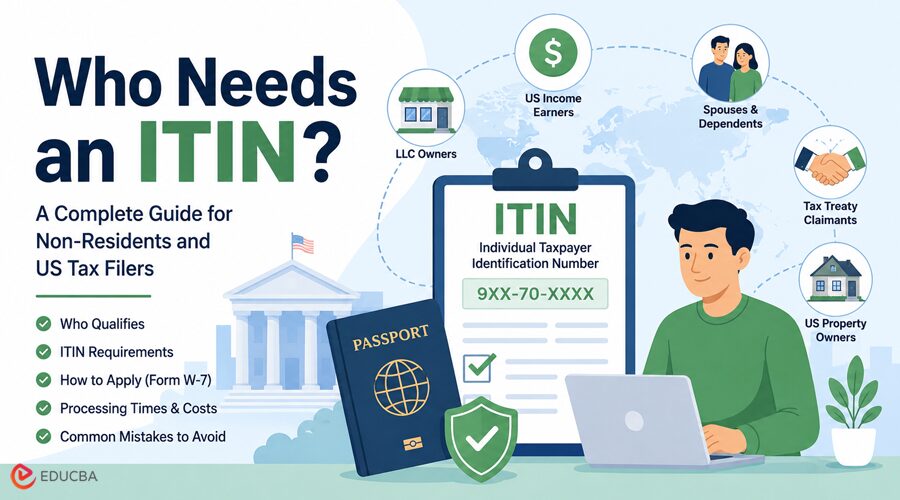
Who Needs an ITIN? A Complete Guide for Non-Residents and US Tax Filers
An ITIN (Individual Taxpayer Identification Number) is required if you need to file a US tax return or are claimed on one. However, you do not qualify for a Social Security Number. This applies to non-resident business owners with US LLCs, foreign nationals earning US income, and dependents or spouses of US taxpayers who lack an SSN. If you formed a US company from outside the country, you almost certainly need an ITIN. We process ITIN applications for non-resident founders every week, and the most common mistake we see is waiting until tax season to apply. The IRS can take 8 to 14 weeks to issue an ITIN, and during peak filing months (February through April), that window stretches to 16 weeks or more.
What is an ITIN and How is It Different from an SSN or EIN?
An ITIN is a 9-digit number issued by the IRS. It always starts with the digit 9 and has a range of 70-88, 90-92, or 94-99 in the fourth and fifth positions (for example, 9XX-70-XXXX). The IRS created the ITIN program in 1996 so that people with US tax obligations but who cannot obtain a Social Security Number could still file returns and pay taxes. The Social Security Administration issues Social Security Numbers (SSNs) to U.S. citizens, permanent residents, and certain work-authorized visa holders.
If you qualify for an SSN, you cannot get an ITIN. The IRS will reject your ITIN application. An EIN (Employer Identification Number) is a tax ID for your business entity, not for you personally. Your LLC or C-Corp gets an EIN. As an individual, you get an ITIN (or SSN). These are separate numbers used for different purposes. A single-member LLC owner filing Form 5472 needs both an EIN for the company and an ITIN for themselves.
Who Needs an ITIN?
Non-Resident LLC and C-Corp Owners
If you live outside the United States and own a US LLC or C-Corporation, you need an ITIN to file your annual tax return. A single-member LLC owned by a non-resident must file Form 5472 and a pro forma Form 1120 with the IRS each year. Your ITIN goes on that return. When asking who needs an ITIN, non-resident business owners are one of the largest categories. Foreign founders operating US entities often require an ITIN for compliance and tax filing purposes. Foreign ownership can complicate matters. Some U.S. disregarded entities with foreign owners may need to file Form 5472 and a pro forma Form 1120, even without U.S. corporate income tax liability.
We had a client from Germany who formed a Wyoming LLC in January, earned no revenue for the entire year, and assumed he did not need to file anything. He was wrong. The IRS requires Form 5472 even if your LLC had zero transactions, as long as the LLC exists and is owned by a foreign person. The penalty for not filing is $25,000 per form. He needed an ITIN to file.
Foreign Nationals Earning US-Source Income
If you earn income from US sources, such as rental income from US property, royalties, dividends, or freelance payments from US companies, you may need to file a US tax return. That requires an ITIN. This is another major category under IRS rules for determining who needs an ITIN. Common situations include: receiving payments through US platforms like Stripe or PayPal that trigger US tax reporting; owning US rental property managed by a US property manager; receiving royalties from US publishers or software marketplaces; or selling goods through a US-based e-commerce operation.
Spouses and Dependents Claimed on US Tax Returns
A US citizen or resident alien who files a joint return with a nonresident spouse must obtain an ITIN for that spouse. The same applies to dependents who do not qualify for an SSN. This is common in families where one spouse works in the US on a visa, and the other has no US immigration status.
Non-Resident Aliens Claiming Tax Treaty Benefits
If you are a non-resident alien and want to claim a reduced tax rate under a US tax treaty with your home country, you need an ITIN. Without it, the US payer must withhold at the default 30% rate on payments like royalties, interest, or dividends. With a valid ITIN and the correct Form W-8BEN, the withholding rate drops to the treaty rate, typically 0% to 15%, depending on the type of income and the country.
Non-Residents Applying for a US Mortgage
Some US lenders issue mortgages to non-resident foreign nationals purchasing US property. These lenders require an ITIN as part of the application process.
Students and Scholars on Certain Visas
International students on F-1 or M-1 visas and exchange visitors on J-1 visas may need an ITIN if they are not eligible for an SSN but have US tax filing requirements, such as receiving a fellowship or stipend that constitutes taxable income.
Who Does NOT Need an ITIN?
Not everyone without an SSN needs an ITIN. The IRS is specific about this. You do not need an ITIN if you are eligible for an SSN. The IRS will reject your application. Apply for the SSN first. You do not need an ITIN if you have no US tax filing requirement. Simply owning a US bank account or having a US mailing address does not, by itself, create a tax filing obligation. You do not need an ITIN if your only US connection is a US-based payment processor. Receiving payments through Stripe or Wise does not automatically mean you owe US taxes. Your tax obligation depends on whether the income is considered US-source income under IRS rules.
If you are a freelancer in India doing work for a US client and all the work is performed outside the US, that income is generally not US-source income, and you may not need to file a US return. Many founders researching who needs an ITIN are surprised to learn that simply forming a US LLC or using Stripe does not automatically create a filing obligation in every case. Consult a CPA for your specific situation.
How to Apply for an ITIN?
The IRS accepts ITIN applications through Form W-7 (Application for IRS Individual Taxpayer Identification Number). There are three ways to submit it.
Option 1: Mail Form W-7 to the IRS
Complete Form W-7 and mail it to the IRS ITIN Operation in Austin, Texas, along with your original passport (or certified copies from the issuing agency) and your completed tax return. The IRS mailing address is:
Internal Revenue Service, ITIN Operation, P.O. Box 149342, Austin, TX 78714-9342 This is the method most non-residents use. The problem is obvious: you must send your original passport to the IRS and wait for it to be returned. Processing takes 8 to 14 weeks as of May 2026. During that time, your passport is in a mailroom in Austin.
Option 2: Apply Through a CAA (Certifying Acceptance Agent)
A Certifying Acceptance Agent is an individual or organization authorized by the IRS to verify your identity documents and submit Form W-7 on your behalf. The advantage is that a CAA can certify copies of your passport, so you do not need to mail the original. We work with authorized CAAs to process ITIN applications for our clients. This is the method we recommend for non-resident founders. You keep your passport. The CAA certifies your documents and submits them to the IRS.
Option 3: Visit an IRS Taxpayer Assistance Center
If you are physically in the United States, you can schedule an appointment at an IRS Taxpayer Assistance Center. Bring your completed Form W-7, your tax return, and original identification documents. The IRS will verify your identity in person. This option is impractical for non-residents who do not plan to visit the US.
Common Mistakes the Team Sees with ITIN Applications
Applying Without a Tax Return
The IRS requires you to attach a completed federal tax return to your Form W-7. The only exceptions are if you fall into one of the specific categories listed in the Form W-7 instructions (such as receiving income subject to third-party withholding or reporting requirements, or claiming treaty benefits on Form 8233). If you send Form W-7 without the required return, the IRS will reject it. We see this happen every month.
Using the Wrong Exception Category
Form W-7 asks you to select a reason for applying. Each reason has a corresponding exception code. Choosing the wrong one causes a rejection. Non-resident LLC owners who need to file Form 5472 should select exception category “a” (Nonresident alien filing a U.S. federal tax return). If this is done incorrectly, it adds 3 to 4 months to the process because you must resubmit.
Sending Uncertified Passport Copies
The IRS does not accept regular photocopies of your passport. You must send either the original document, a certified copy from the issuing agency (the government that issued the passport), or copies certified by a CAA. Notarized copies do not count. A notary public is not the same as the issuing agency. We have seen dozens of ITIN applications rejected for this reason alone.
Waiting Until the Tax Deadline
One of the biggest issues for people researching whether they need an ITIN is applying too late. If your tax return is due on April 15 and you apply for an ITIN on April 1, you will not receive the ITIN in time.
Letting the ITIN Expire
ITINs that have not been used on a federal tax return at least once in the last three consecutive tax years expire. ITINs with middle digits 70 through 88 issued before 2013 have already expired under the IRS’s rolling expiration schedule. If your ITIN has expired, you must renew it by submitting Form W-7 again with “Renew” checked at the top. You can renew without attaching a tax return.
How Long Does It Take to Get an ITIN?
The IRS states that processing takes 7 to 11 weeks. In our experience, filing through CAAs in 2025 and 2026, the actual turnaround has been closer to 10-14 weeks. During January through April (peak tax season), processing slows down. We have seen applications take 16 weeks during this period. Applications submitted by mail without a CAA tend to take longer because the IRS must verify original documents, process the W-7, and then return your passport separately.
The following table summarizes typical ITIN processing times based on our recent filing data as of May 2026:
| Filing Method | Documents Required | Typical Processing Time |
| Mail (original passport) | Original passport + Form W-7 + tax return | 10 to 16 weeks |
| Through a CAA | Certified passport copies + Form W-7 + tax return | 8 to 14 weeks |
| In-person at IRS TAC | Original documents + Form W-7 + tax return | 8 to 11 weeks |
How Much Does an ITIN Cost?
The IRS does not charge a fee for issuing an ITIN. Form W-7 is free to file. Your costs come from preparation and submission. If you hire a CAA to certify your documents, expect to pay $50 to $300, depending on the agent. Suppose you use a tax professional to prepare the tax return that must accompany the W-7, which adds another $150 to $500, depending on the complexity of your return. Mailing costs for sending original documents via a tracked international courier (FedEx, DHL) from outside the US typically range from $40 to $80 each way. EasyFiling’s ITIN service handles the full process: document preparation, CAA coordination, Form W-7 completion, and tax return preparation. Check our ITIN service page for current pricing.
Can an ITIN Be Used to Open a US Bank Account?
An ITIN alone does not authorize you to open a bank account. Banks set their own policies. Some US banks accept an ITIN as a form of tax identification for account opening, while others require an SSN. For business bank accounts, the account is opened under the LLC’s EIN, not your personal ITIN. Your ITIN may be requested as part of the Know Your Customer (KYC) verification for the individual behind the LLC. Mercury, for example, requires the business’s EIN and verifies the beneficial owner’s identity using a passport and address. Wise (formerly TransferWise) has a similar process. We help our clients open US business bank accounts during the formation process. The EIN is the critical number for the business account. The ITIN is important for your personal tax compliance and may be required for certain banking or financial applications down the line.
Does an ITIN Give You Work Authorization or Immigration Status?
No. The IRS is explicit about this. An ITIN does not provide authorization to work in the United States, does not provide eligibility for Social Security benefits, and does not change your immigration status. It is strictly a tax processing number. This is a common misconception. We clarify it in almost every client onboarding call with non-resident founders.
Frequently Asked Questions (FAQs)
Q1. Can I apply for an ITIN without a tax return?
Answer: Only in limited circumstances. The IRS requires a federal tax return with most ITIN applications. Exceptions apply to individuals receiving income subject to IRS reporting or withholding (such as third-party withholding on a Form 1042-S) or to those claiming tax treaty benefits. Check the Form W-7 instructions for the full list of exceptions.
Q2. How do I know if my ITIN has expired?
Answer: If you have not included your ITIN on a US federal tax return for the last three consecutive tax years, it has expired. The IRS also expired all ITINs with middle digits 70 through 88 that were issued before 2013 on a rolling schedule. You can verify by calling the IRS at 1-800-829-1040 or checking your most recent IRS correspondence.
Q3. Can I renew my ITIN before it expires?
Answer: Yes. If your ITIN is set to expire at the end of the current tax year (because it was not used in the last three years), you can submit a renewal Form W-7 without attaching a tax return. The IRS processes renewals the same way as new applications.
Q4. Do I need an ITIN if my LLC had no income this year?
Answer: If you are a non-resident who owns a single-member US LLC, you must file Form 5472 and a pro forma Form 1120 regardless of whether the LLC earned income. Filing that return requires an ITIN. The penalty for failing to file Form 5472 is $25,000 per form, per year.
Q5. Can I use my ITIN to get a US driver’s license?
Answer: This depends on the state. Some states accept an ITIN as proof of tax identification when applying for a driver’s license or state ID. Policies vary. Check with the specific state’s Department of Motor Vehicles.
Q6. Can two people share an ITIN?
Answer: No. An ITIN is assigned to one individual. Each person who needs to file a US tax return or be listed on one must have their own ITIN (or SSN).
Q7. What happens if my ITIN application is rejected?
Answer: The IRS will send a letter explaining the reason for rejection. Common reasons include missing or improperly certified documents, selecting the wrong exception category, or failing to attach the required tax return. You can correct the issue and resubmit Form W-7. There is no limit on how many times you can apply, but each rejection adds months to the timeline.
Disclaimer: This content is for informational purposes only and does not constitute legal, tax, or financial advice. For advice specific to your situation, consult a qualified US attorney or CPA.
Recommended Articles
We hope this guide on who needs an ITIN helps you understand ITIN eligibility, IRS requirements, and the application process. Explore the recommended articles below for more insights on US tax filing, LLC compliance, and non-resident taxation.


