


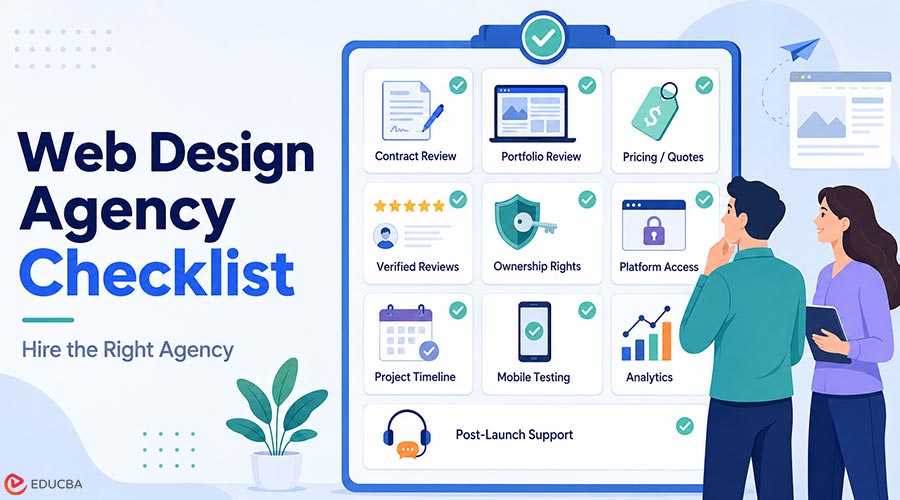
Most businesses evaluate a web design agency by looking at the portfolio, reading a few reviews, and getting three quotes. That process produces the feeling of due diligence without actually reducing your risk.
Portfolios are curated to show best-case outcomes. Reviews on an agency’s own website are not independently verified. Moreover, three quotes, without a shared definition of scope, cannot be meaningfully compared. You could follow every standard recommendation and still sign with an agency that delivers late, builds on a platform you cannot access, or goes quiet when you ask for revisions.
Abbas Noorani, founder of Web Designer Factory, a web design and SEO agency based in Plano, TX, has overseen more than 1,500 projects for businesses across the United States since 2017. Drawing on this extensive experience, he developed a web design agency checklist to help business owners identify common risks when evaluating and hiring a web design agency. His experience has shown that the greatest risks are rarely limited to aesthetics or pricing; they often stem from overlooked structural elements such as contract terms, ownership rights, platform choices, and communication protocols. Each item in this checklist is designed to help business owners verify these critical factors before making any financial commitment.
Start With the Contract, Not the Portfolio
Most business owners treat contract review as the last step before signing. It should be the first filter. An agency that refuses to share a sample contract or define scope before accepting a deposit is not hiding bureaucracy. They are signaling that their process depends on you not knowing what you have agreed to.
Three contract clauses determine the majority of project outcomes.
Intellectual Property Assignment
“Work made for hire” is a US employment law term that applies to employees, not independent contractors. It is not sufficient in an agency contract. You need an explicit assignment clause. Language such as “client retains a license to use the deliverables” is not ownership. It is a permission to use something the agency still owns. The contract must state, in plain language, that all work product, source code, design files, and intellectual property are assigned to you on final payment.
Platform and Hosting Independence
Ask this question directly before signing: if I end this engagement today, can I take my site to another agency without losing functionality? If the agency built your site on a proprietary platform, registered your domain in their account, or configured hosting through a reseller account you cannot access, the answer is no. Your site is a dependency, not an asset. Insist on: a domain registered in your name, a hosting account you control, and a site built on an open platform such as WordPress or Webflow with your own account.
Milestone Payment Structure
Payments should be tied to approved deliverables, not calendar dates. A standard structure: 25% at contract signing, 25% at design approval, 25% at development handoff for your review, and 25% at launch. The word “approved” is critical: you should be required to sign off on each milestone before the next payment is due. Compare that to contracts that bill monthly regardless of progress, or that tie a large final payment to a launch date you have not yet reviewed.
Technical Verification on Portfolio Sites
A portfolio screenshot tells you what an agency’s output looks like on a good day in a browser window. It does not tell you whether that output performs. Before your first meeting, run these four checks on two or three portfolio sites:
Google Indexing Check
Open Google and type site:[portfoliodomain].com in the search bar. If the result shows pages from that domain, the site is indexed and visible in search results. If it returns zero results, the site is not indexed. An agency that builds sites Google cannot find has not delivered a functional SEO foundation, regardless of visual quality.
Core Web Vitals Check
Go to PageSpeed Insights (pagespeed.web.dev) and paste a portfolio URL. Google’s ranking algorithm uses page speed, layout stability, and interactivity as signals. A mobile score below 70 on a portfolio site is a signal about what you will receive, not a one-off. If multiple portfolio sites score poorly on mobile, that is a pattern.
Wayback Machine Verification
At web.archive.org, enter a portfolio domain and review when pages were first captured. This confirms that the agency built the site during the period they claim. Some agencies list sites they minimally updated rather than built from scratch, or claim portfolio items from before a major redesign they were not involved in.
Real-device Mobile Test
Open portfolio sites on your actual phone. Chrome’s mobile emulation in a desktop browser does not replicate real-device touch behavior, font rendering, or loading performance on a cellular connection. If navigation breaks, text requires zooming, or forms are difficult to use on your device, you are seeing a sample of the agency’s mobile delivery quality.
Questions That Reveal How an Agency Actually Operates
Discovery calls are where agencies rehearse answers to predictable questions. These questions are not predictable:
“Walk me through your last project that came in late. What caused it?”
Every agency has had a project run late. An agency that claims otherwise is not credible. What matters is the explanation: did they attribute the cause to the client, to external factors, or to a process gap they identified and corrected? Agencies that own their failures are safer to work with than those with perfect stories.
“If I asked to see your project management system right now, what would I see?”
This reveals whether they track work in structured software (Asana, Basecamp, Monday.com, Jira) with tasks, owners, and deadlines you will have visibility into, or whether projects live in Slack threads and email chains. Informal project tracking produces unclear accountability and timeline drift.
“What happens to my project if the lead developer leaves mid-build?”
Agencies with documented processes and code that adhere to standards can absorb personnel changes without impacting clients. Agencies where one person holds all the institutional knowledge on your project cannot. The answer tells you whether they have a bench and a process, or a dependency on individual contributors.
“What are three things past clients have pushed back on?”
An agency that cannot recall any honest client friction is telling you more about their self-awareness than about their client relationships. Specific, owned answers indicate an agency that learns from projects. Vague or defensive answers indicate someone who does not.
Web Design Agency Checklist for Evaluating Reviews?
An agency’s own website only shows you the reviews it chose to publish. Use these sources:
Clutch.co
Reviews on Clutch require verification: the reviewer’s identity and company are confirmed before the review publishes. Each review includes the client company name, project budget range, project type, and star breakdowns across quality, scheduling, cost, and willingness to refer. An agency with 20 or more verified Clutch reviews from named companies across different industries has a verifiable track record you can actually evaluate. Fewer than five reviews after several years of operation means no independent verification exists.
Google Business Profile
Google reviews cannot be submitted anonymously. Click on reviewer names and check whether they have a history of leaving reviews for other local businesses. A cluster of five-star reviews from accounts with no other review history, all posted in the same week, warrants scrutiny.
Read the Three- and Four-star Reviews First
Agencies with any meaningful volume of reviews will have some negative ones. Do the complaints cluster around a consistent failure type: missed timelines, poor communication after contract signing, or abandonment after launch? Clusters are patterns, not outliers. Patterns reflect how an agency is structured, not how they perform on a good day.
Post-Launch Commitments Most Businesses Forget to Clarify
Most evaluation frameworks focus on the build phase. The most expensive failures happen after launch.
Bug Fix Period Scope
What constitutes a bug versus a change request, and how long does the bug fix period last? Most professional agencies include 30 to 60 days of technical issue resolution at no additional cost after launch. Content updates, scope additions, or design changes typically fall outside this window. If this is not defined in the SOW, it will be disputed.
Domain and DNS Control
After launch, who manages DNS records and domain settings? If the agency handles this, ask how you can recover independent control if you switch agencies. If you cannot access your own DNS settings, you cannot independently verify your hosting, add third-party tools, or migrate without agency involvement. Domain control belongs to you, not to your vendor.
CMS Independence
After the site goes live, can you publish a blog post, update a staff page, or change your business hours without contacting the agency? If not, the project has a hidden recurring cost embedded inside what appeared to be a one-time engagement. A professional agency builds for your independence, not your dependency.
Analytics Configuration
Google Analytics 4 and conversion tracking should be installed, verified, and recording data before launch, not after. If the agency does not include analytics setup in the project scope, you will have no baseline data for the first weeks or months after launch. You cannot optimize what you have not measured from the start.
Red Flags That End the Evaluation
These patterns warrant walking away before investing more time:
- Deposit required before the scope is defined: Scope is how you hold an agency accountable. Paying before the scope exists is paying for a promise, not a deliverable.
- “Unlimited revisions” as a selling point: Unlimited revisions with no defined scope prevent final delivery. It is not client-friendly. It is a condition that removes the completion point from the project. Legitimate agencies define revision rounds per milestone and specify what triggers an out-of-scope charge.
- No US jurisdiction in the contract: If a dispute arises, your legal options depend on where the agency is incorporated and what law governs the contract. An offshore agency without a US entity has limited accountability under US contract law.
- Portfolio entries that no longer exist: Expired domains and 404 pages in a portfolio are either outdated record-keeping or intentional padding. Neither is reassuring.
- Vague answers to specific process questions: An agency that cannot describe its project management workflow, revision process, or handoff procedure in concrete, sequential steps does not have them. It has talking points.
How Web Designer Factory Uses This Web Design Agency Checklist?
Every element in this web design agency checklist came from observing what fails when it is absent.
Every project at Web Designer Factory begins with a signed SOW before any payment is made. The SOW specifies the pages to be built, the platform, the number of revision rounds per milestone, the milestone payment schedule, the post-launch support duration, and an explicit IP assignment clause that transfers all code, domain registrations, and platform accounts to the client upon final payment. Payments are milestone-based: the client approves each deliverable before the next invoice is issued.
The core team is US-based and available during US business hours. Client references are available by phone. After 1,500+ projects and 600+ verified five-star reviews, this process is not a differentiator. It is the baseline that every professional web design engagement should meet.
Run this web design agency checklist before you sign. The hour it takes costs less than the months required to unwind a project with an agency that did not meet these standards.
Frequently Asked Questions (FAQs)
Q1. How do I know if a web design agency is legitimate?
Answer: A legitimate agency should have verified reviews on Clutch.co, a confirmed Google Maps business address, a signed statement of work before payment, and a contract that transfers website ownership to you after final payment. Using a web design agency checklist helps verify these factors before signing.
Q2. What should I expect to pay for a professionally built website in 2026?
Answer: A custom website from a US-based agency typically costs $4,500 to $15,000+, depending on page count, e-commerce features, and integrations. Offshore agencies may charge $800 to $3,000 for a similar scope, but accountability and legal protections may differ.
Q3. How long does it take to build a business website?
Answer: A custom 5–10 page website usually takes 4 to 8 weeks from contract signing to launch, including discovery, design, development, content review, and testing.
Q4. Who should own the website code when the project ends?
Answer: You should own all source code, design files, domain registrations, and platform accounts after final payment. A proper web design agency checklist should include verifying that these ownership terms are included in the contract.
Q5. What is the difference between a website redesign and a rebuild?
Answer: A redesign updates the site’s visual appearance while keeping the existing platform. A rebuild creates the website on a new or different platform, often to improve scalability, performance, or functionality.
Recommended Articles
We hope this web design agency checklist helps you choose the right agency with confidence. Explore these recommended articles for more insights into website design, SEO, user experience, and digital marketing.

