


Virtual Reality Applications in Classroom Education
Virtual reality (VR) has emerged as a game-changing technology across multiple sectors, including entertainment, gaming, and education. Users of this immersive technology experience an interactive, three-dimensional environment where they can engage with digital content in previously unimaginable ways. Virtual reality in education enables students to assume roles and interact directly with the content, creating an engaging and experiential learning environment that differs from conventional educational approaches, which often rely on textbooks and lectures.
What is VR in Education?
Virtual reality in education utilizes specialized devices, including VR headsets and haptic feedback controllers, to immerse students in three-dimensional environments. This allows students to explore, practice, and learn actively in much more engaging ways than conventional teaching methods. For subjects like chemistry, physics, biology, and engineering, where hands-on experience is crucial, VR offers a particularly useful learning tool.
For example, in chemistry, students can conduct experiments virtually. Challenges such as handling hazardous chemicals or utilizing expensive materials in traditional classrooms may limit students’ ability to fully engage with experiments. With VR, students can safely interact with these materials and perform experiments in a risk-free environment, gaining practical experience without the dangers.
How Does Virtual Reality Work in Learning?
Virtual reality in learning combines technology, curriculum development, and teacher training, with growing emphasis on VR for training. Schools can collaborate with VR content creators to develop customized courses that align with existing curricula. Teachers also play a crucial role in implementing VR. They must learn to use the technology effectively, select appropriate content, and design engaging lessons. Once they integrate VR, it enhances education in several ways:
- Interactive Learning: VR allows students to engage with complex topics in ways that traditional methods can not. They can interact with 3D models, explore simulations, and view visual representations of abstract concepts, thereby improving their understanding and retention.
- Distance Learning: VR enables students to take part in immersive lessons remotely, making high-quality education accessible to those without access to physical labs or resources.
- Multiple Learning Styles: VR supports various learning styles by combining visual, auditory, and tactile elements. Students can immediately see the outcomes of their actions, reinforcing their learning.
Benefits of Virtual Reality in Education
One cannot overlook the several benefits provided by immersive learning when contrasting virtual reality education with more conventional approaches.
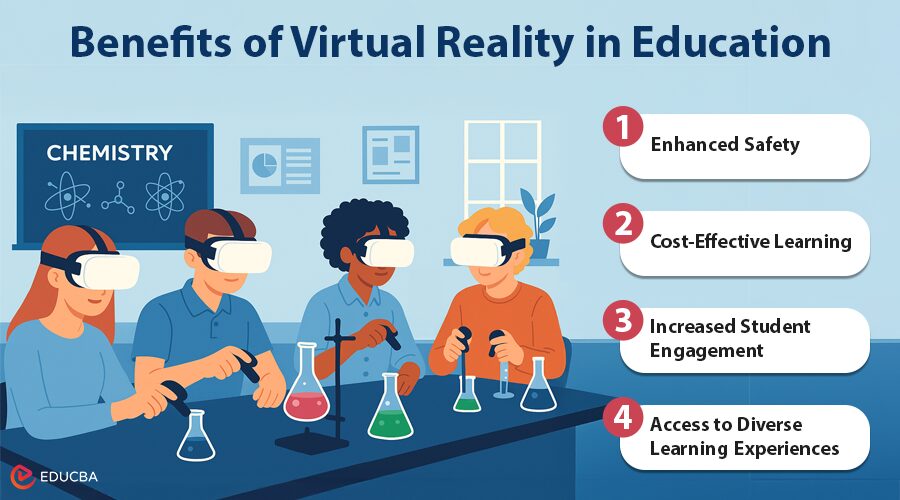
- Enhanced Safety: One of the major advantages of VR in fields like chemistry is its ability to enhance safety during experiments and simulations. Students can conduct experiments with virtual chemicals and observe reactions without the risk of accidents or exposure to hazardous substances.
- Cost-Effective Learning: Although the initial investment in VR technology might seem high, it can be more affordable in the long run. Schools do not need to purchase expensive chemicals or lab equipment. The virtual environment can simulate these resources, significantly lowering costs.
- Increased Student Engagement: Traditional classrooms frequently face challenges in maintaining student engagement. Virtual reality immerses students in their subjects, sparking curiosity and increasing their involvement. For example, a VR chemistry class offers an interactive, gamified learning experience that makes studying more exciting.
- Access to Diverse Learning Experiences: VR offers a range of scenarios and simulations that are not possible in the real world. Students can dive into topics ranging from chemical reactions to human anatomy, gaining memorable and immersive learning experiences that surpass traditional teaching methods.
Real-World Knowledge Without the Risk
VR is especially beneficial in fields like chemistry, where hands-on experience is essential but can be dangerous. In a physical lab, mishaps are a real risk, and working with specific chemicals is costly and complicated. With VR, students can explore complex chemical reactions, conduct experiments, and observe outcomes—all without the physical hazards or need for expensive materials.
In a virtual chemistry lab, for example, students can safely mix substances, see the effects, and repeat experiments as many times as needed. They can change variables, such as temperature or concentration, to observe real-time changes. This level of interaction helps reinforce knowledge in ways that textbooks simply cannot.
The Future of VR in Education
As VR technology continues to improve, its use in education will become increasingly widespread. Schools and educators embracing this digital revolution can create richer, safer, and more engaging learning environments that transform how students interact with their subjects. The future of education lies in integrating Virtual Reality into Education, especially in subjects like chemistry.
Teachers who incorporate VR into their classrooms can provide their students with practical experiences, safety, and a level of engagement that traditional education simply cannot offer. By utilizing VR, educators can help students develop the skills and knowledge necessary to succeed in an increasingly complex world. Virtual reality is not just a novelty in education; it is a transformative tool for learning.
Final Thoughts
Virtual reality in education is transforming the learning experience for students by converting traditional lessons into immersive, hands-on experiences. From enhancing safety in experimental subjects, such as chemistry, to providing engaging and interactive simulations that make complex ideas easier to understand, VR is transforming education. Integrating VR in Education is not just a passing trend—it is a long-term shift that can reshape the future of learning for generations to come.
Recommended Articles
We hope this guide on virtual reality in education provides valuable insights into how immersive technology transforms the learning experience. Check out these recommended articles for more strategies and innovations in educational technology.


