


Updated July 29, 2026
Two business owners hire for what appears to be the same role. One pays $900 a month. The other pays $4,500. Both call it a virtual assistant. Both get real, useful support. So why is the gap so wide?
The answer is that the virtual assistant cost is not one number. It is the result of several variables stacking on top of each other, including experience, location, dedicated hours, and task complexity. Once you understand how each variable moves the price, budgeting for a VA stops being a guessing game and becomes a planning exercise.
This article breaks down the factors that shape virtual assistant costs, so you can set a realistic budget before you start looking for candidates.
Why “How Much Does a VA Cost” Has No Single Answer?
Virtual assistant costs depend on the hiring model, the VA’s location, their experience level, the number of hours you need, and the role’s complexity. Change any one of these, and the number shifts significantly.
This is exactly why two business owners hiring for similar-sounding roles can end up with wildly different invoices. A general admin assistant managing scheduling and inbox support costs less than a finance assistant, an ecommerce specialist, or a marketing coordinator. The job title “virtual assistant” covers a huge range of actual work, and the price reflects that range.
The smarter question is not just what a VA costs. It is determining which pricing factors apply to your specific situation and how each will affect your virtual assistant cost.
Factor 1: Experience Level
Experience is one of the clearest price drivers in the VA market.
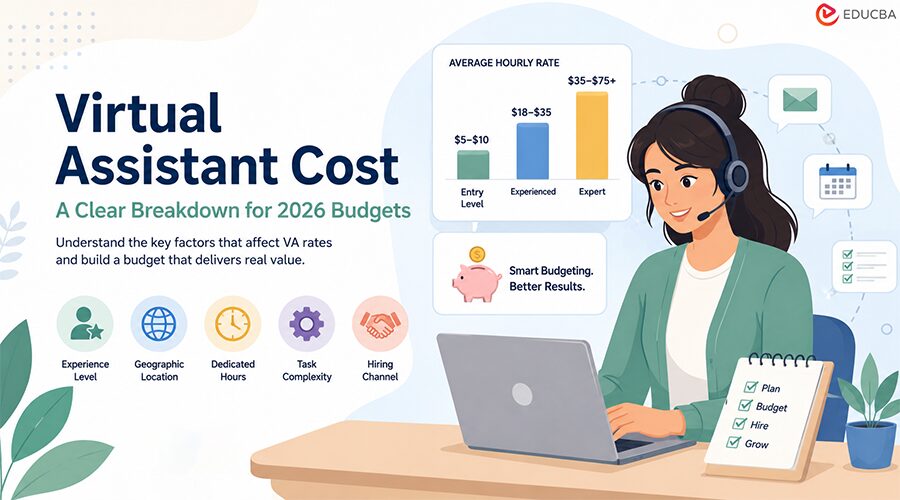
Entry-level VAs, often early in their career, typically charge $5 to $10 per hour. They handle data entry, basic scheduling, inbox management, and straightforward research tasks well, but they need more oversight and clearer instructions to start.
Experienced VAs who can operate with minimal supervision and manage more complex workflows typically charge $18 to $35 per hour. By the time you reach senior-level VAs who bring strategic input, manage other team members, or operate at an executive assistant level, virtual assistant cost can climb to $35 to $75 or more per hour.
The lesson here is not that cheaper is worse. For simple, repetitive tasks, an entry-level VA delivers excellent value. The mismatch occurs when business owners hire entry-level talent for work that genuinely requires senior judgment, only to spend hours correcting and re-explaining what they actually needed.
Factor 2: Geographic Location
Where your VA is based can dramatically change the price, even for the same skill set.
US-based VAs average $25 to $27 per hour, according to recent labor data, with experienced professionals earning $35 to $60 or more. Philippine-based VAs typically charge $6 to $15 per hour for general administrative work, with specialized roles like SEO or project management charging $1,450 to $2,700 per month on a full-time basis. Latin American VAs typically land in the middle, at $15 to $30 per hour, often justified by stronger US time-zone overlap.
Location is not just about cost. It also affects communication style, time zone alignment, and cultural familiarity with your market. The cheapest location is not necessarily the right one if real-time collaboration matters to your business.
Factor 3: Dedicated Hours and Commitment Level
This is the virtual assistant cost factor most business owners underestimate when first setting a budget.
The number of hours you commit per week or month affects both the hourly rate and the total monthly cost. A VA working a small number of occasional hours typically charges a higher hourly rate because they have no guaranteed income. A VA working full-time, dedicated hours, often comes at a noticeably lower effective hourly rate because income is steady and predictable for both parties.
For example, a 10-hour monthly plan might cost around $390, or roughly $39 per hour. A 40-hour monthly plan from the same provider might cost $1,480, which works out closer to $37 per hour. The per-hour rate barely moves, but the structure of dedicated, predictable hours tends to produce more consistent quality and faster turnaround over time.
Dedicated, full-time arrangements also tend to deepen the working relationship. A VA who knows they have your business as a stable, ongoing commitment invests more in learning your systems than one juggling several clients on a few scattered hours each.
Factor 4: Task Complexity and Specialization
The type of work being delegated sets a clear floor and ceiling on virtual assistant cost.
General administrative tasks like scheduling, email management, and data entry sit at the lower end, typically $10 to $20 per hour, regardless of location. Specialized tasks such as social media management, bookkeeping, and content writing usually cost $20 to $45 per hour. Highly technical or niche expertise, such as web development, advanced SEO, or legal and medical administrative support, can run $45 to $100 or more per hour, especially under project-based pricing.
Task complexity sets the floor. Skill set sets the ceiling. A VA with deep, industry-specific expertise justifies a premium because they require far less training and deliver useful output faster than someone learning your systems from scratch.
Factor 5: Hiring Channel
How you find and hire your VA also shapes the final number, sometimes more than people expect.
Freelance marketplaces like Upwork or Fiverr often advertise lower hourly rates. However, platform fees can add 20 percent or more to what you actually pay, and you absorb all the vetting, onboarding, and management time yourself. Independent agencies and managed VA companies typically charge a higher hourly rate but bundle in vetting, training, account management, and replacement guarantees if the fit is not right.
When you add up the hidden time cost of vetting and managing a freelancer yourself, often valued at $500 to $1,250 in one-time vetting time plus several thousand dollars a year in ongoing management, the agency premium frequently evens out or comes out ahead, especially for ongoing, long-term support.
Virtual Assistant Cost by Role Type: Quick Reference Table
| VA Type | Entry Level | Experienced | Expert |
| General Administrative | $10-$18/hr | $18-$28/hr | $28-$40/hr |
| Specialized (Marketing, Bookkeeping) | $20-$35/hr | $35-$50/hr | $50-$75/hr |
| Executive Assistant | $25-$40/hr | $40-$55/hr | $55-$75/hr |
| Technical/Development | $30-$50/hr | $50-$75/hr | $75-$100+/hr |
Use this table as a starting benchmark, then adjust based on the location and hiring channel you choose.
How to Build Your Virtual Assistant Cost Budget?
Follow this simple sequence before you start interviewing candidates.
Step 1: Define the Scope of Work
List every task you want to hand off. Separate simple administrative work from specialized or technical tasks. This determines which row of the rate table applies to you.
Step 2: Decide on Dedicated Hours
Estimate how many hours per week the work realistically requires. A few hours a week point toward a part-time or shared arrangement. Twenty or more hours a week points toward a dedicated, full-time commitment, which usually comes with a better effective rate.
Step 3: Choose your Location Preference
Decide whether time zone overlap and cultural alignment matter enough to justify a higher rate, or whether cost savings from an offshore hire outweigh those factors for your specific tasks.
Step 4: Pick your Hiring Channel
Weigh the lower sticker price of a freelance marketplace against the added structure, vetting, and replacement protection of an agency. For ongoing, business-critical work, the agency premium is usually worth it.
Step 5: Add a 10-15% Buffer
Account for onboarding time, software seats, and the natural learning curve in the first month. This keeps your budget realistic rather than optimistic.
The Real Virtual Assistant Cost Comparison to Make
Most business owners compare a VA’s hourly rate to an employee’s salary and conclude the VA is cheaper. That comparison misses the bigger picture.
A mid-level in-house hire typically costs $6,500 to $9,000 per month once benefits, payroll taxes, equipment, and office space are factored in. A VA covering the same administrative or specialized work typically runs $800 to $3,000 per month, with none of that overhead. The real comparison is the total cost of employment against the total cost of the VA relationship, not rate against salary.
A low hourly rate can still be expensive if the VA needs constant correction and rework. A higher-tier monthly plan can be a better investment if it removes admin drag, speeds up response times, and frees up your time for revenue-generating work.
Final Thoughts
Virtual assistant costs are shaped by five factors working together: experience level, location, dedicated hours, task complexity, and hiring channel. Once you understand how each one moves the price, the wide range you see across providers stops feeling confusing and starts feeling logical.
Build your budget by working through the scope of work first, then layer in the other factors one at a time. The right virtual assistant cost for your business is not the lowest number on the page. It is the one that matches the actual work you need done and is delivered by someone who can do it without constant correction.
Plan with the full picture in mind, and your VA budget will reflect real value, not just a quoted rate.
Recommended Articles
Explore more guides on hiring the right virtual assistant, delegating tasks effectively, and building a productive remote support team. Learn how to compare VA services, choose the best hiring model, and get more value from your business budget.


