
Introduction to Types of Recruitment
Types of recruitment refer to the different methods organizations use to attract, select, and hire suitable candidates for job roles. These recruitment approaches help companies identify the right talent based on business needs, skill requirements, and hiring timelines. Understanding the types of recruitment enables organizations to choose effective hiring strategies, improve workforce quality, and achieve long-term organizational growth.
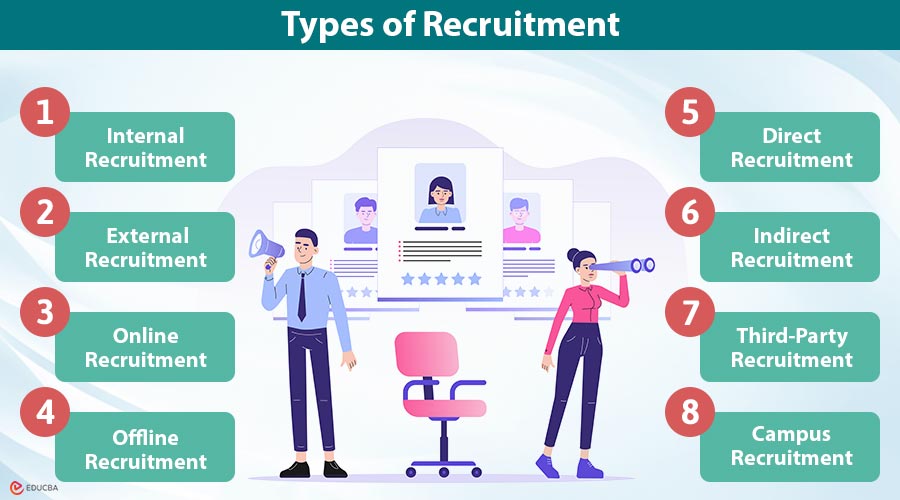
In this article, we discuss the top 8 types of recruitment, including internal, external, online, offline, direct, indirect, third-party, and campus recruitment, along with their advantages, limitations, and use cases.
Different Types of Recruitment
Below are the different types of recruitment commonly used by organizations, each suited to specific hiring needs and workforce strategies.
#1. Internal Recruitment
To make internal recruitment even more effective, organizations can use iMocha’s skills intelligence platform to map existing employee capabilities, identify skill gaps, and enable structured internal mobility by matching the right talent to the right opportunities.
Advantages:
- Reduces hiring costs and time since candidates are already part of the organization.
- Improves employee motivation, loyalty, and career growth through internal advancement opportunities.
- Ensures cultural fit, as employees already understand company values and processes.
Limitations:
- Limits external talent and fresh ideas from entering the organization.
- May create internal rivalry, dissatisfaction, or conflict among employees.
- Creates another vacancy that must be filled elsewhere internally.
Use Cases:
Internal recruitment is ideal for leadership roles, specialized positions, or when employee development is a priority.
#2. External Recruitment
External recruitment involves attracting candidates from outside the organization through job portals, recruitment agencies, campuses, and social media, helping businesses access a wider talent pool with fresh skills and perspectives.
Advantages:
- Provides access to wider talent pool with diverse skills and experiences.
- Brings fresh perspectives, innovation, and industry best practices.
- Helps fill roles when internal talent is unavailable or insufficient.
Limitations:
- Involves higher recruitment costs and longer hiring cycles.
- Requires additional onboarding and training efforts.
- Risk of poor cultural fit and early attrition.
Use Cases:
Best suited for organizational expansion, new skill requirements, or rapid scaling.
#3. Online Recruitment (E-Recruitment)
Online recruitment uses digital platforms, job portals, career websites, applicant tracking systems, and AI tools to efficiently source, screen, and hire candidates, enabling faster communication, broader reach, and data-driven hiring decisions.
Advantages:
- Enables faster candidate sourcing, screening, and communication through digital platforms.
- Offers data-driven insights using analytics and applicant tracking systems.
- Cost-effective for large-scale and remote hiring needs.
Limitations:
- Attracts high volumes of irrelevant or unqualified applications.
- Creates intense competition among employers for top talent.
- Overdependence on technology may overlook suitable candidates
Use Cases:
Popular for IT roles, remote jobs, startups, and high-volume hiring.
#4. Offline Recruitment
Offline recruitment relies on traditional hiring methods such as newspaper advertisements, walk-in interviews, job fairs, and campus drives, commonly used where digital access is limited or personal interaction is essential.
Advantages:
- Effective for hiring local, blue-collar, or non-digital workforce segments.
- Allows direct personal interaction with candidates.
- Suitable for regions with limited internet access.
Limitations:
- It has a limited geographical reach compared to online methods.
- The recruitment process is slower and less scalable.
- Requires high manual effort and administrative work.
Use Cases:
Common in manufacturing, retail, hospitality, and entry-level hiring.
#5. Direct Recruitment
Direct recruitment occurs when organizations hire candidates without intermediaries, using methods such as company career pages, walk-ins, and internal HR sourcing, offering greater hiring control and reduced recruitment costs.
Advantages:
- Gives organizations complete control over the hiring process.
- Reduces dependency on external agencies and associated costs.
- Strengthens employer branding through direct engagement with candidates.
Limitations:
- Places a heavy workload and time pressure on HR teams.
- The limits apply to candidates actively seeking jobs.
- Less effective for niche or senior roles.
Use Cases:
Suitable for small organizations or targeted hiring needs.
#6. Indirect Recruitment
Indirect recruitment attracts candidates through broad promotional efforts, such as advertisements, employer branding campaigns, and career awareness programs, and focuses on long-term talent attraction rather than immediate vacancy fulfillment.
Advantages:
- Builds strong, long-term talent pipelines to meet future hiring needs.
- Enhances employer brand visibility and reputation in the market.
- Attracts passive candidates who are not actively job-hunting.
Limitations:
- Does not provide immediate hiring results.
- It is difficult to measure the return on investment for recruitment accurately.
- Requires sustained branding and promotional investment.
Use Cases:
Effective for large organizations and long-term workforce planning.
#7. Third-Party Recruitment
Third-party recruitment involves outsourcing hiring activities to external agencies, staffing firms, or executive search consultants, enabling organizations to access specialized talent while quickly reducing internal HR workload.
Advantages:
- Provides quick access to specialized and niche talent.
- Speeds up hiring for urgent or critical roles.
- Reduces internal HR workload and administrative burden
Limitations:
- Involves high agency fees and recruitment costs.
- Offers less control over candidate experience.
- Creates dependency on external vendors.
Use Cases:
Ideal for senior leadership roles, niche skills, and urgent hiring needs.
#8. Campus Recruitment
Campus recruitment is a hiring method in which organizations recruit students and recent graduates directly from educational institutions, providing access to young, trainable talent and supporting long-term workforce development strategies.
Advantages:
- Cost-effective method for sourcing entry-level talent.
- Provides access to young, adaptable, and trainable candidates.
- Supports long-term workforce planning and succession strategies.
Limitations:
- Candidates usually lack practical work experience.
- Requires significant training and mentoring investment.
- Productivity may be low during the initial employment period.
Use Cases:
Widely used by IT firms, consulting companies, and large enterprises.
Final Thoughts
Understanding the different types of recruitment empowers organizations to design effective hiring strategies aligned with business goals. Whether leveraging internal talent, tapping into global digital platforms, or partnering with recruitment agencies, the right recruitment approach ensures sustainable growth and workforce excellence. In today’s competitive talent landscape, flexible and technology-enabled recruitment is no longer optional—it is essential.
Frequently Asked Questions (FAQs)
Q1. What is the most cost-effective recruitment type?
Answer: Internal recruitment and employee referrals are generally the most cost-effective.
Q2. Which recruitment type is best for startups?
Answer: Online recruitment works well for startups due to low cost and wide reach.
Q3. Can companies use multiple recruitment types?
Answer: Yes, most organizations use a blended recruitment strategy for optimal results.
Q4. What role does technology play in modern recruitment?
Answer: Technology automates hiring, improves candidate matching, accelerates screening, enables data-driven decisions, and enhances recruitment efficiency overall.
Recommended Articles
We hope that this EDUCBA information on “Types of Recruitment” was beneficial to you. You can view EDUCBA’s recommended articles for more information.

