
Introduction to Types of Cryptocurrency
Types of cryptocurrency refer to the various digital currencies that operate on decentralized blockchain technology. Each type serves unique purposes, from peer-to-peer transactions to smart contracts and decentralized finance. The scalability, security, and functionality of well-known cryptocurrencies, such as Bitcoin, Ethereum, and Ripple, vary. Understanding the various types of cryptocurrency enables investors, developers, and users to select the most suitable digital assets for trading, investment, or technological applications within the evolving crypto ecosystem.
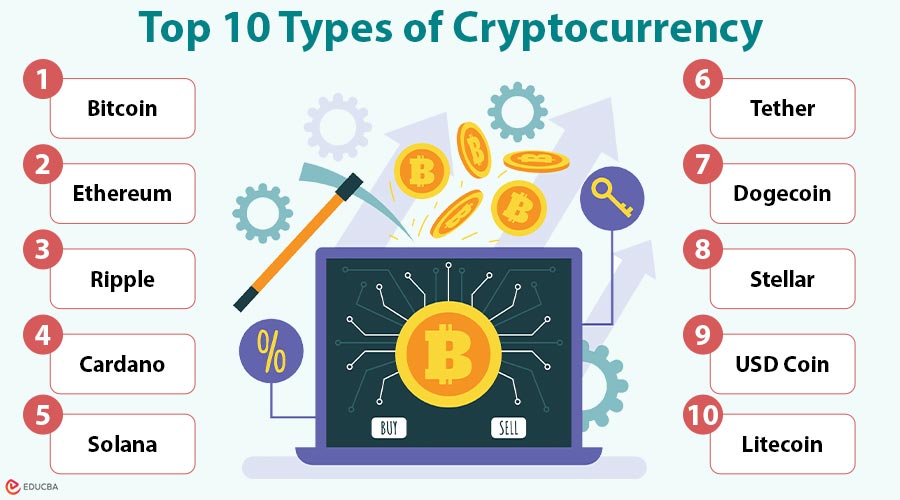
Top 10 Types of Cryptocurrency
Here are the 10 most popular types of cryptocurrencies currently shaping the digital finance world:
#1. Bitcoin (BTC)
Introduced in 2009, Bitcoin is the pioneering cryptocurrency that functions without a central authority, enabling users to conduct direct peer-to-peer transactions . It serves as a digital store of value with limited supply, high liquidity, and global recognition for investment and payments.
Purpose: Digital store of value and peer-to-peer payments.
Key Features:
- Decentralized and secure
- Limited supply (21 million BTC)
- High liquidity and recognition
#2. Ethereum (ETH)
Ethereum is decentralized blockchain platform launched in 2015, supporting smart contracts and decentralized applications (dApps). It enables programmable transactions, token creation, and DeFi ecosystems, powered by the Ethereum Virtual Machine and a large developer community.
Purpose: Supports programmable transactions and decentralized ecosystems.
Key Features:
- Smart contract functionality
- Ethereum Virtual Machine (EVM)
- Large developer community
#3. Ripple (XRP)
Ripple is a digital payment protocol and cryptocurrency facilitating fast, low-cost international transactions. It is intended for banks and other financial institutions, providing centralized monitoring through Ripple Labs, enhancing liquidity, and facilitating cross-border payments.
Purpose: Facilitate cross-border payments between banks and financial institutions.
Key Features:
- High-speed transaction settlement
- Low transaction fees
- Centralized oversight by Ripple Labs
#4. Cardano (ADA)
Cardano is a third-generation blockchain platform using proof-of-stake consensus. Focused on security, scalability, and sustainability, it supports smart contracts, DeFi, identity verification, and tokenization through a peer-reviewed, academically driven approach.
Purpose: Supports smart contracts and decentralized applications with a proof-of-stake consensus.
Key Features:
- Peer-reviewed academic approach
- Proof-of-Stake (PoS) consensus
- Environmentally friendly
#5. Solana (SOL)
Solana is a high-performance blockchain that enables fast and scalable decentralized applications. Using proof-of-history consensus, it offers extremely high throughput, low transaction costs, and supports DeFi, NFTs, gaming, and Web3 applications efficiently.
Purpose: Enables decentralized apps and crypto projects with high throughput.
Key Features:
- Extremely fast transaction speeds (up to 65,000 TPS)
- Low transaction costs
- Proof-of-History (PoH) consensus
#6. Tether (USDT)
Tether is a US dollar–pegged stablecoin that ensures price consistency, providing a reliable option for crypto trading, payments, and other digital transactions.
Purpose: Reduce volatility in cryptocurrency trading.
Key Features:
- 1:1 value backed by fiat currency
- Used widely in crypto trading and lending
- High liquidity
#7. Dogecoin (DOGE)
Dogecoin is a fun, meme-based cryptocurrency used to send small payments or tips online. It’s fast, has low fees, and has a lively community, making it good for small transactions and digital donations.
Purpose: Digital currency for small transactions and social tipping.
Key Features:
- Low transaction fees
- Active community
- Fast transaction confirmation
#8. Stellar (XLM)
Stellar is a blockchain platform that makes sending money across countries fast and cheap. It lets people create digital tokens, helps banks and financial institutions connect, supports small payments, and makes global transactions easier and more accessible for everyone.
Purpose: Facilitate fast and cheap global money transfers.
Key Features:
- Low-cost transactions
- Supports token issuance
- Strong partnerships with financial institutions
#9. USD Coin (USDC)
USD Coin is a fully fiat-backed stablecoin pegged 1:1 to the US Dollar. Transparent and audited, it provides a stable digital currency widely used for trading, DeFi, payments, and hedging against cryptocurrency market volatility.
Purpose: Provide a stable digital currency for crypto users and traders.
Key Features:
- Fiat-backed and audited
- Transparent reserves
- Widely used in DeFi and crypto exchanges
#10. Litecoin (LTC)
Litecoin, launched in 2011, is a peer-to-peer cryptocurrency designed as a faster, low-fee alternative to Bitcoin, enabling quicker transactions and broader adoption for everyday digital payments.
Purpose: Enable faster and cheaper transactions than Bitcoin.
Key Features:
- Shorter block generation time (2.5 minutes)
- Lower transaction fees
- Widely accepted by merchants
Final Thoughts
The diverse types of cryptocurrency cater to various needs, from digital payments and investment to decentralized applications and stable value storage. Knowing their special qualities, functions, and applications enables investors and users to make wise choices. As blockchain technology evolves, these cryptocurrencies continue shaping the future of finance, digital commerce, and decentralized innovation worldwide.
Frequently Asked Questions (FAQs)
Q1. What is the most popular cryptocurrency?
Answer: Bitcoin remains the most recognized and widely used cryptocurrency worldwide.
Q2. How are tokens different from cryptocurrencies?
Answer: Tokens are built on existing blockchain networks and can represent utilities, assets, or governance rights, whereas cryptocurrencies often have their own blockchain.
Q3. Can cryptocurrencies be used for everyday transactions?
Answer: Yes, cryptocurrencies like Litecoin, Bitcoin, and Dogecoin are increasingly used for payments, online purchases, and remittances.
Recommended Articles
We hope that this EDUCBA information on “Types of Cryptocurrency” was beneficial to you. You can view EDUCBA’s recommended articles for more information.

