


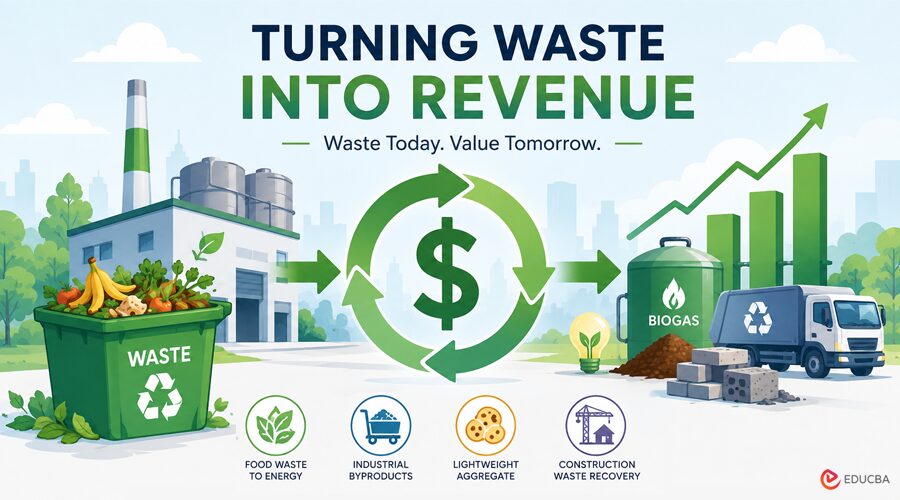
For a long time, many companies treated waste as the cost of doing business. If a process created scrap or a resource that could not be used directly in the product or service, the main question was how to dispose of it. That usually meant paying someone to do the job. However, that mindset is starting to change.
More companies are looking at waste and asking a better question: Is there still value here? Turning waste into revenue helps businesses reduce costs, support sustainability, and create new income opportunities.
This does not mean every kind of waste can be turned into profit. Some materials are too contaminated or expensive to recover. However, when companies understand their waste streams and find the right use for them, they can reduce disposal costs and sometimes create new revenue.
Food Waste
Food waste is one of the best examples of how waste that would normally be thrown away can be turned into a valuable resource. Restaurants and food processors often produce organic waste that still contains energy. If that waste goes to a landfill, the business may pay to have it removed.
Anaerobic digestion offers a different path. In this process, microorganisms break down organic material in a controlled, oxygen-free environment. The result is biogas, which can be used for heat or electricity, or upgraded into renewable natural gas.
For a company with steady organic waste, this can change the economics of disposal. Instead of seeing food scraps or processing waste only as a cost, the business may be able to participate in a system that turns that material into energy.
The larger point is that organic waste still contains energy. Companies that turn waste into revenue by capturing its energy are often in a better position than those that pay to dispose of it.
Industrial Byproducts
Manufacturers often create byproducts as part of normal production. In the past, those byproducts may have been treated as leftover material with little value. Now, more businesses are looking for ways to reuse them within their operations or sell them to another company that can use them.
This can work especially well when the byproduct is consistent. A steady stream of mineral material, metal scrap, glass, ash, or process residue may be more useful than mixed waste. If the material has known properties and can be handled safely, it may be incorporated into a new manufacturing process.
That is where the idea of waste starts to shift. The material may no longer be waste in a practical sense. It may simply be a secondary material waiting for the right buyer or application.
This kind of thinking can also help companies reduce exposure to raw material price swings. If a manufacturer can safely use recovered material in place of a more expensive virgin input, the savings can be incorporated into the value, turning waste into revenue.
Lightweight Aggregate
Some waste-to-revenue opportunities require more than basic recycling. They depend on engineering the material into something with a clear performance purpose. Lightweight aggregate is a good example.
Lightweight aggregate is used in construction and other applications where lower weight, insulation, or certain structural properties may be valuable. Traditionally, it has been made from materials such as clay or shale. However, modern production methods can also use certain mineral- or waste-derived feedstocks when properly processed.
“Lightweight aggregate is produced by heating mineral or waste-derived feedstocks until partial melting and gas evolution create a vesicular (honeycomb-like) structure,” IntoCeramics mentions. “While traditionally produced from clay or shale, modern LWA can be engineered from a variety of waste-derived mineral feedstocks.”
For companies with mineral byproducts, this opportunity may be worth exploring. The challenge is that the feedstock must be tested and the process must be controlled. However, when those pieces line up, these “scrap” materials can become part of a higher-value product, further turning waste into revenue.
Construction Waste
Construction and demolition work can produce a large amount of leftover material. Some of it may be damaged or mixed in ways that make reuse difficult, but not all of it has to be discarded. Concrete, asphalt, brick, wood, etc., can sometimes be recovered and used again in practical ways.
The value here often comes from avoiding two costs at once. A contractor or project owner may reduce disposal costs while also lowering the need for new materials. Recycled concrete, for example, may be used in certain base or fill applications when properly processed and permitted by local requirements.
This kind of reuse works best when it is planned before the job begins. If materials are separated carefully, they are more likely to hold value. If everything gets mixed in a rush, recovery becomes harder and less profitable.
Maximizing Resources
As you can see, companies across all industries are turning waste into revenue by changing how they view leftover materials. Instead of asking only how to dispose of waste, they are asking where the value might still be.
What if there are ways for you to use waste in your own business or industry? The opportunity depends on the material, the market, and the process. Not every waste stream is worth recovering, and not every recovery idea will make financial sense.
However, companies that study their waste carefully often find some value hidden beneath the surface.
Recommended Articles
We hope this guide on Turning Waste Into Revenue helps you discover how businesses can reduce waste, lower costs, and create new revenue streams through resource recovery and sustainable practices. Explore these recommended articles for more insights on the circular economy, waste management, industrial recycling, sustainable manufacturing, and environmental innovation.


