


What is Turnaround Time?
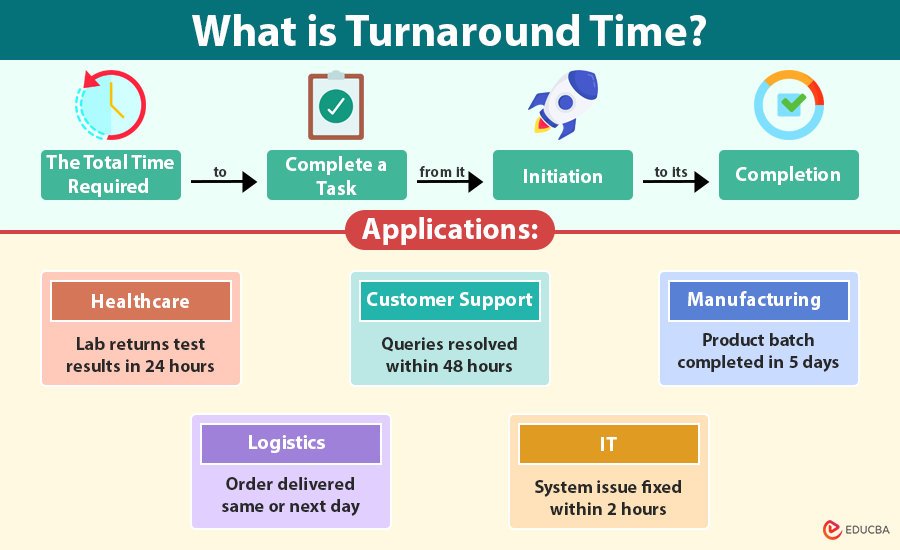
Turnaround Time (TAT) refers to the total time required to complete a task, from its initiation to its completion. It includes all steps involved, such as processing, waiting, and delivery time.
For example, if a customer sends a request at 9:00 AM and receives the final output at 1:00 PM, the turnaround time is 4 hours.
Table of Contents
- Meaning
- Importance
- Industry-Specific Applications
- Factors Affecting
- How to Measure?
- Tips to Improve
- Challenges in Managing
- Turnaround Time vs. Response Time
- Real-Life Example
Why is Turnaround Time Important?
Reducing TAT is a key driver of customer satisfaction and business competitiveness. Here is why it matters:
- Customer satisfaction: Faster service delivery improves the customer experience.
- Operational efficiency: Shorter TAT often indicates more streamlined internal processes.
- Competitive advantage: Businesses that deliver quickly often gain a market edge.
- Resource optimization: Tracking TAT helps identify bottlenecks and improve resource allocation.
- Quality assurance: Monitoring TAT can help ensure consistent service quality and compliance with service-level agreements (SLAs).
Industry-Specific Applications of Turnaround Time
1. Healthcare
In healthcare, TAT can refer to the time it takes for a lab to return test results or a pharmacy to fill a prescription.
2. Customer Support
TAT here refers to the time taken to resolve customer queries or complaints.
3. Manufacturing
In production, TAT may include machine setup, production, quality checks, and delivery.
4. Logistics and Supply Chain
TAT refers to the time between order placement and delivery.
5. IT and Software Development
TAT in IT could relate to bug fixes, feature development, or service ticket resolutions.
6. Printing and Publishing
TAT here includes design approval, printing, binding, and shipping.
Factors Affecting Turnaround Time
Several elements can influence TAT across industries:
- Workload and volume: An increase in tasks or requests can lead to longer turnaround times if capacity is limited.
- Resource availability: Lack of staff, tools, or technology can cause delays.
- Process complexity: More complex processes naturally require longer processing times.
- Automation levels: Manual operations usually have higher turnaround times than automated ones.
- Communication gaps: Miscommunication can lead to rework and extended TAT.
- External dependencies: Delays from suppliers, third parties, or external systems can also increase TAT.
How to Measure Turnaround Time?
To effectively manage TAT, organizations must accurately measure and analyze it. Here is how:
- Track start and end time: Use software systems or logs to capture the start and completion time of tasks.
- Use average TAT: For repetitive tasks, calculate the average TAT over a specific period.
- Compare with SLAs: Match actual TAT with your internal or client-defined Service Level Agreements.
- Set benchmarks: Establish acceptable TAT benchmarks for each type of process.
Example Calculation:
| Request | Start Time | End Time | Turnaround Time |
| Task A | 9:00 AM | 11:00 AM | 2 hours |
| Task B | 2:00 PM | 6:00 PM | 4 hours |
Average TAT = (2 + 4)/2 = 3 hours
Tips to Improve Turnaround Time
Improving TAT is not about working faster—it is about working smarter. Here are proven strategies:
1. Streamline Workflow
- Map out every step of the process and eliminate unnecessary actions to streamline the workflow.
- Use lean process management techniques to remove inefficiencies.
2. Automate Repetitive Tasks
- Implement software or automation tools to streamline tasks such as data entry, report generation, and customer email management.
3. Enhance Team Collaboration
- Encourage transparent communication among departments.
- Utilize tools like Asana, Trello, or Monday.com to track tasks and monitor progress.
4. Train Employees
- Ensure staff are well-trained to perform their tasks efficiently.
- Offer upskilling opportunities to reduce human error and rework.
5. Invest in Technology
- Upgrade outdated systems that cause slowdowns.
- Utilize cloud-based tools and real-time tracking systems to boost efficiency and speed.
6. Monitor KPIs Regularly
- Track TAT as a key performance indicator (KPI).
- Review TAT reports on a weekly or monthly basis to identify trends and take corrective actions.
Challenges in Managing TAT
Despite best efforts, some hurdles can affect TAT:
- Unexpected demand surges: Spikes in workload can overwhelm resources.
- System downtime: Technical failures significantly delay processes.
- Lack of standardization: Without clear protocols, processes vary and become inefficient.
- Resistance to change: Employees may be slow to adopt new tools or workflows.
Turnaround Time vs. Response Time: What is the Difference?
| Criteria | Turnaround Time (TAT) | Response Time |
| Definition | Time to complete a task | Time to respond to an initial request |
| Includes Execution? | Yes | No |
| Used In | Manufacturing, healthcare, IT | Customer support, messaging |
| Focus | Completion of task | Acknowledgment of request |
Example: If a customer emails a support team at 9 AM and receives an automated reply at 9:05 AM, the response time is 5 minutes. If the issue is resolved by 3 PM, the TAT is 6 hours.
Real-Life Example of TAT Improvement
Case Study: Logistics Company
A logistics firm was facing high customer complaints due to late deliveries. They conducted a TAT analysis and found that manual sorting caused a 6-hour delay. By implementing barcode scanning and automated sorting, they reduced their average delivery TAT by 33%, resulting in higher customer satisfaction and lower refund rates.
Final Thoughts
Turnaround time is more than just a metric—it reflects the efficiency, reliability, and responsiveness of your business. By understanding what influences TAT and taking steps to improve it, organizations can enhance customer experience, meet deadlines, and achieve operational excellence.
Frequently Asked Questions (FAQs)
Q1. What is the difference between turnaround time and lead time?
Answer: While TAT refers to the time taken to complete a specific task from start to finish, lead time is broader. Lead time refers to the total duration from when a request or order is placed to when it is delivered, including any delays that occur before the work commences.
Q2. Is a shorter turnaround time always better?
Answer: Not necessarily. While shorter TATs are usually preferred, they should not come at the cost of quality or accuracy. Rushing tasks may lead to mistakes, rework, or unsatisfied customers. A well-balanced TAT ensures efficiency without compromising standards.
Q3. Can turnaround time be used as a performance metric for employees?
Answer: Yes, TAT can be a valuable employee performance metric, especially in roles with measurable outputs (e.g., ticket resolutions, order processing). However, it should be used in conjunction with other metrics, such as quality of work, customer satisfaction, and team collaboration, to ensure a balanced evaluation.
Q4. How does turnaround time impact customer loyalty?
Answer: Consistently fast and reliable turnaround times build trust and reliability, which directly affect customer retention and loyalty. Customers are more likely to return to businesses that deliver on time and meet their needs, especially in areas such as online shopping, repair work, and consulting services.
Recommended Articles
Explore more insightful articles to improve your business operations and service delivery:

