

Updated November 24, 2026
What is Tree of Thoughts?
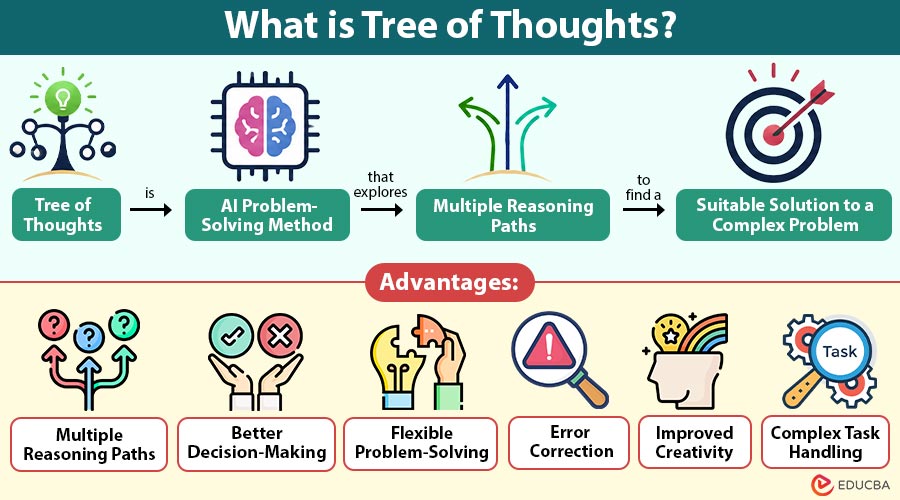
Tree of Thoughts is AI problem-solving method that explores multiple reasoning paths to find a suitable solution to a complex problem.
It allows large language models (LLMs) to think through different possibilities instead of following only one sequence of ideas. The method creates several possible thoughts, evaluates their usefulness, and selects promising paths for further exploration. It can also return to an earlier step when a particular direction does not produce a good result.
Unlike basic step-by-step reasoning, this approach organizes possible ideas into a tree-like structure. Each branch represents a different direction that the AI system can explore before reaching a final answer.
Table of Contents:
Key Takeaways:
- Tree of Thoughts enables AI systems to explore multiple reasoning paths instead of following a single sequence of ideas.
- It generates, evaluates, and compares alternative thoughts to identify suitable solutions for complex problem-solving tasks.
- Tree of Thoughts enables AI systems to compare alternative solutions and choose reasoning paths that best align with specific goals.
- It supports better decision-making, planning, and creativity but may increase computational costs, processing time, and implementation complexity.
How Does Tree of Thoughts Work?
Tree of Thoughts works by generating, evaluating, and exploring different possible ideas until the system identifies a suitable solution. Each idea becomes a node in the search tree, while its possible next steps form separate branches.
Below given steps explain how this method works:
1. Understand the Problem
The AI system first examines the given question or task and identifies what it needs to solve or achieve.
2. Generate Initial Thoughts
It creates several possible ideas or approaches that could help solve the problem instead of following one fixed direction.
3. Create Thought Branches
Each initial idea develops into separate branches containing additional thoughts, possible actions, or reasoning steps for further exploration.
4. Evaluate Each Thought
The system checks every generated idea based on its relevance, usefulness, logical strength, and ability to move toward the final goal.
5. Select Promising Paths
It retains the most useful branches and continues exploring them while removing options that appear unsuitable or unlikely to produce good results.
6. Backtrack When Necessary
If a selected path leads to an incorrect or unhelpful result, the system returns to an earlier point and explores another branch.
7. Reach the Final Solution
After examining the available possibilities, the system selects a suitable reasoning path and produces the final answer or result.
Types of Tree of Thoughts
Tree of Thoughts can use different search strategies to explore possible reasoning paths. The choice depends on the problem, available resources, and required results.
The following are common search approaches used with this method:
1. Breadth-First Search
Breadth-first search explores thoughts at the same level before moving toward deeper branches. It allows the system to compare several alternatives before selecting a direction for further reasoning.
2. Depth-First Search
Depth-first search follows one promising branch as far as possible before examining other alternatives. If the selected path does not work, the system can return to an earlier node.
3. Best-First Search
Best-first search prioritizes the thoughts that receive the highest evaluation scores. It helps the system focus its resources on branches that appear more likely to produce useful solutions.
4. Beam Search
Beam search keeps a fixed number of promising thoughts at each level and removes weaker alternatives. This approach controls the search space while allowing multiple reasoning paths to remain active.
Example of Tree of Thoughts
Consider student preparing for an important examination who wants to create an effective study plan. The student has limited time and needs to decide how to divide study hours among different subjects.
An AI system using Tree of Thoughts explores several possible study plans instead of suggesting only one approach.
Step 1: Identify the Problem
The student wants to prepare for three subjects: Mathematics, Science, and English within seven days.
Step 2: Generate Possible Approaches
The AI system considers three different study plans:
- Plan A: Study all three subjects every day.
- Plan B: Focus on one subject each day and revise previously studied topics.
- Plan C: Spend more time on difficult subjects and less time on familiar topics.
Step 3: Evaluate Each Approach
The system compares these plans based on available time, subject difficulty, revision needs, and preparation goals.
| Study Plan | Approach | Evaluation |
| Plan A | Study all subjects daily | Provides regular practice but may reduce focused learning time |
| Plan B | Focus on one subject daily | Allows deeper learning but requires careful revision |
| Plan C | Give more time to difficult subjects | Supports weak areas while maintaining revision time |
Step 4: Select the Best Approach
After evaluating the options, the AI system selects Plan C because it provides additional attention to difficult subjects while keeping enough time for revision.
Step 5: Develop the Final Plan
The system further explores how to divide study hours and recommends spending more time on Mathematics, followed by Science and English.
This example shows how Tree of Thoughts generates different possibilities, evaluates each approach, and selects a suitable solution instead of following only one reasoning path.
Applications of Tree of Thoughts
Tree of Thoughts supports AI tasks that require comparing alternatives, planning actions, and solving problems through multiple reasoning steps.
The following are some important applications:
1. Complex Problem-Solving
AI systems can use this approach to examine different solutions to difficult problems. It helps compare possible outcomes before selecting a suitable method.
2. Mathematical Reasoning
The method can explore different calculation strategies and possible intermediate results. It allows AI models to examine alternative approaches when solving multi-step mathematical problems.
3. Creative Writing
Writing systems can generate different storylines, character decisions, and plot developments. They can compare these ideas before selecting a direction for the final content.
4. Strategic Planning
Businesses can use AI-powered reasoning systems to compare different strategies, evaluate possible outcomes, and identify suitable actions for achieving organizational goals.
5. Game Playing
AI systems can explore different moves and possible future situations during gameplay. This helps them compare strategies before choosing their next action.
6. Decision-Making
The approach allows AI systems to examine multiple choices, consider their possible consequences, and identify options that best match specific requirements.
7. Research and Analysis
AI tools can explore different explanations, compare possible conclusions, and organize relevant ideas. This supports tasks that require examining information from multiple perspectives.
Advantages of Tree of Thoughts
Tree of Thoughts offers several advantages when AI systems need to handle problems involving multiple possibilities and reasoning steps.
1. Multiple Reasoning Paths
It allows AI systems to explore different approaches simultaneously, increasing the chances of identifying a suitable solution for complex tasks.
2. Better Decision-Making
It compares alternative ideas before selecting an approach, helping systems make more informed decisions when several possible solutions exist.
3. Flexible Problem-Solving
It supports different search strategies, allowing developers to adjust how an AI system explores possibilities according to specific requirements.
4. Error Correction
It allows systems to revisit earlier reasoning steps when a selected path produces an incorrect result or an unsuitable conclusion.
5. Improved Creativity
It encourages the generation of alternative ideas, helping AI systems produce varied suggestions for writing, planning, brainstorming, and other creative activities.
6. Complex Task Handling
It breaks difficult problems into smaller reasoning steps, making it easier to examine different possibilities before producing a final answer.
Limitations of Tree of Thoughts
Despite its problem-solving capabilities, Tree of Thoughts has certain limitations that affect its performance, cost, and practical implementation.
1. Higher Computational Cost
Exploring multiple reasoning paths requires additional processing power, memory, and model interactions compared with simpler step-by-step reasoning methods.
2. Slower Responses
Evaluating several alternatives can increase response time, making this approach less suitable for applications that require immediate answers.
3. Evaluation Challenges
The system may struggle to identify the most useful thought when different branches receive similar scores or unclear evaluations.
4. Implementation Complexity
Building and managing search trees requires additional logic, evaluation methods, and control mechanisms, increasing development and maintenance efforts.
5. Unreliable Reasoning
Exploring multiple branches does not guarantee correct conclusions because the AI model may generate inaccurate ideas or evaluate them incorrectly.
6. Resource Consumption
Large search trees can contain many possible branches, increasing resource requirements when the system explores deeper reasoning paths.
Difference Between Tree of Thoughts and Chain of Thought
The table below highlights the differences between the two:
| Basis | Tree of Thoughts | Chain of Thought |
| Structure | Uses a tree-like structure with multiple branches | Uses a sequence of connected reasoning steps |
| Reasoning | Explores different possible approaches | Follows one reasoning path |
| Alternatives | Considers multiple ideas | Usually develops one line of reasoning |
| Backtracking | Can revisit earlier thoughts | Generally follows a forward sequence |
| Complexity | More complex to implement | Comparatively simpler |
| Resource Usage | Often requires more computational resources | Usually requires fewer resources |
| Best Suited For | Complex problems with several possible solutions | Problems that benefit from step-by-step reasoning |
Final Thoughts
Tree of Thoughts helps AI explore multiple ideas before choosing a solution. It evaluates different reasoning paths, allows backtracking, and supports complex problem-solving, planning, creative writing, and decision-making. However, exploring multiple options increases processing time and computational costs. Its performance depends on the quality of generated thoughts and evaluation methods.
Frequently Asked Questions (FAQs)
Q1. What is the main purpose of Tree of Thoughts?
Answer: Its main purpose is to help AI systems explore multiple reasoning paths, evaluate possible solutions, and select an effective approach for complex problems.
Q2. Can Tree of Thoughts improve creative writing?
Answer: Yes. It can explore different storylines, character developments, plot ideas, and writing approaches before selecting a suitable direction.
Q3. Is Tree of Thoughts suitable for real-time applications?
Answer: It may be less suitable for real-time applications because evaluating multiple reasoning paths can increase response time and computational requirements.
Q4. Does Tree of Thoughts always produce accurate answers?
Answer: No. It can still generate incorrect ideas, evaluate alternatives poorly, or select an unsuitable reasoning path, depending on the model and evaluation process.
Recommended Articles
We hope that this EDUCBA information on “Tree of Thoughts” was beneficial to you. You can view EDUCBA’s recommended articles for more information –