


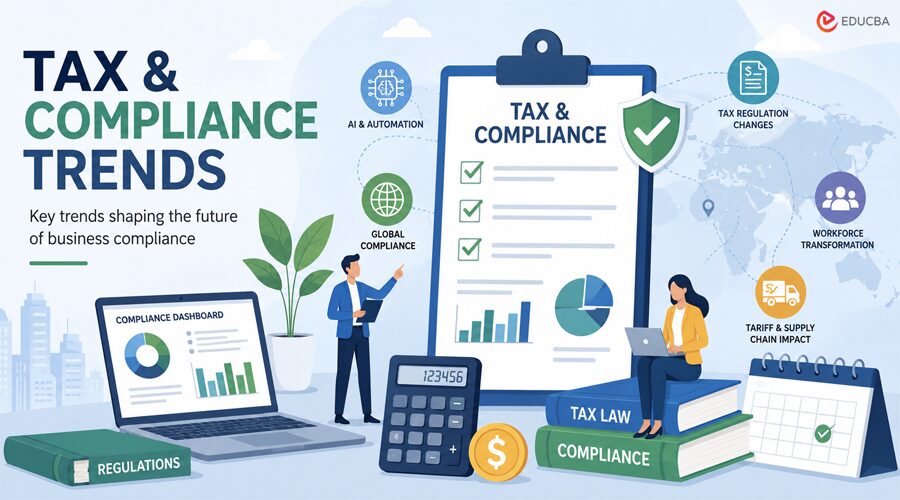
Business leaders have always had to consider how tax and compliance issues affect their organizations. However, several factors have made it increasingly challenging for companies of all sizes to stay ahead of evolving tax and compliance trends, meet their tax obligations, and remain compliant with changing regulations.
Below is a breakdown of the biggest tax and compliance trends affecting businesses today. In addition to explaining each challenge, the most effective strategies for overcoming them are highlighted.
Tax and Compliance Trends
Here are some of the biggest tax and compliance trends shaping today’s business landscape, along with ways organizations can stay ahead of evolving regulatory requirements:
1. Global Tax and compliance complexity
The first factor concerns global expansion. Today, even the smallest startups can compete in international marketplaces. While this presents a golden opportunity to make sales and build brand recognition across country and continental borders, it also opens the door to significant obstacles. Making tax and compliance missteps when operating globally can be costly. A survey of nearly two dozen global companies showed that in 2022 and 2023, they spent $282 million cleaning up tax and compliance errors.
Keeping pace with global tax and compliance trends is increasingly difficult because regulations can vary widely across cities, states, and countries. This makes it imperative for businesses to maintain accurate records, understand jurisdiction-specific requirements, and plan to meet critical deadlines.
To overcome this factor, businesses are understandably turning to artificial intelligence (AI) solutions. As noted by EY, a firm that offers organizations customized AI consulting services, AI can be used to automatically manage and maintain tax and compliance data. As a result, the predictive software can be trained to alert human employees of upcoming due dates and make human agents aware of potential compliance problems while they are still fixable.
2. Routine compliance updates and ongoing maintenance
The second tax and compliance factor affecting businesses is the need to regularly update content and messaging whenever a change is made. For example, a company may be expected to change the wording it uses to describe a particular internal- or external-facing policy. However, accurately and quickly updating can be difficult.
What makes widespread content changes a challenge? For many companies, duplicate content may lie in several places. Therefore, a policy that’s in the paper form of an employee handbook may be in the handbook’s digital form, too. The same holds for product manuals and other documents that may be available to customers in both print and online forms.
Again, AI can solve this issue. Blee is a solid example of a product that uses AI to monitor content and highlight what needs updating. Although Blee may make more sense for published digital-only content, you can use it alongside other AI tools to ensure content is properly flagged when language updates are needed. For businesses evaluating how AI can support broader operational and compliance goals, an artificial intelligence strategy can help align AI initiatives with business priorities and identify practical areas for implementation.
3. Loss of worker knowledge
The business world is entering a new phase as more Baby Boomers retire each year. This “silver tsunami” is not only leaving companies without experienced leaders but also creating new challenges in tax and compliance functions.
As seasoned employees leave, they often take years of institutional knowledge with them. If these individuals have been responsible for maintaining tax compliance and regulatory processes, their departure can expose organizations to unnecessary risks.
To address today’s major tax and compliance challenges, many organizations invest in structured training, documentation, and mentoring programs. Pairing retiring employees with younger colleagues supports knowledge transfer. This approach helps businesses preserve compliance expertise and reduce operational risks after experienced professionals retire.
4. Adjustments to tariff-related tax and compliance processes
For businesses operating across the United States border, the 2025 tariffs had tax consequences. The good news is that tariffs had less impact on some businesses than feared, but they are still a major topic of discussion in compliance meetings.
Many organizations revised their supply chains due to the tariffs. This shift required them to work with suppliers in new locations and update their tax-related processes. Without proper guidance, organizations risked paying hefty fines or missing important deadlines.
The solution to this issue has been a doubling down on third-party consultants. Agencies and individuals with deep knowledge of tariffs and taxes have helped companies navigate new supply chains strategically and safely. The happy ending? Fewer organizations are likely to find themselves surprised in 2026. This reliance on external expertise can extend beyond tariffs, particularly when businesses operate across multiple jurisdictions or face changing reporting requirements. Tax compliance services can help organizations manage these obligations while keeping pace with regulatory changes and filing deadlines.
Every company’s senior management team members need to take compliance seriously. However, it can be tough to know exactly how to identify and remedy every potential risk. By staying on top of trends, exploring AI solutions, and speaking with other businesspeople, leaders can avoid preventable snags and end the year strong, supported, and secure.
Recommended Articles
We hope this guide on tax and compliance trends helps you stay informed about evolving regulations and strengthen your business compliance strategy. Explore these recommended articles for more insights on taxation, regulatory compliance, risk management, and AI-driven compliance solutions.


